
Greek and Latin Roots Worksheets
Knowing that bio relates to life or port means carry gives students a useful starting point when encountering unfamiliar words. These 6th grade Greek and Latin roots worksheets explore meaningful word parts through root matching, vocabulary analogies, word breakdowns, and passages about science and technology. Learners also correct inaccurate word choices and replace simple expressions with more precise vocabulary. Teachers can use the activities to examine how well students recognize roots, explain their contributions, and apply that knowledge in context.
About This Collection of Worksheets
Greek and Latin roots provide important clues to the meanings of many English words, particularly those used in science, mathematics, history, and informational writing. Recognizing that geo relates to earth, spect means to look, and scrib refers to writing gives learners a starting point for interpreting vocabulary they have not previously encountered. However, understanding a root is only part of the process. Prefixes, suffixes, and other word components influence how the complete word is understood and used. These activities help 6th grade students examine those relationships while developing a more flexible understanding of how academic vocabulary is constructed.
The collection explores word origins through matching exercises, morphological analysis, contextual reading, analogy completion, and vocabulary revision. Some worksheets ask students to connect roots with their meanings or identify shared components within familiar words, while others require them to explain how those components contribute to a complete definition. Informational passages introduce terminology associated with space exploration, renewable energy, animal adaptations, and ancient engineering. Additional activities challenge learners to replace imprecise expressions with stronger academic vocabulary, identify incorrectly used words, and classify root-based terms by subject area. These different approaches encourage students to apply morphological knowledge rather than simply memorize lists of roots.
Teachers can select activities according to students’ familiarity with common word parts and their ability to use morphological clues independently. Root-definition matching provides a starting point for learners who need to recognize foundational components, while word breakdowns and analogies require closer examination of how those components interact. Passage-based exercises add contextual support, helping students determine whether a possible meaning makes sense within a sentence or broader explanation. Editing and vocabulary replacement tasks require greater precision because students must evaluate whether a complete word communicates the intended idea. Discussing why a root-based interpretation works, or where it falls short, can help students develop more reliable strategies for understanding unfamiliar academic language.
Paul’s Teacher Tip
A useful way to deepen root-word understanding is to compare two words that share a root but communicate different ideas. For example, introduce spect, meaning to look, and examine how it contributes to inspect and spectator. Ask students to explain why inspecting something involves examining it closely, while a spectator is someone who watches an event. Then have learners identify the additional word parts and explain how those components help distinguish the complete meanings. This approach encourages students to treat roots as meaningful clues rather than assuming every word containing the same root has an identical definition.
Worksheet Collection Skill Spotlights
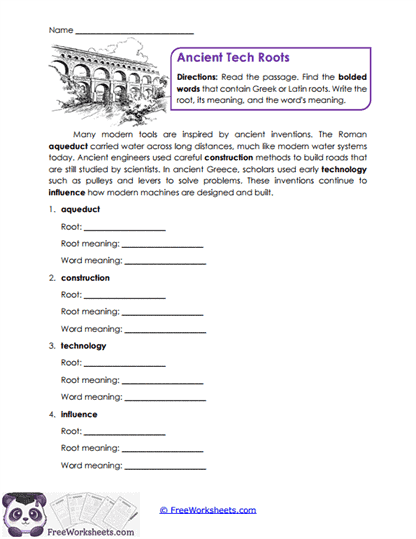
Ancient Tech Roots
What Kids Do: Learners read an informational passage describing ancient Roman and Greek innovations, including aqueducts, construction techniques, pulleys, and levers. Four bold vocabulary words-aqueduct, construction, technology, and influence-are examined through separate response sections. For each term, students identify a Greek or Latin root, explain its meaning, and describe how that component contributes to the meaning of the complete word.
Target Skill: Analyzing the origins of academic vocabulary strengthens morphological awareness and comprehension of specialized terminology. Students practice connecting roots associated with water, building, practical skills, and influence to words used in historical and technological contexts. The activity also encourages learners to recognize that some modern meanings are closely connected to their roots, while others have developed more abstract interpretations over time.
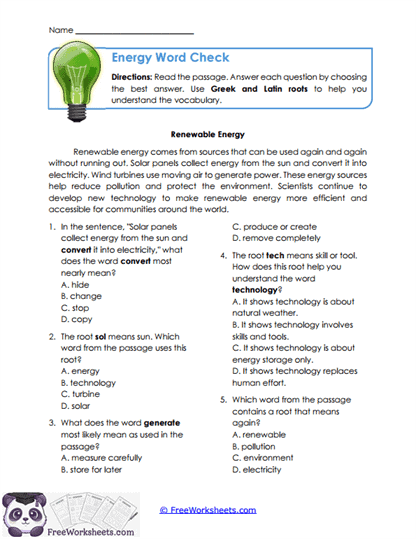
Energy Word Check
What Kids Do: A passage titled “Renewable Energy” introduces solar panels, wind turbines, electricity generation, and technological development. Students answer five multiple-choice questions requiring them to interpret vocabulary such as convert and generate while examining meaningful word parts in solar, technology, and renewable. The exercises combine information from the passage with root and prefix knowledge to identify the most appropriate answers. Question five should identify re- in renewable as a prefix meaning again, rather than calling it a root.
Target Skill: Combining morphological analysis with context clues supports the interpretation of unfamiliar academic vocabulary in informational reading. Learners practice recognizing how word components contribute to meanings involving energy production, technological processes, and scientific concepts. Distinguishing roots from prefixes also strengthens their understanding of word structure and encourages more accurate explanations of how complex terms are formed.
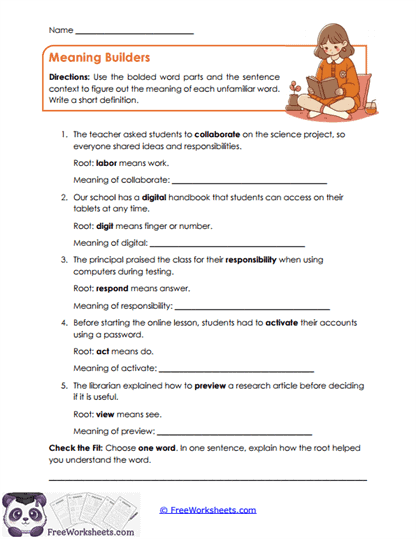
Meaning Builders
What Kids Do: Five sentences introduce academic vocabulary words alongside clues about their roots or related word parts. Learners examine collaborate, digital, responsibility, activate, and preview, using the printed root information and surrounding context to construct student-friendly definitions. A concluding Check the Fit question asks students to select one word and explain how its meaningful component helped them interpret the complete term.
Target Skill: Integrating root knowledge with contextual reasoning strengthens vocabulary comprehension and morphological awareness. Students recognize how familiar components contribute to words associated with collaboration, technology, responsibility, and academic preparation. The activity encourages learners to move beyond literal root definitions by considering how prefixes, suffixes, historical word forms, and surrounding sentences influence the meaning of a complete word.
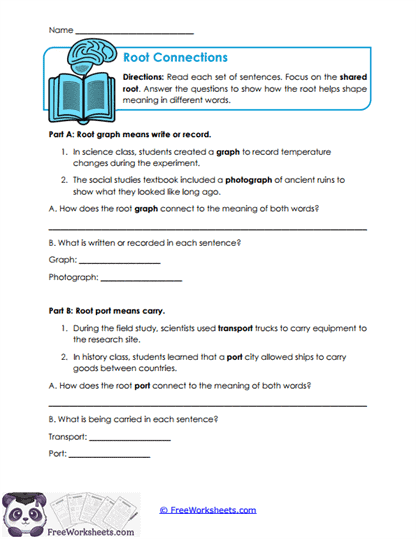
Root Connections
What Kids Do: Two sections present word pairs within short contextual sentences and ask learners to examine how their meanings relate to a shared root. Part A compares graph and photograph through examples involving recorded temperatures and historical images, while Part B presents transport and port in situations involving the movement of goods. Students explain the intended relationships and identify what is recorded or carried in each example. Part B requires correction because transport derives from Latin portare, meaning to carry, while port meaning harbor derives from portus; portable would provide a more appropriate comparison with transport.
Target Skill: Identifying genuine morphological relationships develops a more accurate understanding of word origins and meaningful components. Students practice explaining how shared roots contribute to different vocabulary terms, particularly when the complete words describe related but distinct actions or objects. The activity also provides an opportunity to distinguish a true historical word relationship from a coincidental similarity in spelling or meaning.
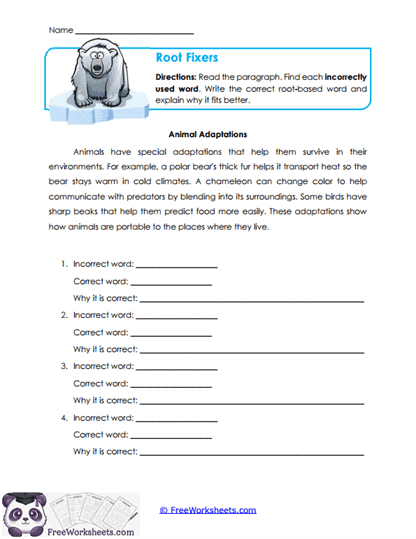
Root Fixers
What Kids Do: Students read an informational paragraph titled “Animal Adaptations” containing four incorrectly used vocabulary words. The passage describes polar bears retaining heat, chameleons blending into their surroundings, birds finding food, and animals adapting to their environments, but uses inappropriate terms such as transport, communicate, predict, and portable. Learners identify each incorrect word, provide a more accurate root-based replacement, and explain why their correction better communicates the intended scientific meaning.
Target Skill: Evaluating vocabulary within connected writing reinforces morphological reasoning, semantic precision, and informational reading comprehension. Students must recognize when a word’s meaning does not fit the situation, even if the term resembles other familiar academic vocabulary. Because several appropriate replacements may be possible, the explanations are especially valuable for determining whether learners understand the distinction between the original word and the corrected terminology.
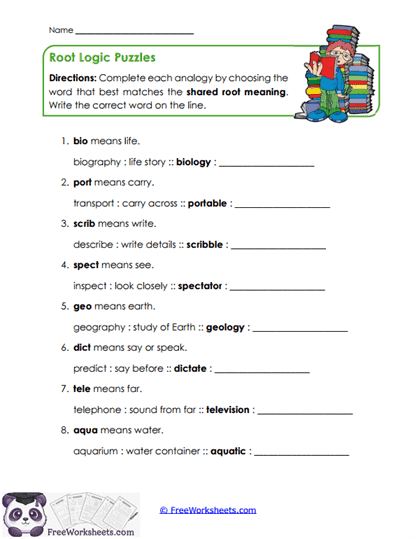
Root Logic Puzzles
What Kids Do: Eight root-based analogies require students to complete missing word meanings using a supplied Greek or Latin root definition and a related vocabulary example. Comparisons include biography and biology, transport and portable, describe and scribble, inspect and spectator, and geography and geology. Learners examine how the first word relates to its definition, then apply their knowledge of the shared root to explain the second word without a word bank.
Target Skill: Interpreting word families through analogies strengthens morphological awareness and semantic reasoning. Students practice identifying meanings shared by words containing roots such as bio, geo, port, spect, scrib, dict, tele, and aqua. Recognizing how additional word components influence a complete definition helps learners avoid assuming that words sharing a root must have identical meanings.
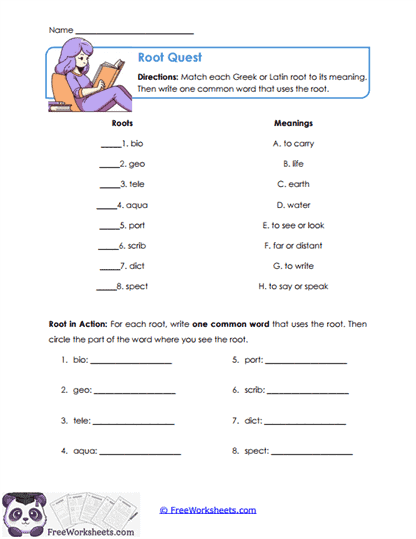
Root Quest
What Kids Do: Learners begin by matching eight Greek and Latin roots with their meanings using a lettered answer bank. The roots include bio, geo, tele, aqua, port, scrib, dict, and spect, representing concepts such as life, earth, distance, water, carrying, writing, speaking, and seeing. In the Root in Action section, students write one common word containing each root and circle the specific word part that demonstrates the connection.
Target Skill: Recognizing common Greek and Latin roots establishes a foundation for interpreting unfamiliar academic vocabulary through meaningful word components. Students practice associating roots with their definitions and locating those components within complete words. Generating original examples requires them to apply their understanding independently, while circling the root reinforces accurate identification of morphological structures.
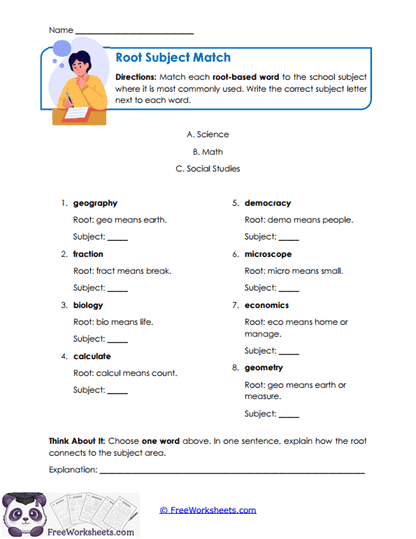
Root Subject Match
What Kids Do: Eight academic vocabulary words must be matched with the school subject where they are most commonly used: Science, Math, or Social Studies. Students examine terms such as geography, fraction, biology, democracy, microscope, economics, and geometry, using printed root clues to support their classifications. A Think About It prompt asks learners to explain how one selected root connects with its academic subject. Before use, clarify two inaccurate printed explanations: geo means earth, not measure, and eco relates to home or household, rather than directly meaning manage.
Target Skill: Connecting morphological knowledge with academic disciplines strengthens vocabulary comprehension and cross-curricular word recognition. Students practice determining how roots contribute to specialized terminology while considering the subject-specific applications of complete words. Comparing terms such as geography and geometry also reinforces the importance of examining additional word components rather than assigning meanings based on a shared root alone.
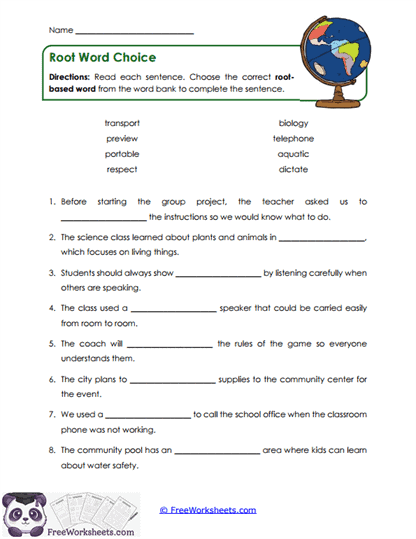
Root Word Choice
What Kids Do: Eight sentence-completion exercises require learners to select appropriate vocabulary from a word bank containing transport, preview, portable, respect, biology, telephone, aquatic, and dictate. Each sentence provides contextual clues that help establish the meaning of the missing term. Students use their understanding of word roots and the surrounding language to choose the correct completion, including identifying portable as something that can be carried easily and aquatic as something related to water.
Target Skill: Applying root-based vocabulary in complete sentences strengthens semantic understanding and contextual word selection. Learners practice recognizing how roots associated with carrying, life, distance, water, and observation contribute to the meanings of familiar terms. The activity also reinforces the need to evaluate grammatical structure and sentence meaning rather than selecting words solely because their roots seem familiar.
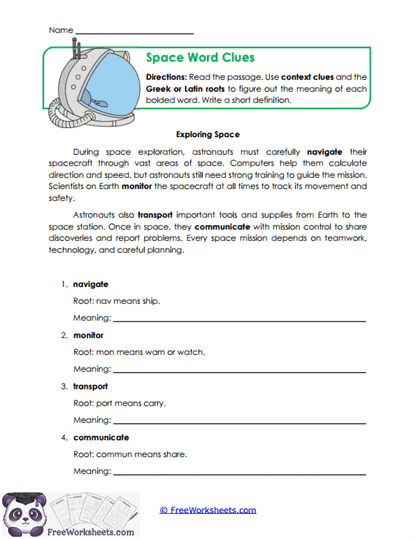
Space Word Clues
What Kids Do: A two-paragraph passage titled “Exploring Space” describes how astronauts navigate spacecraft, monitor conditions, transport supplies, and communicate with mission control. Four bold vocabulary terms are followed by root clues identifying nav with ship, mon with warning or watching, port with carrying, and commun with sharing. Students combine these clues with information from the passage to write definitions explaining how each word functions within the space exploration scenario.
Target Skill: Combining morphological clues with informational reading develops the ability to interpret specialized vocabulary through multiple sources of evidence. Learners practice recognizing how roots contribute to words describing movement, observation, transportation, and communication. Examining the surrounding context also helps students distinguish the intended meanings of words that may have other familiar uses, such as monitor as a verb rather than a computer display.
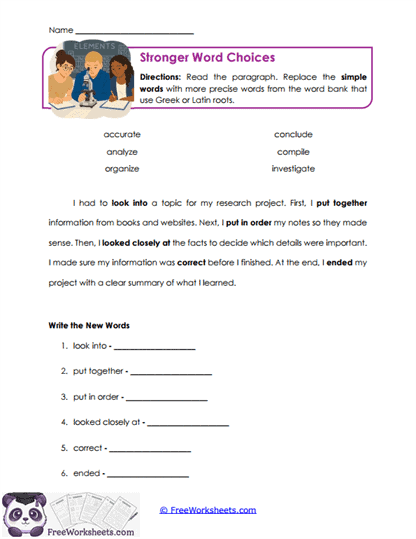
Stronger Word Choices
What Kids Do: Students read a first-person paragraph about completing a research project and replace six simple expressions with more precise vocabulary from a word bank. Phrases such as look into, put together, put in order, and looked closely at correspond to academic words including investigate, compile, organize, and analyze. Learners record the appropriate replacements in a numbered section beneath the passage. The word bank provides base-form verbs, so rewriting the original past-tense paragraph accurately would require forms such as compiled, organized, analyzed, and concluded.
Target Skill: Recognizing Greek- and Latin-derived academic vocabulary strengthens precision in word choice and understanding of meaningful word components. Students practice connecting familiar expressions with terms commonly used in research and informational writing. The activity also encourages attention to grammatical form, demonstrating that selecting a more sophisticated word must preserve both the intended meaning and the structure of the sentence.
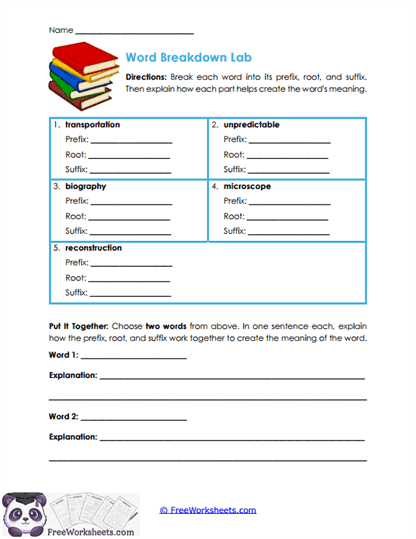
Word Breakdown Lab
What Kids Do: Five complex vocabulary words-transportation, unpredictable, biography, microscope, and reconstruction-are examined through a graphic organizer containing separate lines for prefixes, roots, and suffixes. Students identify meaningful components and consider how the parts contribute to each complete word. A concluding Put It Together section asks learners to select two terms and explain how their components combine to create meaning. Teachers should clarify that some words, particularly microscope, contain combining forms rather than a separate conventional prefix, root, and suffix for every labeled line.
Target Skill: Breaking complex words into meaningful components develops morphological analysis and supports independent vocabulary comprehension. Students examine how prefixes, roots, suffixes, and combining forms contribute different information to a word’s overall meaning. Comparing the structures of several academic terms reinforces the understanding that English vocabulary follows multiple formation patterns rather than requiring every word to contain the same set of components.