
About This Worksheet
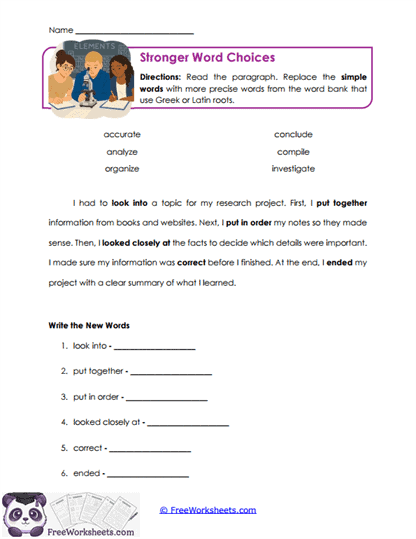
Stronger Word Choices challenges learners to improve the precision of a written passage by replacing simple expressions with more specific academic vocabulary. This 6th grade vocabulary worksheet presents a short paragraph about completing a research project, accompanied by six replacement words containing Greek or Latin roots. Students examine expressions such as look into, put together, and looked closely at before selecting more precise alternatives. The activity connects morphological knowledge with vocabulary development and demonstrates how word choice can make academic writing clearer and more concise.
Curriculum and Grade Alignment
Selecting precise academic vocabulary supports reading comprehension, written expression, and morphological awareness within the 6th grade language arts curriculum. Students practice recognizing connections between familiar expressions and more formal words derived from Greek or Latin components. Terms such as investigate, compile, organize, analyze, accurate, and conclude reinforce vocabulary commonly used in research, informational writing, and classroom assignments. The activity also supports revision skills by encouraging learners to examine how replacing vague expressions with specific terminology can improve the clarity of written communication.
Student Tasks
Learners read a short paragraph describing the steps involved in completing a research project, from gathering information to organizing notes and developing a final summary. Six simple words or phrases appear in bold, and students must replace them with more precise vocabulary from the provided word bank. For example, look into corresponds to investigate, while put together relates to compile and put in order corresponds to organize. Students record the six replacement words on individually numbered lines in the Write the New Words section, following the order in which the original expressions appear in the paragraph.
Common Challenges and Misconceptions
Some students may understand the meanings of the academic words but struggle to determine which expression each one should replace. Others may select vocabulary that is generally related to research without recognizing the precise action described by the original phrase. The distinction between analyze and investigate can be particularly challenging because both involve examining information, although investigating emphasizes inquiry while analyzing involves studying details to understand them. Comparing the purpose of each action within the research process can help students recognize which replacement communicates the intended meaning most accurately.
Implementation Guidance
Begin with look into and investigate, explaining how the academic term communicates the process of researching a topic more precisely. Encourage students to match the remaining phrases with the vocabulary bank before discussing how the substitutions affect the paragraph’s clarity. The printed word bank contains base-form verbs even though several original expressions describe past actions, so clarify that grammatically correct replacements within a rewritten paragraph would include compiled, organized, analyzed, and concluded. For an extension, have students rewrite the complete research paragraph using the appropriately inflected vocabulary and discuss how the revised language changes its academic tone.
Details and Features
The worksheet presents a six-word vocabulary bank arranged in two columns above a short first-person paragraph about a research project. Six simple expressions appear in bold within the passage, making the words and phrases targeted for replacement easy to identify. A Write the New Words section beneath the paragraph lists the original expressions in numbered order, with one response line for each academic vocabulary replacement. The activity focuses on word selection and vocabulary precision, while the connected paragraph provides meaningful context for understanding how the replacement terms are used.