
Domain-Specific Vocabulary Worksheets
Academic vocabulary helps students interpret scientific explanations, understand historical developments, and communicate mathematical ideas accurately. These 6th grade domain-specific vocabulary worksheets explore subject classifications, Greek and Latin roots, ecosystem terminology, and scientific word meanings. Learners complete informational passages, compare words across disciplines, correct misused terminology, and write explanations about weather and tectonic plates. Teachers can select activities that emphasize recognizing academic language, understanding its meaning, or applying vocabulary independently.
About This Collection of Worksheets
Domain-specific vocabulary refers to words and expressions that carry particular meanings within academic subjects. Understanding these terms allows students to interpret informational texts, follow explanations, and communicate concepts with greater precision. A word such as population has a specific meaning in ecology, while denominator identifies a particular component of a fraction in mathematics. Some academic terms are unfamiliar because they describe specialized processes, while others are challenging because familiar words take on different meanings in different contexts. These distinctions are important in 6th grade, when learners encounter more complex subject-area reading and are increasingly expected to explain concepts using accurate terminology.
The activities explore academic vocabulary through classification, comparison, reading, and written application. Sorting exercises ask learners to identify subject areas or distinguish processes from physical objects and abstract concepts. Scientific vocabulary receives closer examination through Frayer Models, ecosystem definition matching, renewable and nonrenewable resource comparisons, and Greek and Latin root analysis. Other worksheets place terminology within historical passages and practical situations, including ancient river civilizations and hurricane preparedness. Writing activities require students to explain tectonic plate movement, rewrite formal glossary definitions, and correct scientific terms used inaccurately. These varied formats encourage learners to consider both what academic words mean and how they function within particular disciplines.
Educators can choose worksheets based on whether students need to develop familiarity with terminology or demonstrate independent understanding. Matching and sorting tasks provide structured opportunities to review meanings and identify misconceptions, while passage-based exercises require students to interpret vocabulary in connected informational writing. Graphic organizers are useful for examining defining characteristics, examples, and non-examples, particularly when related terms are easily confused. More demanding writing activities ask learners to construct explanations, justify word choices, and apply vocabulary accurately within scientific or historical contexts. Combining an identification task with a written explanation can help reveal whether students understand the underlying concepts or are relying primarily on memorized definitions.
Paul’s Teacher Tip
When teaching closely related academic terms, ask students to explain what makes each word different before requiring them to memorize its definition. For example, weathering, erosion, and deposition all describe processes affecting Earth’s surface, but weathering breaks down material, erosion transports it, and deposition leaves it in a new location. Have learners describe a single rock fragment undergoing these three processes, identifying exactly when each vocabulary term applies. Then encourage them to use the distinctions when choosing examples and non-examples in a Frayer Model or correcting an inaccurate scientific explanation. This approach helps students connect terminology to the specific processes it represents rather than treating related scientific words as interchangeable.
Worksheet Collection Skill Spotlights
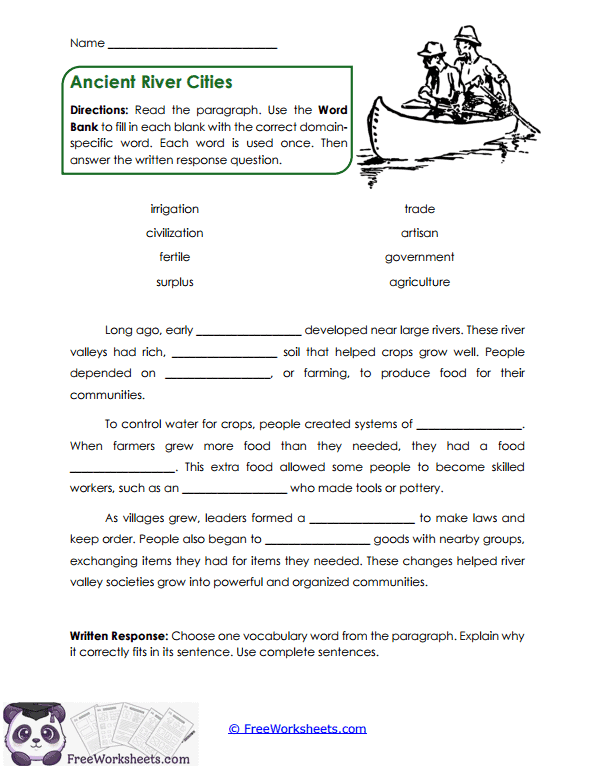
Ancient River Cities
What Kids Do: Learners read an informational passage about the development of early river valley civilizations and complete eight blanks using a domain-specific vocabulary bank. Terms such as irrigation, agriculture, fertile, surplus, government, and trade must be placed in sentences describing farming, specialized labor, and community organization. After completing the passage, students select one word and explain why its meaning fits the surrounding historical information.
Target Skill: Interpreting specialized vocabulary within connected historical writing strengthens academic reading comprehension and contextual word knowledge. Students practice recognizing how terms describe relationships between agricultural production, technological developments, economic exchange, and organized societies. The written explanation reinforces the ability to justify vocabulary choices using meaningful information from the text rather than relying solely on memorized definitions.
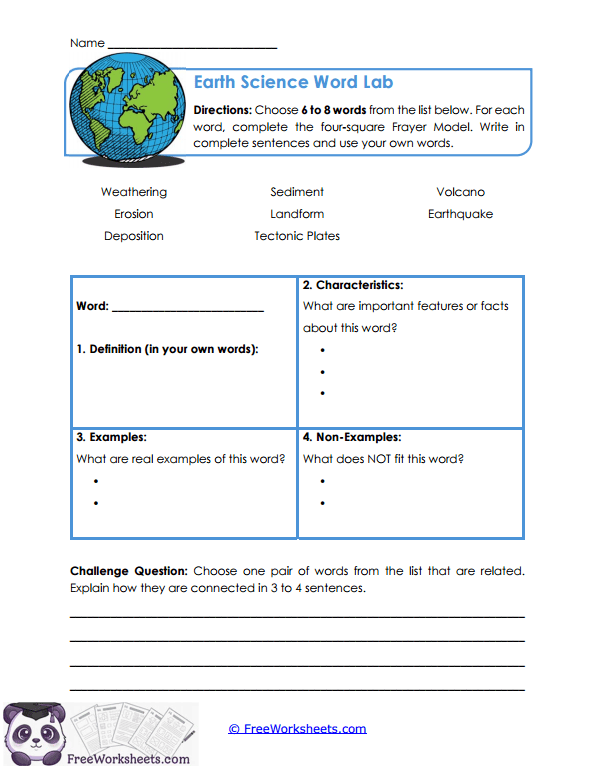
Earth Science Word Lab
What Kids Do: Students select six to eight earth science terms from a vocabulary bank containing weathering, erosion, deposition, sediment, landform, tectonic plates, volcano, and earthquake. For each word, they complete a four-square Frayer Model containing a definition, important characteristics, examples, and non-examples. A final challenge asks them to select two related terms and explain their connection in three to four sentences. The printed page provides one model, so additional copies or recording space are needed to complete the requested number of words.
Target Skill: Examining scientific vocabulary through multiple characteristics develops a more precise understanding of geological processes and features. Learners distinguish a term’s definition from its examples and identify non-examples that clarify the boundaries of its meaning. Comparing related concepts reinforces the ability to recognize scientific connections without confusing processes such as weathering, erosion, and deposition.
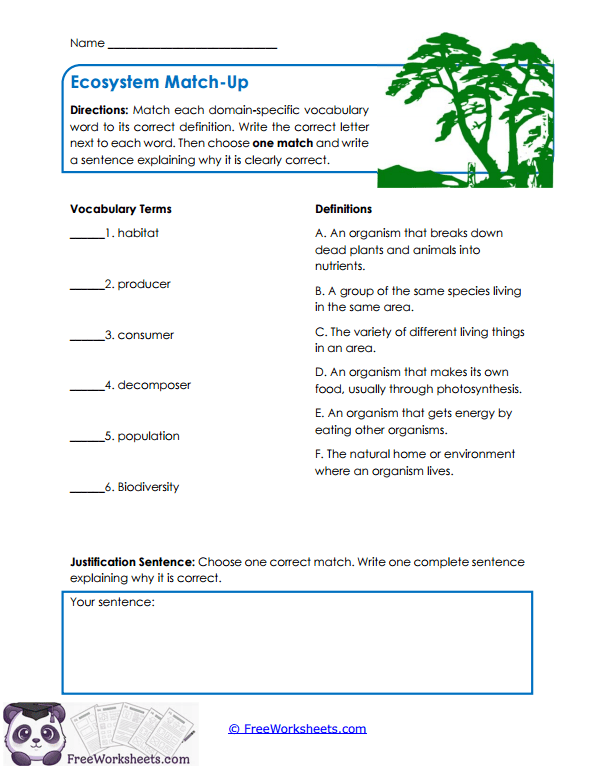
Ecosystem Match-Up
What Kids Do: Six ecosystem vocabulary terms appear alongside lettered definitions that students must match accurately. Learners distinguish habitat, producer, consumer, decomposer, population, and biodiversity by identifying the explanation that corresponds to each term. After completing the matching activity, students select one correct pairing and write a complete sentence explaining why the definition accurately represents the ecological concept.
Target Skill: Recognizing ecological terminology strengthens the ability to interpret scientific explanations about organisms, environments, and biological communities. Students practice distinguishing the roles of producers, consumers, and decomposers while recognizing differences between habitats, populations, and biodiversity. Justifying a selected match encourages learners to connect defining characteristics with the appropriate scientific vocabulary rather than depend exclusively on answer recognition.
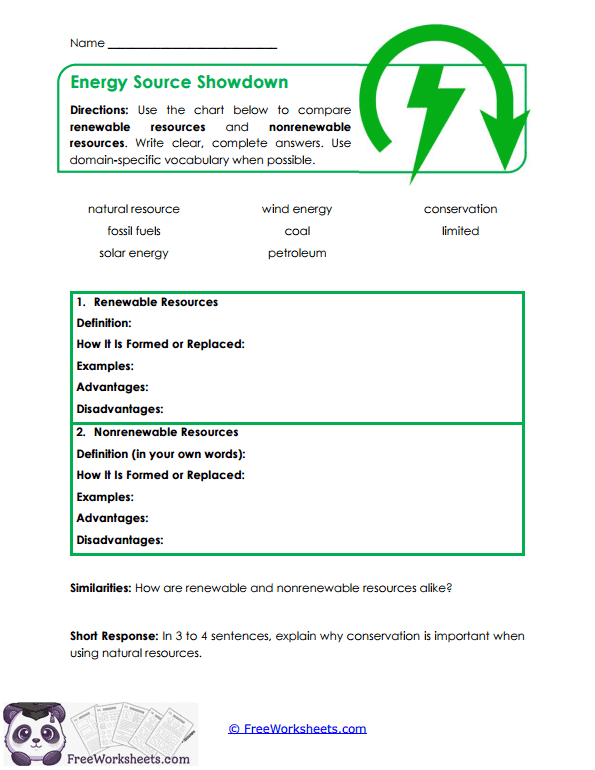
Energy Source Showdown
What Kids Do: A comparison chart asks learners to examine renewable and nonrenewable resources using a vocabulary bank containing terms such as fossil fuels, solar energy, wind energy, petroleum, and conservation. Students provide definitions, describe how resources are formed or replaced, and identify examples, advantages, and disadvantages for each category. They also explain similarities between the two types of resources and write a three- to four-sentence response about the importance of conservation.
Target Skill: Comparing natural resource classifications develops an understanding of replenishment, resource availability, and environmental considerations. Students learn to use scientific terminology when distinguishing energy sources that are naturally renewed from those available in limited supplies. Evaluating similarities and differences encourages accurate vocabulary application while reinforcing that resource classifications involve specific scientific characteristics rather than simple judgments about whether a resource is beneficial.
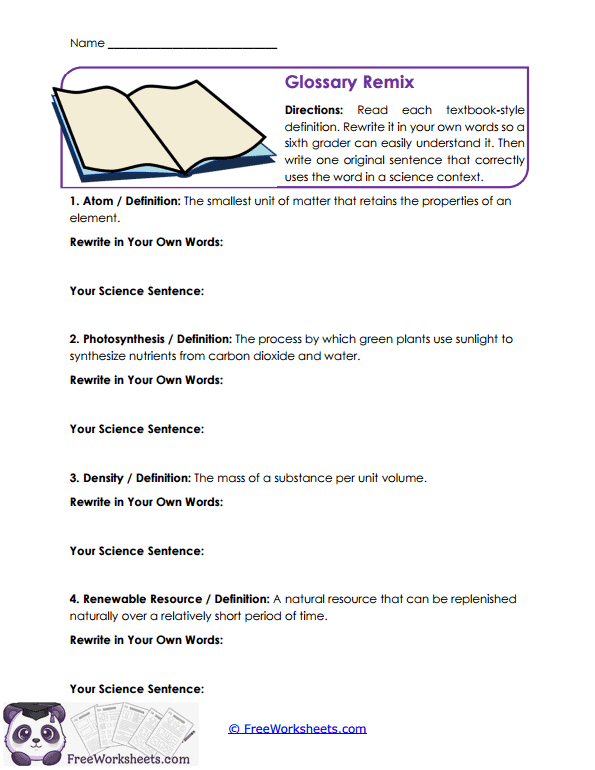
Glossary Remix
What Kids Do: Four scientific terms-atom, photosynthesis, density, and renewable resource-are presented with formal textbook-style definitions. Learners rewrite each definition using language that another 6th grade student could understand while preserving its scientific meaning. They then compose an original science-related sentence demonstrating how the term can be used accurately within an appropriate context.
Target Skill: Rephrasing technical definitions develops vocabulary comprehension, paraphrasing, and precise scientific communication. Students must identify the essential information within each explanation and express it using accessible language without changing the underlying concept. Applying the terms in original sentences provides an additional demonstration of understanding, particularly for abstract concepts such as density and processes such as photosynthesis.
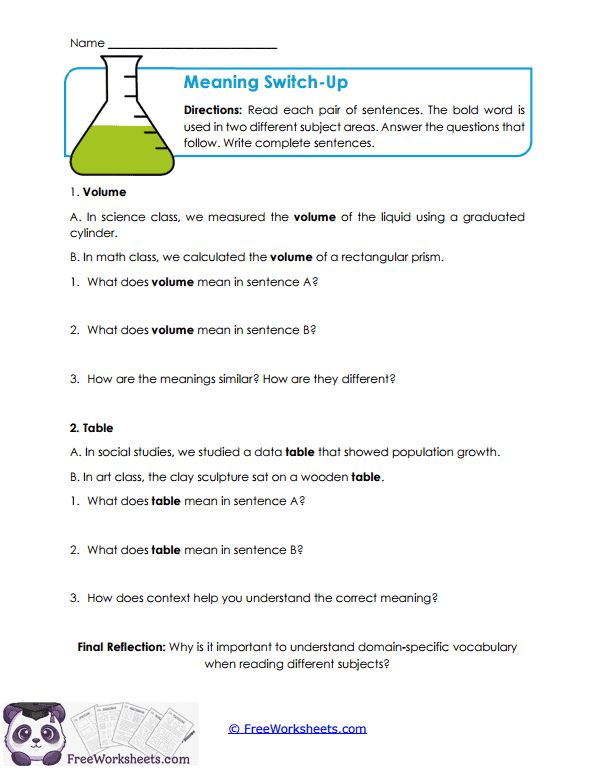
Meaning Switch-Up
What Kids Do: Two sets of paired sentences demonstrate how the words volume and table appear in different academic contexts. Students compare volume as measured in a graduated cylinder with volume calculated for a rectangular prism, then examine table as a display of population data and as a piece of furniture. Written questions require them to explain each use, identify similarities or differences, and reflect on why subject-area context matters when interpreting vocabulary.
Target Skill: Understanding how academic context influences word meaning develops flexible vocabulary interpretation and reading comprehension across disciplines. Students practice distinguishing related applications of the same concept from words that have substantially different definitions. The comparison of volume reinforces a shared mathematical and scientific idea, while the table examples demonstrate how surrounding information identifies distinct meanings of a familiar term.
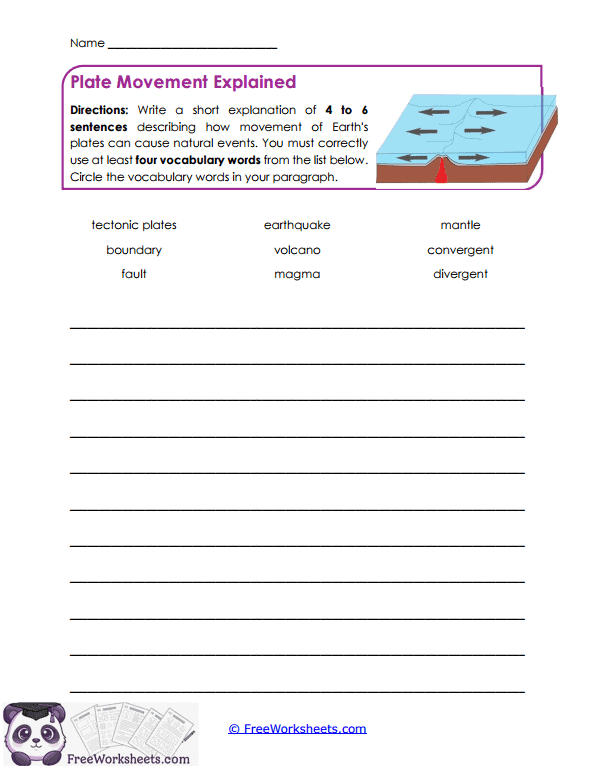
Plate Movement Explained
What Kids Do: Learners compose a four- to six-sentence explanation describing how the movement of Earth’s tectonic plates can produce natural events. A nine-term vocabulary bank includes tectonic plates, boundary, fault, mantle, magma, convergent, divergent, earthquake, and volcano. Students must accurately incorporate at least four of these terms into their writing and circle the vocabulary words they used after completing their paragraph.
Target Skill: Applying geological terminology within a coherent explanation reinforces academic vocabulary and scientific cause-and-effect reasoning. Students practice connecting individual concepts into descriptions of plate movement, boundary interactions, and related geological events. Writing with precise terminology also requires learners to distinguish different types of plate boundaries and explain scientific relationships without treating every tectonic process as having identical outcomes.
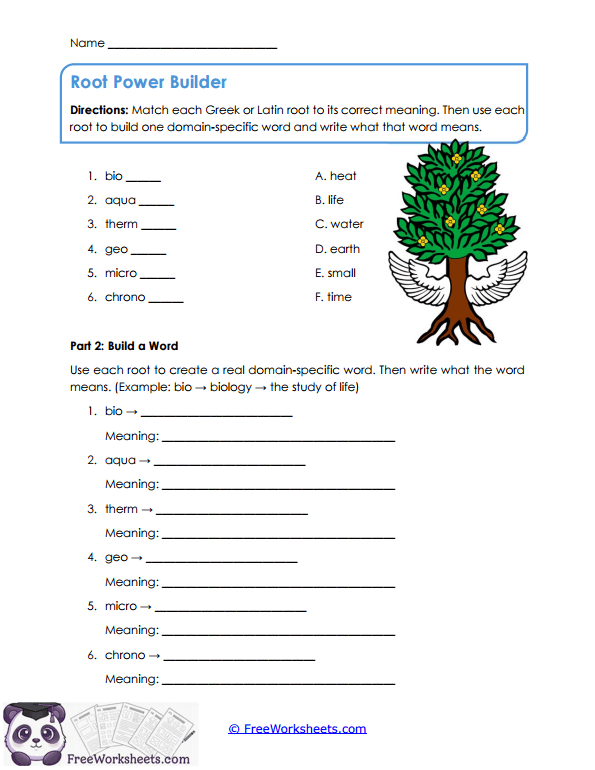
Root Power Builder
What Kids Do: Students begin by matching six Greek and Latin roots-bio, aqua, therm, geo, micro, and chrono-with their corresponding meanings. In the second part, they use each root to construct a real domain-specific vocabulary word and write an explanation of the complete word’s meaning. A provided example connects bio with biology and the study of life, demonstrating how a root contributes meaning to a larger academic term.
Target Skill: Recognizing meaningful word parts develops morphological awareness and supports the interpretation of unfamiliar academic vocabulary. Learners practice connecting roots associated with life, water, heat, earth, size, and time to specialized terminology across subjects. Constructing and explaining complete words reinforces the distinction between knowing a root’s meaning and understanding how that meaning contributes to a more complex term.
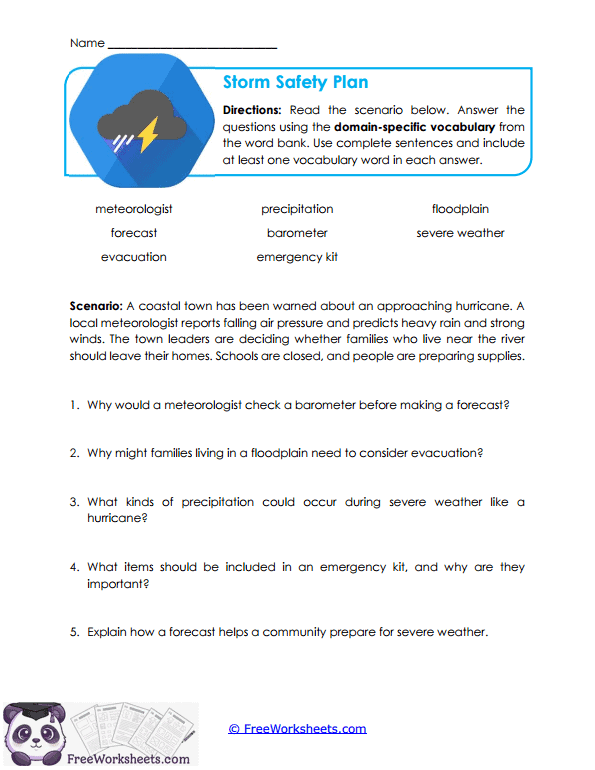
Storm Safety Plan
What Kids Do: A hurricane preparedness scenario introduces a coastal community facing falling air pressure, strong winds, heavy rainfall, and possible flooding. Students answer five questions about weather forecasting, barometers, floodplain evacuation, precipitation, and emergency supplies. Each response must use complete sentences and incorporate at least one appropriate term from the vocabulary bank. Because the worksheet does not provide dedicated writing lines beneath the questions, separate response paper may be useful.
Target Skill: Applying weather vocabulary to a practical situation reinforces scientific comprehension and the ability to explain decisions using specialized terminology. Students connect atmospheric measurements with forecasting, geographical conditions with flood risks, and weather information with emergency preparedness. The written responses encourage learners to use vocabulary meaningfully within explanations rather than insert scientific words without demonstrating their relevance.
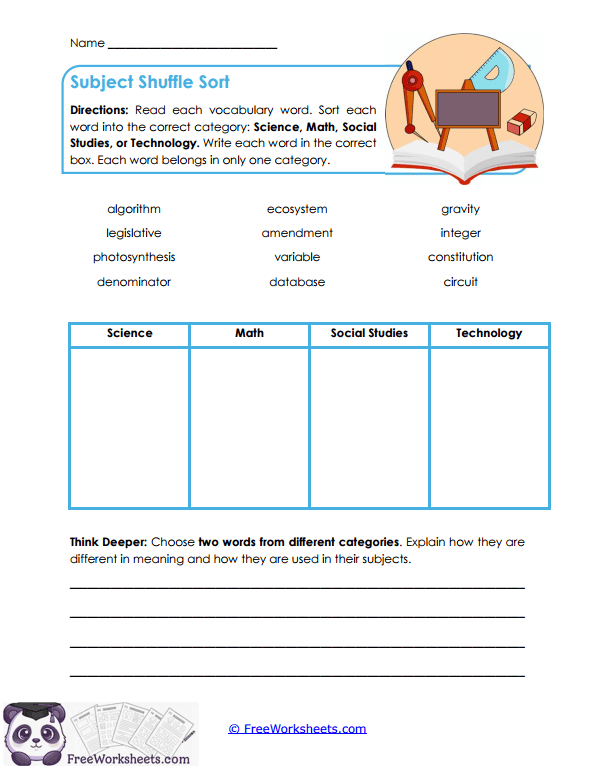
Subject Shuffle Sort
What Kids Do: Twelve academic vocabulary terms must be sorted into four subject categories: Science, Math, Social Studies, and Technology. Students examine words such as ecosystem, denominator, legislative, algorithm, and database before recording them in the appropriate columns. A Think Deeper question asks learners to select two words from different categories and explain how their meanings and academic uses differ. Teachers should clarify the intended classifications of cross-disciplinary terms such as algorithm, variable, and circuit because these words can reasonably appear in more than one subject.
Target Skill: Classifying vocabulary by academic discipline develops an understanding of specialized terminology and the language used across different subjects. Learners practice connecting words with the concepts and applications they describe rather than relying on familiarity alone. Comparing terms from separate disciplines also reinforces precise definitions and encourages students to recognize when academic vocabulary overlaps between fields.
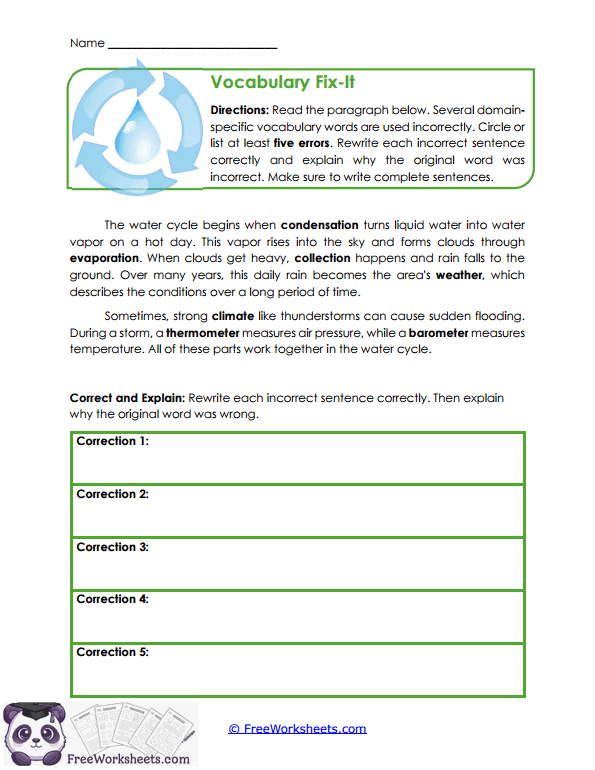
Vocabulary Fix-It
What Kids Do: Students read a two-paragraph explanation of the water cycle containing deliberately misused scientific vocabulary. They identify at least five errors, including incorrect uses of terms associated with evaporation, condensation, weather, climate, and atmospheric measurement instruments. Learners circle or list the mistakes, rewrite incorrect sentences, and explain why the original wording was inaccurate. Five correction boxes are provided, so related errors may need to be addressed together or recorded in additional space.
Target Skill: Identifying inaccurate terminology strengthens conceptual understanding, scientific literacy, and critical reading. Students must recognize how closely related vocabulary terms differ and determine whether a word accurately describes the process or measurement presented. Explaining corrections reinforces distinctions between evaporation and condensation, weather and climate, and instruments that measure temperature or atmospheric pressure.
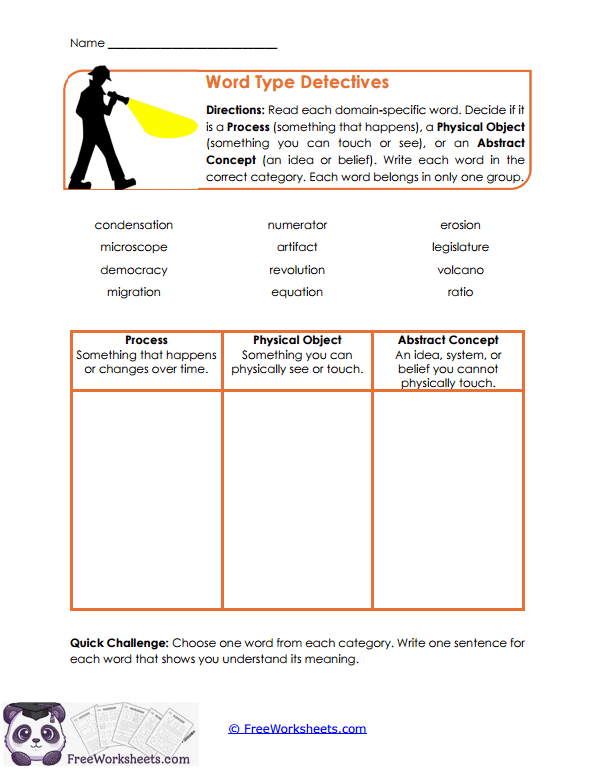
Word Type Detectives
What Kids Do: Twelve domain-specific vocabulary words are classified into three groups: Process, Physical Object, and Abstract Concept. Students examine terms such as condensation, erosion, microscope, democracy, equation, and ratio before recording them in the appropriate columns. A final challenge asks learners to choose one word from each category and write an original sentence demonstrating its meaning. Teachers should clarify the intended classification of terms such as legislature, which describes an institution and does not fit the simplified categories as neatly as some other entries.
Target Skill: Distinguishing processes, tangible objects, and abstract concepts develops semantic classification and more precise academic vocabulary knowledge. Students practice recognizing whether specialized terms describe actions or changes, physical items, or intangible mathematical and social ideas. Constructing sentences with selected words extends the classification task by requiring learners to communicate each term’s meaning within an appropriate context.