
About This Worksheet
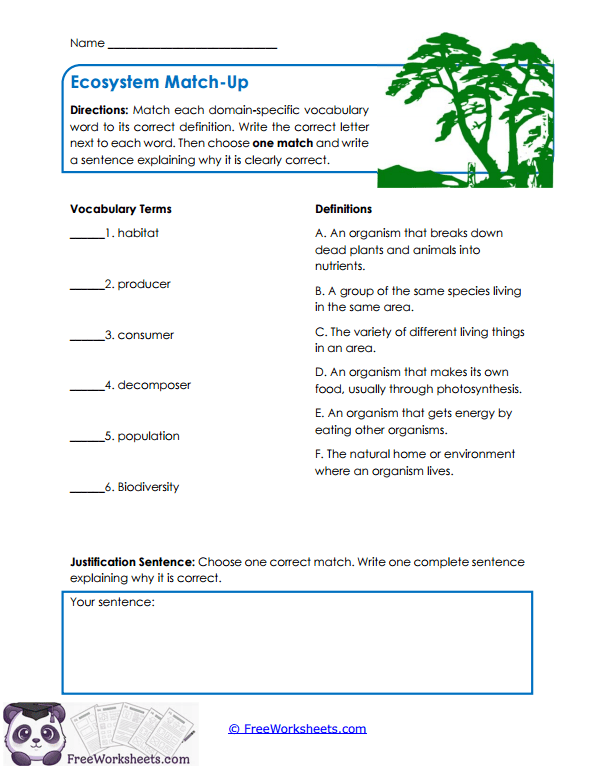
Ecosystem Match-Up introduces learners to essential ecological terminology through a vocabulary matching activity focused on organisms and their environments. This 6th grade vocabulary worksheet presents six scientific terms that students must connect with their corresponding definitions. The featured words include habitat, producer, consumer, decomposer, population, and biodiversity, each representing a different aspect of how ecosystems function. A final written explanation encourages students to demonstrate their understanding of a selected term rather than relying exclusively on matching the correct answer.
Curriculum and Grade Alignment
Understanding ecosystem terminology supports scientific literacy, academic vocabulary development, and informational reading comprehension within the 6th grade curriculum. Students practice distinguishing the roles organisms play in obtaining energy, the environments where they live, and the ways living things are organized within ecological communities. Terms such as population and biodiversity require learners to recognize the difference between members of a single species and the variety of organisms present in an area. Explaining a vocabulary match also reinforces the ability to communicate scientific concepts accurately using complete sentences.
Student Tasks
Learners examine six numbered ecosystem vocabulary terms and match each one with the appropriate definition from a lettered answer bank. They write the corresponding letter beside each term, using the definitions to distinguish relationships involving habitats, feeding roles, populations, and ecological diversity. For example, students must recognize that a producer makes its own food, usually through photosynthesis, while a consumer obtains energy by eating other organisms. After completing the matches, learners select one correct pairing and write a complete sentence explaining why the definition accurately describes the vocabulary word.
Common Challenges and Misconceptions
Students may confuse producers, consumers, and decomposers because all three are connected to the movement of energy and nutrients within ecosystems. Another difficulty involves distinguishing population from biodiversity, since both terms describe living organisms within an area but emphasize different characteristics. Learners may also define habitat too broadly as an entire ecosystem rather than recognizing it as the natural home or environment of an organism. Comparing the defining characteristics of each term can help students recognize which details distinguish one ecological concept from another.
Implementation Guidance
Begin by discussing the different roles organisms play in an ecosystem, using a plant, an animal, and a decomposer to illustrate how their functions differ. Encourage students to underline key phrases within the definitions, such as “makes its own food” or “same species living in the same area,” before selecting matching letters. For learners who need additional support, organize the vocabulary into smaller groups involving organism roles, habitats, and community characteristics. During the written justification, encourage students to explain the specific evidence supporting their match rather than simply repeating the definition word for word.
Details and Features
The worksheet organizes six vocabulary terms in a numbered left-hand column and six lettered definitions in a corresponding right-hand column. Each term includes a short blank where students record the letter of its matching definition. The definitions are written in complete explanatory phrases, allowing learners to identify important scientific characteristics without consulting a separate word bank. A large rectangular response area at the bottom provides space for one complete justification sentence explaining why a selected match is correct.