
Context Clues Worksheets
Figuring out an unfamiliar word often depends on what the surrounding sentences reveal, not on knowing its definition in advance. These 6th grade vocabulary context clues worksheets explore that process through mystery stories, a coral reef science passage, multiple-meaning words, and sentence revision. Some activities ask learners to underline evidence and explain definitions; others have them choose words or build helpful clues themselves. Select a task based on whether students need practice finding, interpreting, or writing contextual support.
About This Collection of Worksheets
Context clues allow readers to determine unfamiliar word meanings by examining the information an author provides nearby. Sometimes the meaning appears almost directly through a definition, synonym, or explanatory phrase. Other times, readers must infer the meaning from a character’s actions, the consequences of an event, or details spread across several sentences. For 6th grade learners, recognizing these different forms of contextual support is particularly valuable as reading materials introduce more abstract vocabulary and specialized academic language. The activities explore how surrounding information helps readers interpret words accurately and explain the evidence behind their conclusions.
The exercises vary in both reading demands and the types of responses students produce. Sentence-level activities focus on interpreting individual vocabulary terms, selecting appropriate words from a bank, or identifying how one word changes meaning across different contexts. Longer passages introduce connected reading experiences involving a mysterious laboratory, an inventor’s struggle for recognition, environmental changes affecting coral reefs, and a family’s unexpected detour. Several exercises require students to define vocabulary, identify supporting evidence, and explain how the clues establish meaning. Writing-focused activities reverse the process by asking learners to add helpful clues to existing sentences or construct original examples that communicate unfamiliar word meanings.
Teachers can choose materials according to the kind of contextual reasoning students need to practice. Direct explanation and example-clue activities are useful when learners are first identifying textual evidence, while narrative inference exercises require closer attention to behavior, tone, and events. Word-bank questions provide structured practice with evaluating possible meanings, whereas open-ended definitions reveal how independently students can interpret vocabulary. Sentence construction activities offer an additional challenge because learners must deliberately communicate meaning to someone else. Pairing a reading-based exercise with a writing task can help determine whether students understand not only how to find context clues but also how to use them effectively.

Paul’s Teacher Tip
When students encounter an unfamiliar word, encourage them to look for both the closest clue and the broader situation before deciding on its meaning. For example, in a sentence describing a treacherous trail where hikers grip rocks and test every step, ask learners what those actions reveal about the trail’s conditions. Have them replace treacherous with dangerous or unsafe and reread the sentence to check whether the meaning still fits. Next, ask them to identify which details provide the strongest evidence and explain why those details are more useful than simply knowing the trail is on a mountain. This approach helps students distinguish between a reasonable guess and an interpretation supported by the text.
Worksheet Collection Skill Spotlights
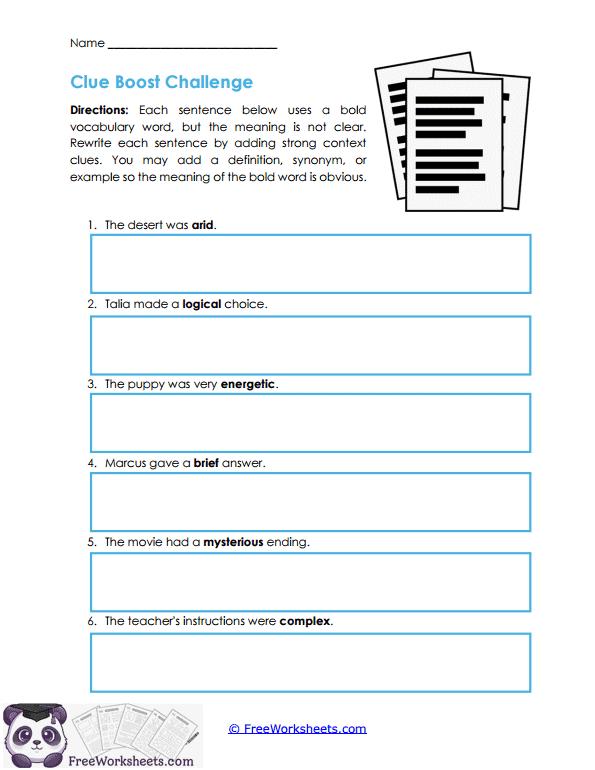
Clue Boost Challenge
What Kids Do: Six short sentences containing bold vocabulary words must be rewritten to provide clearer contextual information. Learners expand statements such as “The desert was arid” by adding definitions, synonyms, examples, or descriptive explanations that reveal the target word’s meaning. Large writing boxes allow students to develop complete sentences that communicate vocabulary more effectively.
Target Skill: Constructing meaningful context clues strengthens vocabulary understanding and purposeful sentence development. Students learn to distinguish helpful explanatory information from details that merely make a sentence longer. By revising sentences from the perspective of an unfamiliar reader, they practice making word meanings accessible without relying on separate dictionary definitions.
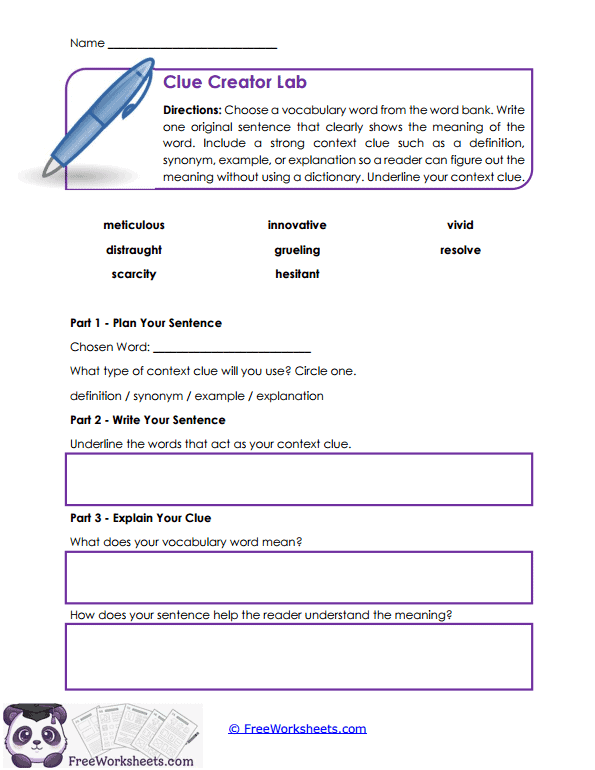
Clue Creator Lab
What Kids Do: Learners select a vocabulary word from a bank containing terms such as meticulous, innovative, vivid, and hesitant, then develop an original sentence that communicates its meaning. The activity includes separate stages for choosing a context-clue strategy, writing the sentence, and explaining the resulting clue. Students underline their contextual evidence and describe how their writing helps another reader interpret the selected word.
Target Skill: Applying context-clue strategies through original writing develops the ability to communicate unfamiliar vocabulary deliberately and accurately. Students practice incorporating definitions, synonyms, examples, or explanations into sentences while maintaining natural language. The planning and reflection components encourage them to evaluate whether their chosen details genuinely support the intended word meaning.
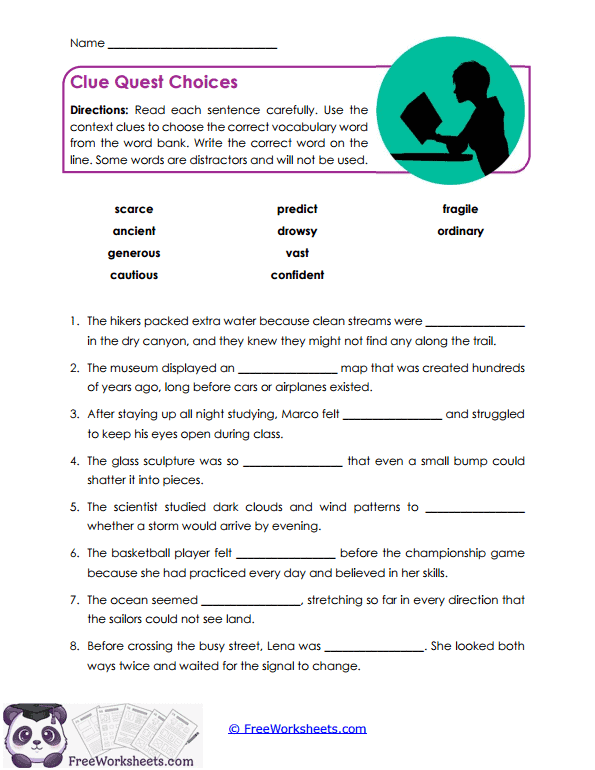
Clue Quest Choices
What Kids Do: Eight sentence-completion questions require students to select appropriate vocabulary from a ten-word bank. Each sentence provides situational details that guide the choice, including hikers searching for scarce water, an ancient map, and a fragile glass sculpture. Learners write the selected word directly into each sentence while recognizing that some vocabulary choices are distractors and will not be used.
Target Skill: Selecting vocabulary through contextual evidence reinforces accurate word interpretation and sentence comprehension. Students must distinguish words that may share general associations but communicate different meanings, such as confident and cautious. Evaluating the surrounding information and checking grammatical fit helps learners develop a more deliberate approach to choosing precise vocabulary.
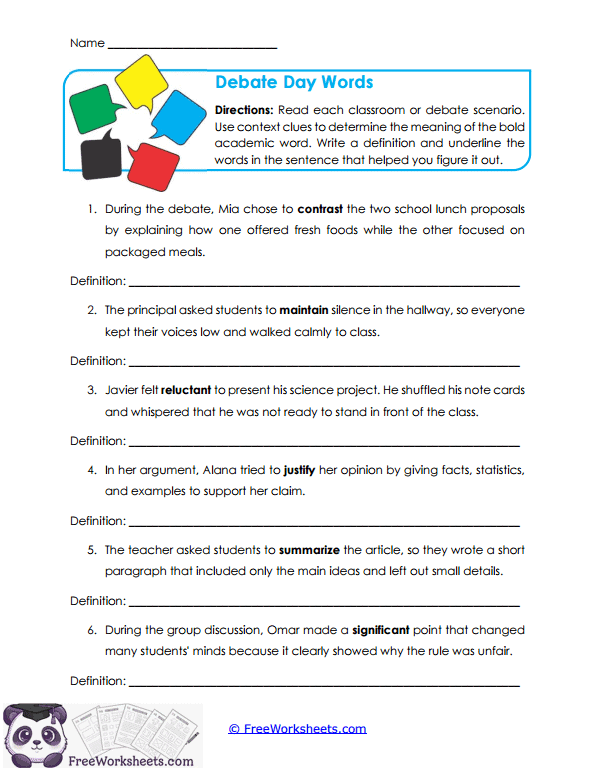
Debate Day Words
What Kids Do: Six classroom and debate-related scenarios contain bold academic vocabulary that students must define through contextual evidence. Learners interpret words such as contrast, maintain, reluctant, justify, summarize, and significant by examining surrounding explanations and examples. They underline the specific phrases supporting each interpretation and record a student-friendly definition on the corresponding response line.
Target Skill: Understanding academic vocabulary through explanatory context strengthens reading comprehension and language used in classroom discussions. Students practice recognizing how examples, descriptions, and actions reveal meanings associated with comparing ideas, supporting arguments, and communicating information. Identifying evidence alongside each definition encourages accurate interpretation rather than relying solely on prior familiarity with a word.
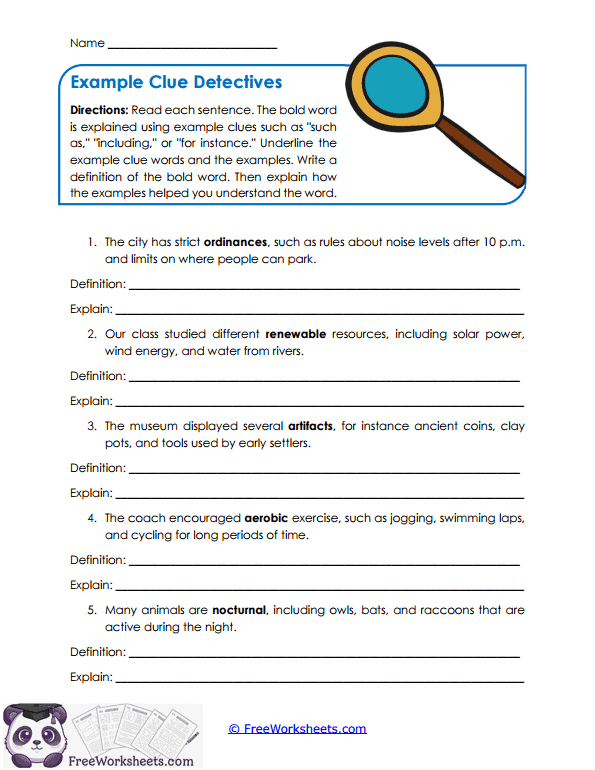
Example Clue Detectives
What Kids Do: Five sentences introduce unfamiliar vocabulary through lists of examples and recognizable signal phrases, including “such as,” “including,” and “for instance.” Students examine terms such as ordinances, renewable, artifacts, aerobic, and nocturnal, underlining the examples that clarify their meanings. Each exercise requires both a written definition and an explanation of how the contextual examples support that interpretation.
Target Skill: Recognizing example-based context clues develops the ability to infer broader word meanings from specific illustrations. Learners practice identifying signal phrases, determining what related examples have in common, and connecting those characteristics to an unfamiliar term. Explaining the relationship between examples and definitions reinforces close reading and helps prevent overly narrow interpretations based on a single illustration.
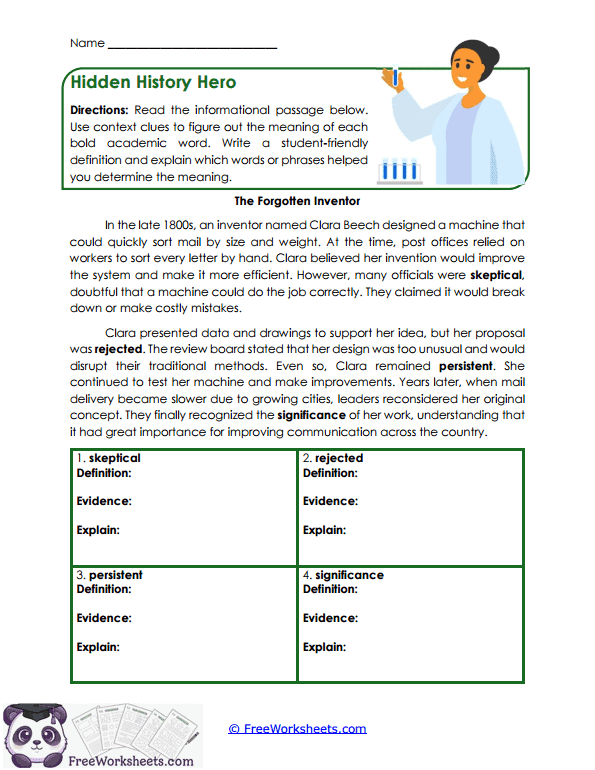
Hidden History Hero
What Kids Do: An informational-style passage titled “The Forgotten Inventor” introduces Clara Beech, an inventor whose proposed mail-sorting machine initially meets resistance. Students examine four bold vocabulary words-skeptical, rejected, persistent, and significance-and complete separate response sections for each term. They write definitions, identify supporting evidence from the passage, and explain how the selected details establish the intended meanings.
Target Skill: Interpreting academic vocabulary within a connected historical-style narrative develops contextual reasoning and evidence-based reading comprehension. Learners distinguish between attitudes, actions, personal qualities, and abstract ideas while examining how events clarify unfamiliar terms. The separate Definition, Evidence, and Explain fields reinforce the distinction between knowing what a word means and demonstrating how the passage supports that conclusion.
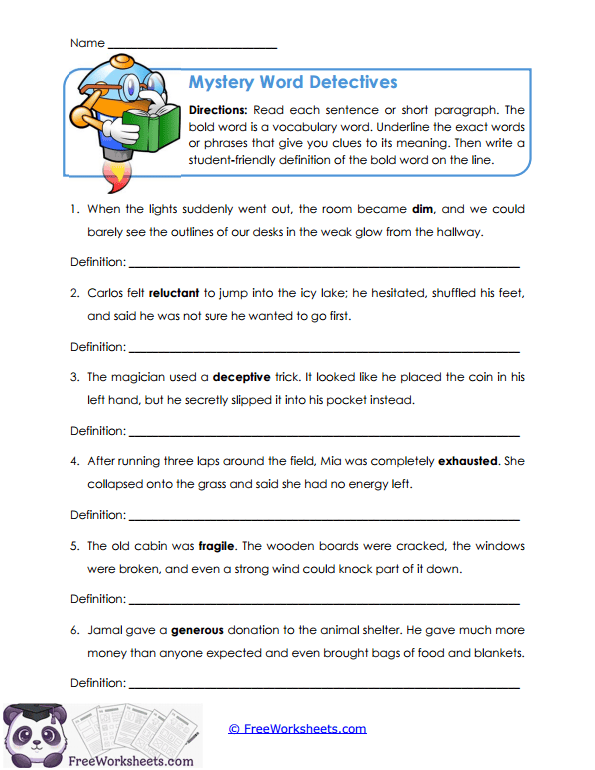
Mystery Word Detectives
What Kids Do: Six short passages present bold vocabulary words embedded in situations involving darkness, hesitation, deception, exhaustion, damaged objects, and generosity. Learners read each passage, underline the exact words or phrases that reveal the target term’s meaning, and write a student-friendly definition. The exercises require students to interpret context rather than select answers from a word bank or rely on directly supplied definitions.
Target Skill: Identifying meaningful textual evidence strengthens vocabulary inference and close-reading skills. Students learn to connect descriptions, character actions, and consequences with unfamiliar word meanings, including terms that describe feelings or personal qualities. The combination of underlining and defining encourages learners to support interpretations with precise contextual clues rather than making unsupported guesses.
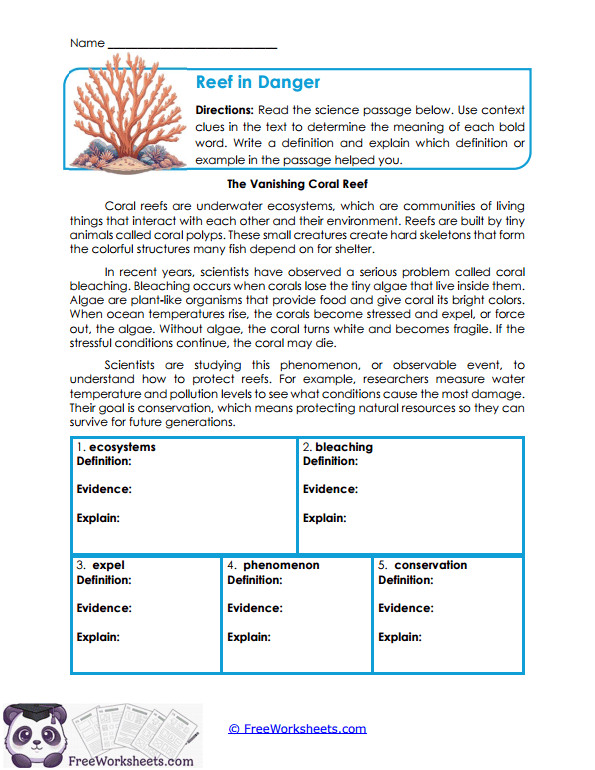
Reef in Danger
What Kids Do: Students read a science passage titled “The Vanishing Coral Reef,” which describes coral ecosystems, bleaching, environmental conditions, and conservation efforts. Five bold vocabulary words appear throughout the reading, including ecosystems, bleaching, expel, phenomenon, and conservation. Learners complete individual response sections by writing definitions, identifying relevant evidence, and explaining how details from the passage clarify the scientific terminology.
Target Skill: Interpreting domain-specific vocabulary supports comprehension of informational and scientific texts. Students practice recognizing direct explanations, restatements, and descriptions that reveal unfamiliar meanings within connected paragraphs. Examining the relationship between coral bleaching and environmental stress also encourages learners to connect vocabulary with the broader scientific process being described rather than treating each term as an isolated definition.
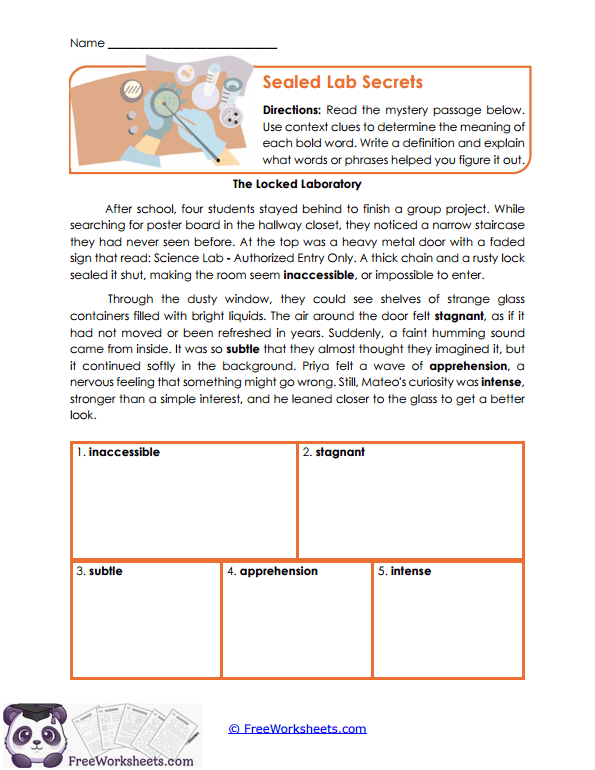
Sealed Lab Secrets
What Kids Do: A mystery passage titled “The Locked Laboratory” follows students investigating a sealed science laboratory containing unusual equipment and an unexplained sound. Learners interpret five bold vocabulary terms-inaccessible, stagnant, subtle, apprehension, and intense-using clues from the narrative. They write definitions and explain which details, including direct explanations, sensory descriptions, and character reactions, helped them determine each meaning.
Target Skill: Combining direct and indirect context clues strengthens vocabulary inference within narrative reading. Students practice distinguishing words explained through immediate restatements from terms whose meanings depend on atmosphere, actions, or emotional responses. The mystery setting encourages attention to how descriptive vocabulary establishes tension while requiring learners to justify interpretations using evidence from the passage.
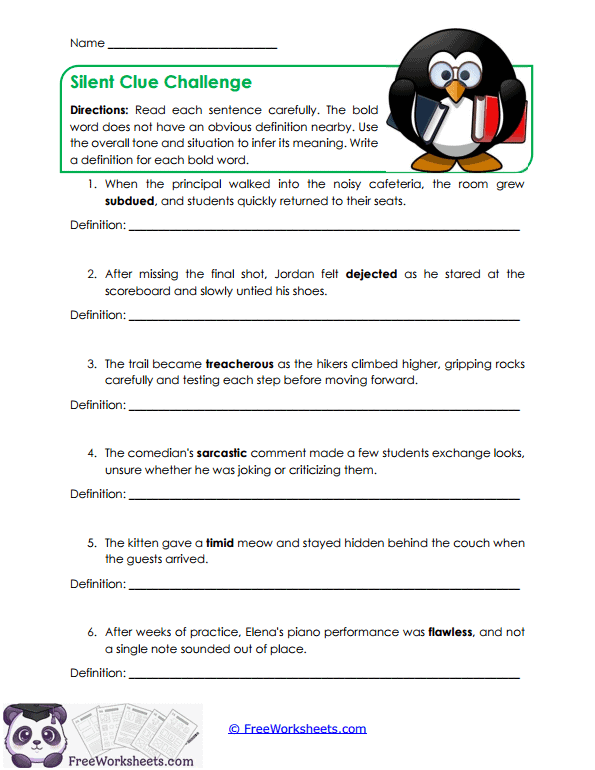
Silent Clue Challenge
What Kids Do: Six descriptive sentences contain bold vocabulary words whose meanings must be inferred without obvious definitions or synonyms. Learners interpret words such as subdued, dejected, treacherous, sarcastic, timid, and flawless through surrounding actions and situational details. After examining each scenario, students write an appropriate definition on the provided response line, drawing conclusions from the overall context rather than a single explanatory phrase.
Target Skill: Inferring vocabulary through implied meaning develops careful reading and interpretive reasoning. Students learn to recognize how behavior, emotional reactions, and descriptive details communicate information about unfamiliar words. This activity places particular emphasis on interpreting indirect evidence, helping learners distinguish between general impressions of a situation and the specific meaning supported by the text.
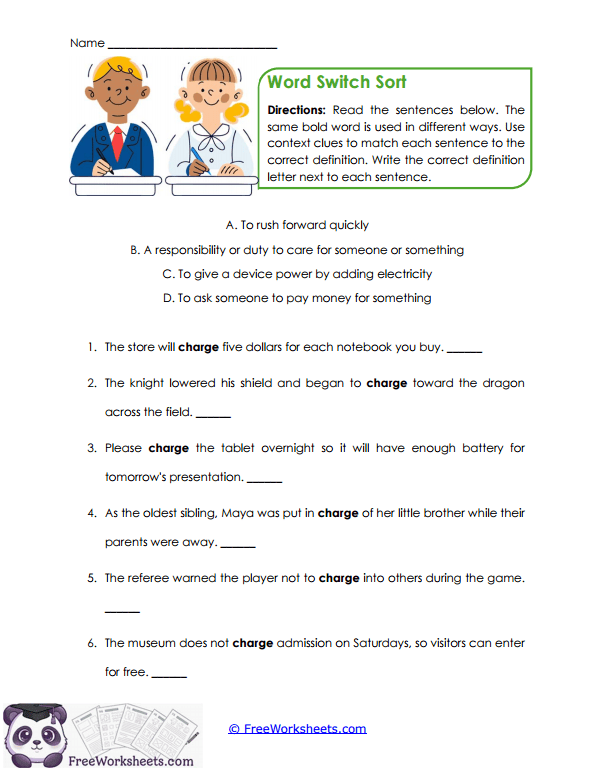
Word Switch Sort
What Kids Do: The word charge appears in six different sentences involving payment, rapid movement, electrical power, and responsibility. Students examine how the surrounding language changes its meaning and match each use with one of four lettered definitions. Several definitions apply to more than one sentence, requiring learners to interpret each example independently rather than assuming every answer choice will be used only once.
Target Skill: Understanding multiple-meaning words reinforces vocabulary flexibility and the importance of contextual interpretation. Learners practice recognizing that a familiar word can function differently depending on the situation and surrounding language. Matching the correct definition to each sentence encourages students to consider the intended meaning rather than automatically applying the definition they encounter most frequently.
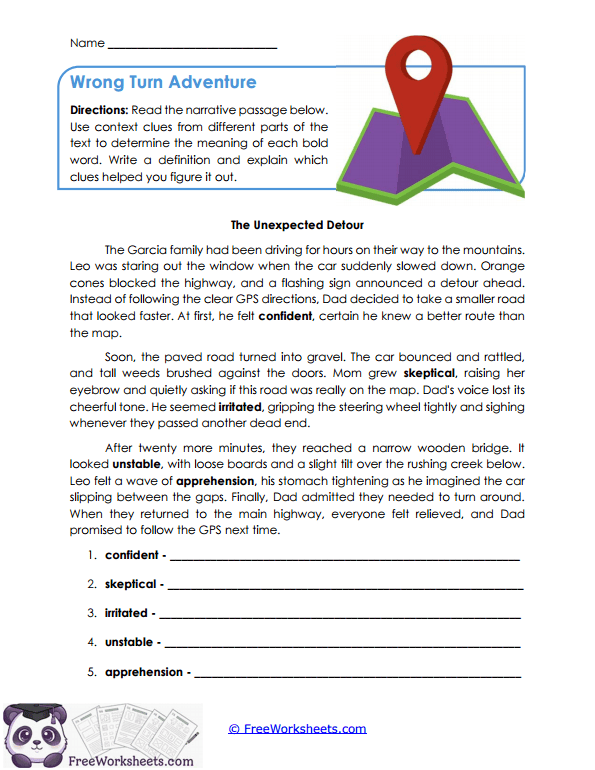
Wrong Turn Adventure
What Kids Do: Learners read “The Unexpected Detour,” a three-paragraph story about a family navigating an unfamiliar road and encountering an unsafe-looking bridge. Five bold vocabulary words-confident, skeptical, irritated, unstable, and apprehension-appear as the family’s journey becomes increasingly uncertain. Students write definitions and explain how the characters’ changing reactions and the surrounding events provide clues to each meaning. Because the printed response area provides only one line per word, additional writing space may be useful for the requested explanations.
Target Skill: Interpreting vocabulary across a developing narrative strengthens inference, reading comprehension, and the ability to connect words with changing circumstances. Students examine how confidence, doubt, frustration, and anxiety differ while using character behavior and environmental descriptions as evidence. The activity emphasizes combining information from multiple parts of a passage to determine precise meanings rather than relying only on the sentence containing the unfamiliar word.