
About This Worksheet
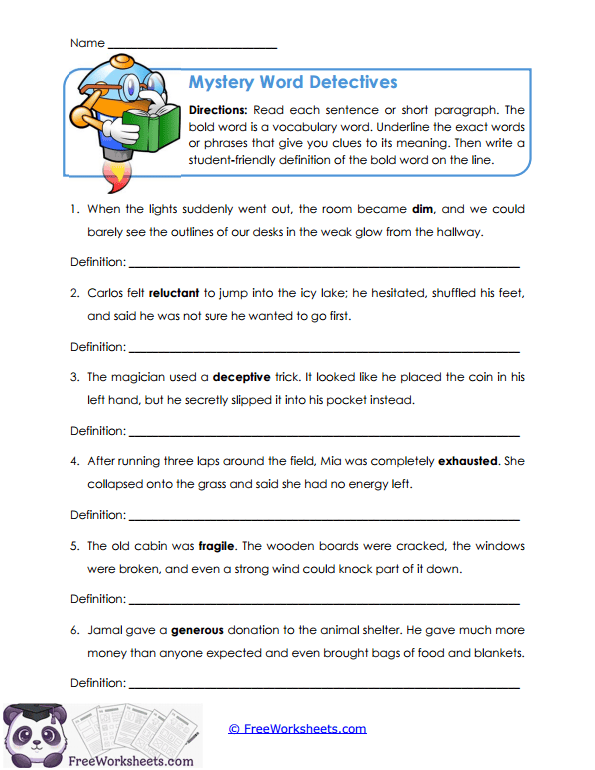
Mystery Word Detectives introduces learners to using surrounding words and phrases to determine the meanings of unfamiliar vocabulary. This 6th grade vocabulary worksheet presents six short passages containing bold academic and descriptive words that students must interpret through context. Rather than relying on a dictionary or predetermined answer choices, learners examine details within each sentence to identify clues that reveal the intended meaning. The activity emphasizes both vocabulary comprehension and the ability to support word definitions with specific textual evidence.
Curriculum and Grade Alignment
Using context clues to determine word meanings supports vocabulary development, reading comprehension, and evidence-based reasoning within the 6th grade language arts curriculum. Students practice recognizing how surrounding descriptions, actions, and explanations provide information about unfamiliar terms. The featured vocabulary includes dim, reluctant, deceptive, exhausted, fragile, and generous, offering opportunities to interpret descriptive words across everyday situations. This activity reinforces the connection between understanding vocabulary and identifying textual details that support a reasonable interpretation.
Student Tasks
Learners read six numbered sentences or short paragraphs, each containing a bold vocabulary word whose meaning can be determined from the surrounding text. They underline the specific words or phrases that provide clues and then write a student-friendly definition on the designated response line. For example, the sentence describing a room becoming dim includes details about barely seeing desks in the weak glow from a hallway, helping students determine that dim means having little light. Other passages use actions, consequences, and descriptive details to clarify words such as reluctant, deceptive, and generous.
Common Challenges and Misconceptions
Some students may understand the overall situation without recognizing which specific words provide evidence for the vocabulary definition. Others may underline entire sentences rather than isolating the details that most clearly reveal the intended meaning. Words such as deceptive and reluctant can create additional difficulty because their meanings are implied through behavior rather than directly stated. Encouraging learners to connect their proposed definition with one or two precise textual clues can help strengthen both their interpretations and their evidence selection.
Implementation Guidance
Begin with the sentence containing dim and demonstrate how the phrases “barely see” and “weak glow” support the interpretation that the room has very little light. Model how to underline these clues before writing a short definition in familiar language. Encourage students to work independently on the remaining passages, then compare their selected evidence with a partner to determine whether different clues support the same meaning. For additional practice, invite learners to write an original sentence using one of the vocabulary words and include enough contextual information for another reader to infer its meaning.
Details and Features
The worksheet contains six numbered vocabulary passages arranged vertically, each followed by a clearly labeled Definition line. Target vocabulary words appear in bold within the text, allowing students to identify which term they must interpret. The passages range from everyday situations involving dark rooms and hesitant behavior to descriptions of damaged objects, physical exhaustion, and generous actions. The directions explicitly require students to underline supporting context clues and write their own definitions, combining text annotation with written vocabulary responses.