
6th Grade Spelling Mastery Worksheets
Accurate spelling depends on more than memorizing word lists; students also need to recognize patterns, choose words by meaning, and edit their own writing. These 6th grade spelling mastery worksheets combine suffix and vowel-team sorting, commonly confused words, academic vocabulary, paragraph correction, and original sentence writing. Learners identify errors in connected text, match definitions, and apply spelling rules to different word forms. Teachers can select recognition-based practice or writing tasks to examine how well students transfer correct spelling into everyday schoolwork.
About This Collection of Worksheets
Spelling proficiency involves recognizing how words are constructed, understanding the patterns that influence their written forms, and applying those conventions accurately in context. As students encounter more complex vocabulary in 6th grade, they must navigate suffix changes, consonant doubling, vowel combinations, and words whose spellings do not directly reflect their pronunciation. Knowing how these patterns work can make unfamiliar words easier to analyze, while understanding word meanings helps students distinguish between similar-looking or commonly confused terms. These activities connect spelling conventions with vocabulary knowledge, grammatical awareness, and the practical skills needed to produce accurate written communication.
The collection addresses spelling through several different approaches, allowing students to work with individual words, complete sentences, and connected passages. Pattern recognition activities examine suffix endings, vowel teams, consonant doubling, and word transformations, while multiple-choice questions challenge learners to distinguish correctly spelled vocabulary from plausible errors. Definition matching and contextual sentence completion reinforce the relationship between spelling and meaning, including academic terminology used in science and social studies. Editing exercises require students to identify incorrect spellings, verb forms, and grammatical structures within passages about school activities and technology. Other worksheets move beyond recognition by asking learners to construct original sentences, complete a paragraph using appropriate vocabulary, or incorporate required spelling words into their own writing.
Teachers can choose activities according to the spelling difficulties students demonstrate in their daily work. Learners who frequently misspell words containing suffixes or doubled consonants may benefit from targeted pattern analysis, while those who confuse similar words can practice selecting vocabulary based on sentence meaning. Multiple-choice exercises provide a focused way to check word recognition, whereas editing activities reveal whether students can identify errors when attention is divided between spelling and overall meaning. Original writing tasks offer a more demanding opportunity to apply vocabulary accurately without relying on supplied answer choices. Reviewing both isolated word accuracy and spelling within connected writing can help educators identify which conventions students recognize and which still require reinforcement.
Paul’s Teacher Tip
When students repeatedly misspell a word, encourage them to identify the spelling pattern or word-family relationship before simply copying the correct version. For example, compare hope and hoping with run and running, asking students to explain why one word drops its final e while the other doubles its final consonant. Then introduce happy and happiness to show how a different ending requires changing y to i before adding the suffix. Have learners apply each pattern to another familiar word and explain the change aloud before writing it. This approach helps students understand spelling as a system of recognizable conventions rather than a collection of unrelated words to memorize.
Worksheet Collection Skill Spotlights
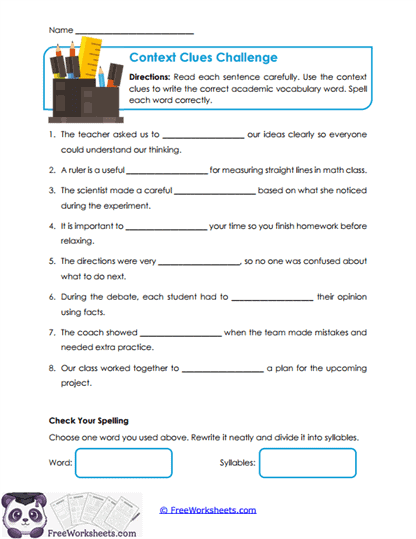
Context Clues Challenge
What Kids Do: Eight incomplete sentences ask learners to generate academic vocabulary words using clues from the surrounding language. The scenarios involve classroom communication, measurement, scientific observation, time management, debates, and collaborative planning. Students write words that fit each sentence’s meaning, then select one of their completed terms to rewrite and divide into syllables in the Check Your Spelling section.
Target Skill: Combining contextual reasoning with spelling accuracy develops the ability to retrieve appropriate vocabulary independently. Students must consider a word’s meaning, grammatical role, and conventional spelling without relying on a word bank. The syllable-division task adds attention to word structure and pronunciation, while the open-ended sentences encourage learners to recognize that more than one response may be appropriate when supported by the context.
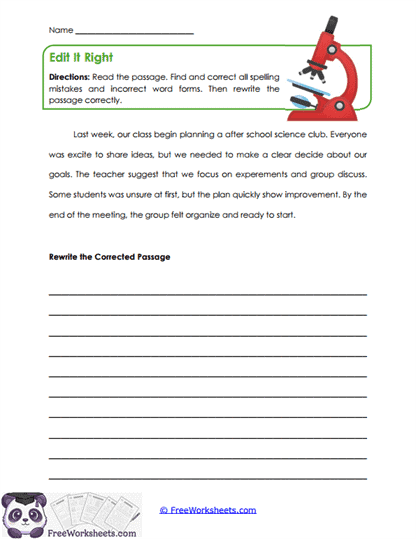
Edit It Right
What Kids Do: Learners examine a short narrative describing students organizing an after-school science club and identify incorrectly written words and grammatical forms. The passage includes errors involving verb tense, subject-verb agreement, noun formation, and adjective usage. Students determine how expressions such as “a clear decide” and “the group felt organize” should be corrected, then rewrite the complete passage on the provided writing lines.
Target Skill: Proofreading connected writing strengthens spelling awareness, grammatical accuracy, and the ability to recognize appropriate word forms. Students distinguish between words that are misspelled and words that are spelled correctly but used incorrectly within a sentence. Rewriting the passage reinforces consistent verb tense, accurate noun and adjective forms, and attention to language conventions while preserving the original meaning.
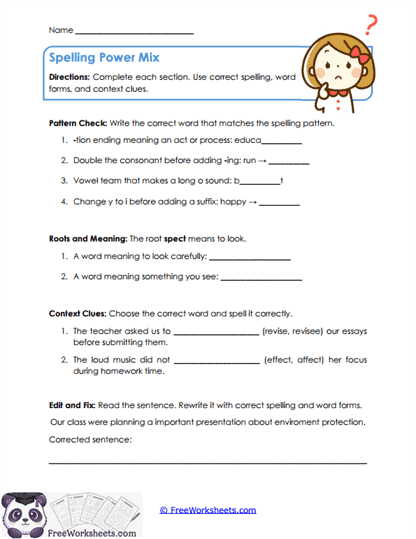
Spelling Power Mix
What Kids Do: Four short sections challenge students to apply different spelling and vocabulary strategies. Pattern Check covers suffix endings, consonant doubling, vowel teams, and changes to words ending in y, while Roots and Meaning explores vocabulary containing spect. Context Clues requires selecting correctly spelled words in sentences, and Edit and Fix asks learners to correct a sentence about an environmental protection presentation. The spect question asking for a word meaning “something you see” may allow more than one interpretation, so teachers should clarify the intended response.
Target Skill: Selecting appropriate word-analysis strategies supports flexible spelling knowledge and vocabulary comprehension. Students practice recognizing when a familiar spelling rule applies, interpreting the meaning of a word root, and distinguishing commonly confused words according to grammatical context. The editing task connects these skills with written language conventions, encouraging learners to evaluate spelling, agreement, and word forms within a complete sentence.
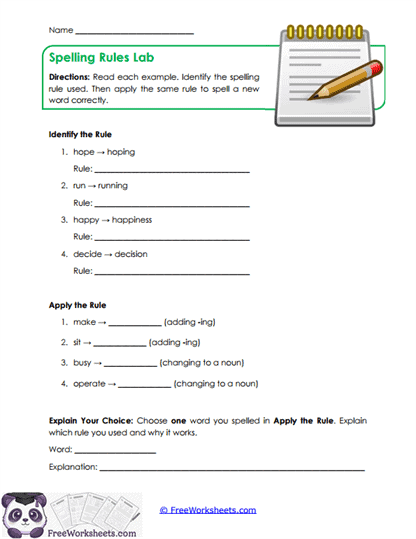
Spelling Rules Lab
What Kids Do: Students examine four completed word transformations and explain the spelling changes represented by each example. These include hope becoming hoping, run becoming running, happy becoming happiness, and decide becoming decision. They then apply related patterns to make, sit, busy, and operate before choosing one transformed word and writing an explanation of how its spelling changes.
Target Skill: Understanding how suffixes and related word forms affect spelling develops morphological awareness and more accurate written vocabulary. Learners practice recognizing the conditions that require dropping a final e, doubling a consonant, or changing y to i. Comparing transformations also helps students distinguish predictable suffix rules from less straightforward word-family changes, such as the relationship between decide and decision.
Spelling Snapshot
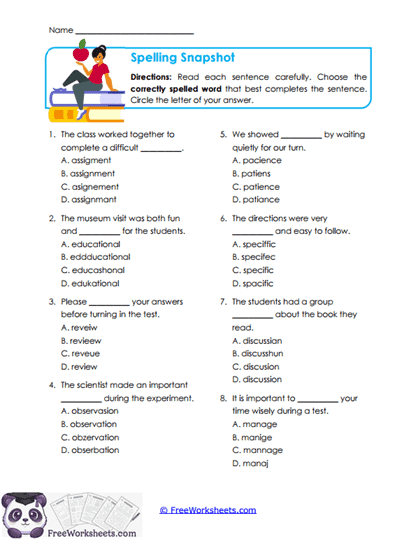
What Kids Do: Eight multiple-choice questions present academic vocabulary words within short classroom-related sentences. Each exercise includes four spelling options, requiring learners to identify the correctly written form of terms such as assignment, educational, review, observation, patience, specific, discussion, and manage. Students circle the letter corresponding to the accurate spelling while distinguishing it from alternatives containing omitted, added, or misplaced letters.
Target Skill: Recognizing conventional spelling patterns strengthens orthographic awareness and familiarity with frequently used academic vocabulary. Students practice identifying differences between visually similar word forms, including errors involving vowel combinations, consonant patterns, and syllable structures. The sentence contexts help establish the intended vocabulary word, allowing learners to concentrate on identifying its accurate written form.
Spelling Sort Lab
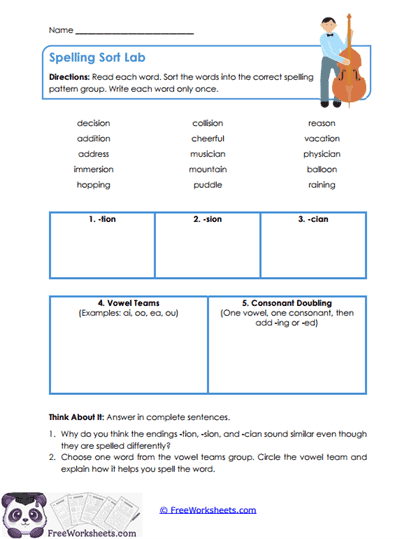
What Kids Do: Fifteen vocabulary words must be classified according to five spelling-pattern groups: -tion, -sion, -cian, vowel teams, and consonant doubling. Students examine words such as decision, collision, musician, cheerful, balloon, and hopping before recording each term in the appropriate section. Two reflection questions ask learners to explain why similar-sounding endings use different spellings and how recognizing a vowel team can support accurate writing. Teachers should clarify that address and puddle contain doubled consonants but do not demonstrate the suffix-doubling rule printed in the category heading.
Target Skill: Classifying spelling patterns develops awareness of recurring letter combinations and the conventions that influence word formation. Learners examine how similar sounds may be represented by different suffixes while recognizing vowel teams and doubled consonants within familiar vocabulary. Explaining their classifications encourages students to connect spelling observations with underlying rules rather than memorizing words without considering their structure.
Spelling Story Task
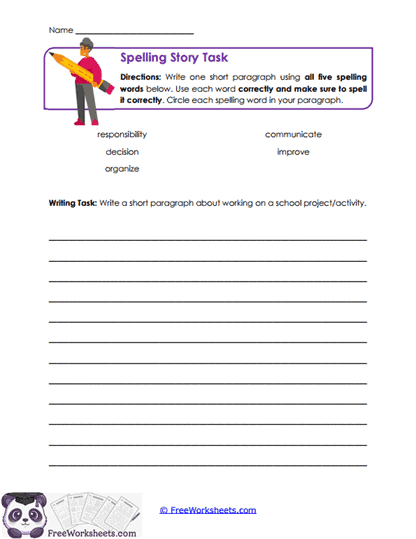
What Kids Do: Students write an original paragraph about working on a school project or participating in a school activity. The writing must include five required vocabulary words: responsibility, decision, organize, communicate, and improve. Learners incorporate every term with correct spelling and appropriate meaning, then circle each spelling word within their completed paragraph. Multiple writing lines provide space for developing a connected description rather than isolated example sentences.
Target Skill: Applying academic vocabulary within original writing reinforces spelling accuracy, grammatical usage, and coherent sentence development. Students must understand the meanings of the required words and determine how they fit naturally into a paragraph about planning or collaboration. The task encourages transfer from word recognition to independent written communication, where spelling must remain accurate alongside organization and clarity.
Subject Word Skills
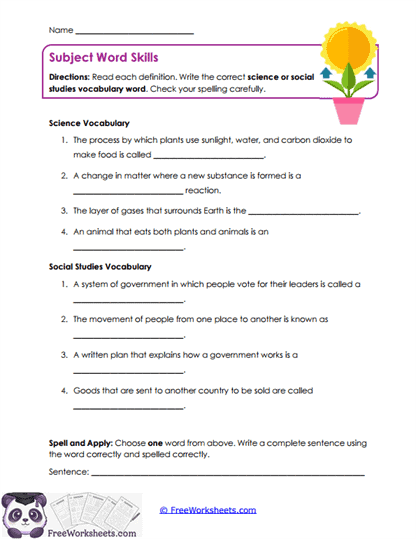
What Kids Do: Eight definition-based questions ask learners to recall and spell academic terminology from science and social studies. The science section includes concepts such as photosynthesis, chemical reactions, the atmosphere, and animal diets, while the social studies section addresses democracy, migration, constitutions, and exports. After supplying the correct terms, students select one word and use it accurately in an original sentence.
Target Skill: Retrieving domain-specific vocabulary from definitions develops academic word knowledge and precise spelling across subjects. Students practice recognizing specialized terminology, including multisyllabic words with unfamiliar letter combinations. Writing a sentence with one selected term reinforces its meaning and grammatical use, requiring learners to demonstrate that they can apply the vocabulary rather than simply associate it with a definition.
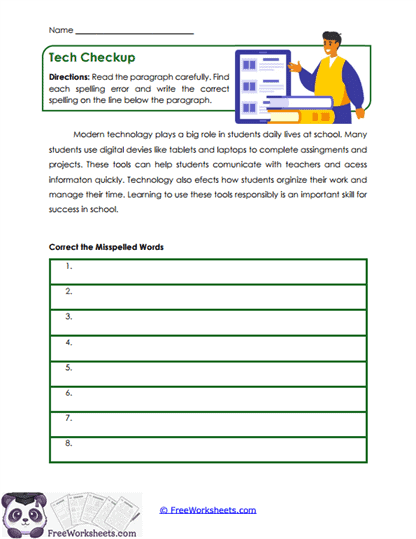
Tech Checkup
What Kids Do: A short informational paragraph describes how students use tablets, laptops, and other digital tools for assignments, communication, and organization. Learners examine the passage for incorrectly written words and record corrections in eight numbered response boxes. The activity requires students to inspect spelling within connected writing rather than predetermined word lists. Teachers should also clarify the missing possessive apostrophe in “students daily lives” and the incorrect use of “efects,” which should be affects, when discussing the scope of the corrections.
Target Skill: Identifying errors in informational writing strengthens proofreading, spelling recognition, and awareness of how words function within sentences. Students practice examining vocabulary associated with technology and school activities while distinguishing accurate spelling from incorrect letter patterns. The connected passage encourages learners to maintain reading comprehension while attending to individual word forms, a skill that supports editing their own written work.
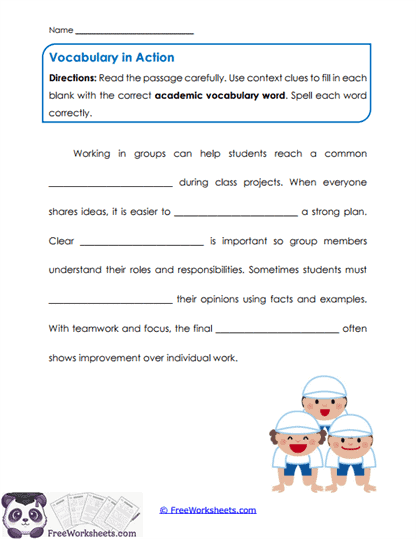
Vocabulary in Action
What Kids Do: Learners complete five blanks within a connected paragraph about students working together on classroom projects. The surrounding sentences describe shared objectives, planning, communication, supporting opinions, and the results of collaboration. Without a word bank, students determine appropriate academic vocabulary and spell each selected term correctly. They must also reread the completed passage to ensure their responses fit its grammatical structure and overall meaning.
Target Skill: Completing connected text through contextual reasoning reinforces vocabulary retrieval, spelling accuracy, and grammatical awareness. Students practice recognizing which types of academic words fit particular sentences and how individual word choices contribute to a coherent explanation. Because several blanks may allow different appropriate completions, the activity also supports evaluating vocabulary according to meaning, sentence structure, and conventional spelling.
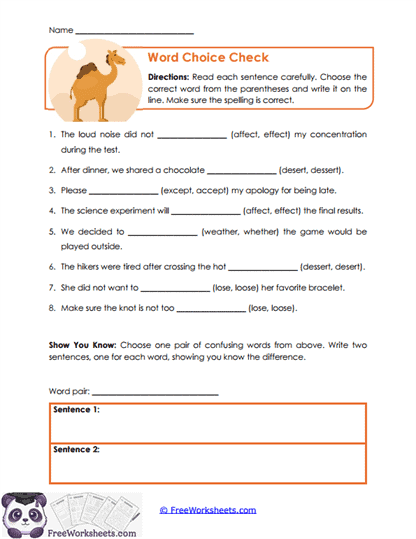
Word Choice Check
What Kids Do: Eight sentence-completion exercises ask students to select the correct word from commonly confused pairs, including affect and effect, desert and dessert, accept and except, and lose and loose. Learners use sentence meaning and grammatical structure to determine which spelling belongs in each blank. A concluding Show You Know section requires two original sentences demonstrating the different meanings of one selected pair. The fifth printed question needs revision because neither weather nor whether grammatically completes “We decided to ___ the game would be played outside”; it can be corrected to “We needed to decide whether the game would be played outside.”
Target Skill: Distinguishing commonly confused words develops precise vocabulary usage and spelling accuracy within meaningful contexts. Students practice identifying how grammatical roles and sentence meanings determine the appropriate written form, even when two words sound similar. Constructing original examples reinforces the ability to apply these distinctions independently rather than recognizing the correct option only when choices are provided.
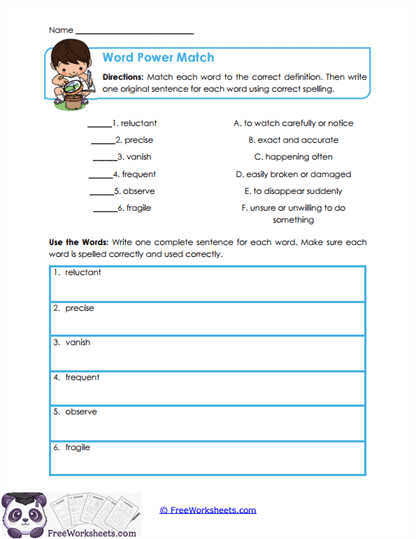
Word Power Match
What Kids Do: Six vocabulary words-reluctant, precise, vanish, frequent, observe, and fragile-must be matched with their corresponding definitions. Students record the appropriate letter beside each term before moving to a sentence-writing section. They then compose one original sentence for every vocabulary word, demonstrating its meaning through appropriate usage and correct spelling. Separate writing boxes organize the responses and keep each term clearly identified.
Target Skill: Connecting definitions with original sentence construction reinforces both receptive and expressive vocabulary knowledge. Learners practice recognizing precise meanings before applying words accurately within their own writing. The activity also develops spelling familiarity with academic and descriptive terms, encouraging students to move beyond recognizing a correct definition toward demonstrating meaning through context and grammatical usage.