
Analogies Worksheets
Analogies ask learners to look beyond individual definitions and recognize how two word pairs share a meaningful relationship. These 6th grade vocabulary worksheets explore similarities and opposites, degrees of intensity, functions, categories, and part-to-whole connections. Students complete open-ended comparisons, classify finished analogies, create original word pairs, and interpret real-world scenarios. Teachers can use these varied activities to distinguish students who recognize vocabulary relationships from those ready to explain or construct them independently.
About This Collection of Worksheets
Understanding analogies requires students to examine not only what words mean, but also how their meanings connect. Two words may express similar ideas, represent opposites, describe different degrees of intensity, or establish a relationship between an object and its purpose. Other comparisons involve categories, individual components, occupations, locations, or cause-and-effect relationships. These distinctions become especially valuable in 6th grade vocabulary instruction as learners encounter more abstract language and increasingly specialized academic terminology. Working with analogies encourages students to move beyond memorized definitions and consider the logical connections that make vocabulary meaningful.
The collection approaches verbal reasoning through several different types of activities. Some worksheets require students to generate missing words independently, while others provide multiple-choice answers or matching columns that allow learners to compare possible completions. Classification exercises ask students to identify relationship types, distinguish part-to-whole connections, or recognize changes in intensity. More open-ended activities challenge learners to create original word pairs, extend categories with additional examples, and apply analogy reasoning to realistic situations. Cross-curricular comparisons introduce vocabulary from science, mathematics, geography, government, and other subjects, encouraging students to recognize relationships between academic concepts as well as everyday words.
Teachers can select exercises according to whether students need practice identifying relationships, applying them, or constructing original comparisons. Learners who are still developing familiarity with analogy structures may benefit from multiple-choice and matching activities before moving to open-ended vocabulary completions. Relationship classification provides a useful way to assess whether students understand why a comparison works, while original analogy construction requires them to demonstrate that understanding independently. Several activities also invite discussion because more than one response may be reasonable when the same semantic relationship is preserved. Encouraging students to explain their choices can reveal misunderstandings that might remain hidden when only the final answer is checked.
Paul’s Teacher Tip
A useful way to teach analogies is to have students turn the relationship between two words into a short explanatory sentence before completing the comparison. For example, in “petal : flower :: page : book,” students can say, “A petal is part of a flower, just as a page is part of a book.” Then reverse the first pair to “flower : petal” and ask learners what must change in the second pair to preserve the relationship. This simple adjustment demonstrates why word order matters and helps distinguish part-to-whole relationships from whole-to-part relationships. Once students can express the connection in words, encourage them to use the same technique with less concrete relationships involving synonyms, functions, and degrees of meaning.
Worksheet Collection Skill Spotlights
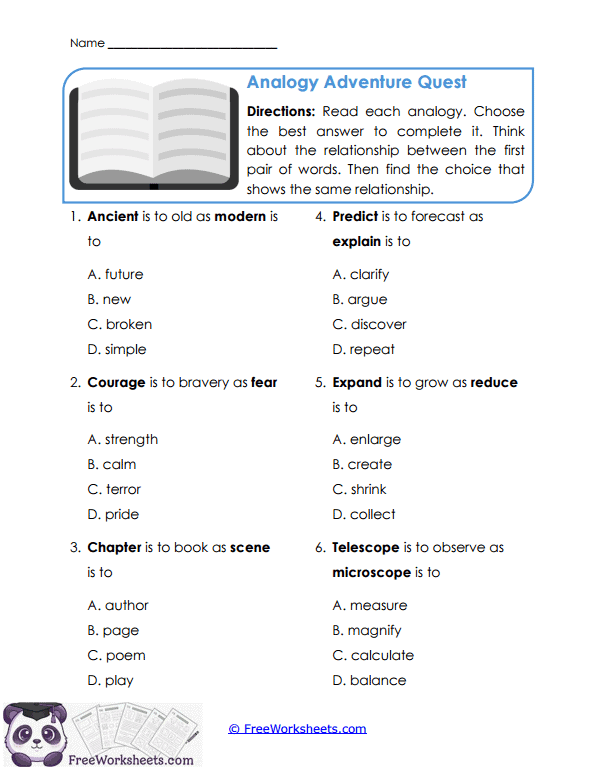
Analogy Adventure Quest
What Kids Do: Learners complete six multiple-choice analogies by selecting the word that best maintains the relationship established by the first pair. Each question provides four lettered answers, requiring students to compare possible completions involving synonyms, antonyms, structural relationships, and object functions. The format encourages careful evaluation of vocabulary choices rather than independent word generation.
Target Skill: Recognizing consistent semantic relationships is the primary objective, with particular attention to distinguishing logical completions from plausible distractors. Students practice identifying similarities in meaning, contrasting word relationships, and connections between components and larger structures. The courage/bravery and fear/terror comparison also provides an opportunity to discuss how words can be closely related while expressing different degrees of intensity.
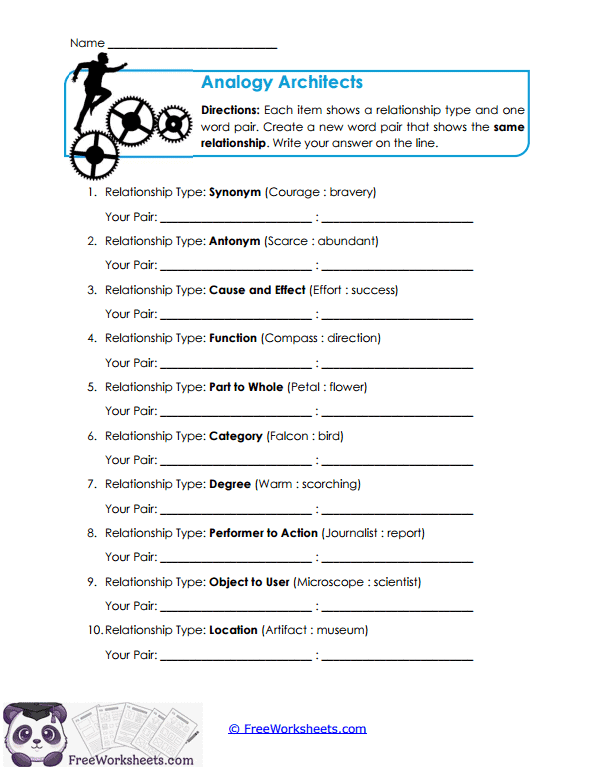
Analogy Architects
What Kids Do: Ten relationship categories challenge students to construct original word pairs based on supplied examples. Learners examine connections such as synonyms, antonyms, cause and effect, functions, categories, and part-to-whole relationships before creating their own comparisons. Each exercise provides two answer lines separated by a colon, allowing students to record vocabulary terms that demonstrate the specified relationship.
Target Skill: Generating original examples reinforces semantic reasoning by requiring learners to apply vocabulary relationships rather than simply recognize them. Students must understand how word meanings connect, maintain the correct relationship direction, and select terms that form logically consistent pairs. The open-ended format also encourages flexible word retrieval and the ability to explain why a particular comparison is valid.
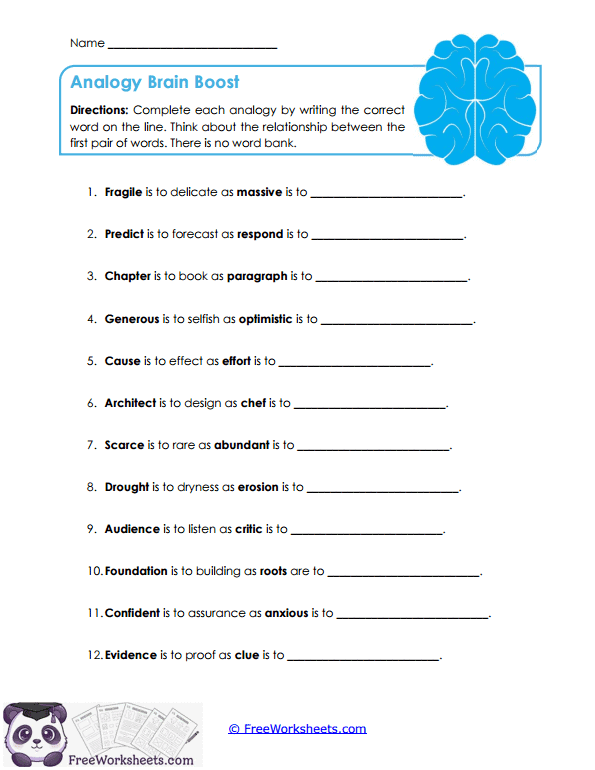
Analogy Brain Boost
What Kids Do: Twelve open-ended analogies ask learners to identify a missing word that preserves the relationship established by the first pair. The exercises include comparisons involving synonyms, antonyms, cause and effect, occupations, and structural connections. Without a word bank or answer choices, students must interpret vocabulary terms such as fragile, abundant, erosion, and evidence before independently generating an appropriate completion.
Target Skill: Completing unfamiliar verbal comparisons develops word knowledge, semantic flexibility, and the ability to recognize logical connections between vocabulary terms. Students practice identifying the relationship represented by one pair and transferring that understanding to another. The range of comparisons also reinforces accurate word selection, including recognizing differences in meaning and grammatical form that influence whether an analogy works.
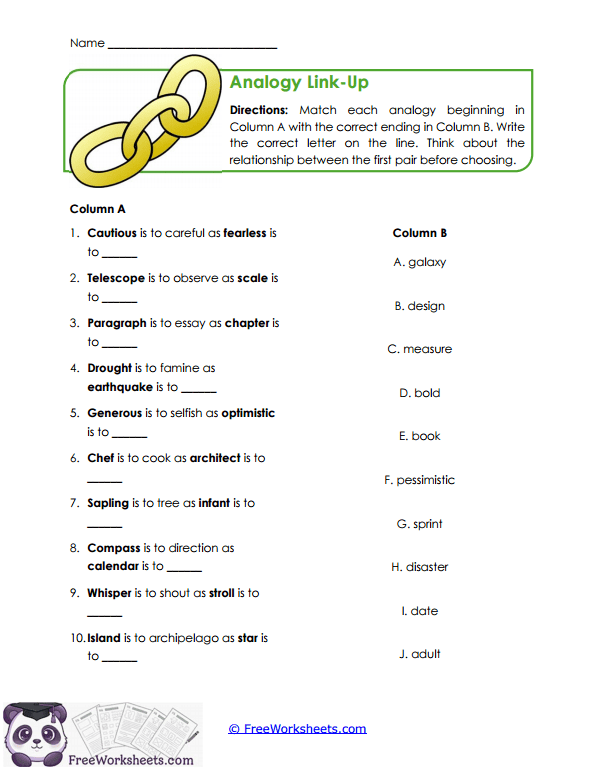
Analogy Link-Up
What Kids Do: Students match ten incomplete analogies in Column A with their appropriate endings from a lettered answer bank in Column B. Each question provides a complete first word pair and an unfinished second comparison, requiring learners to identify the relationship before selecting a matching word. The exercises include meanings, functions, categories, developmental stages, and associations between individual objects and larger collections.
Target Skill: Matching analogy endings reinforces the ability to compare semantic relationships and evaluate whether a proposed word completes a logical pattern. Learners practice using the first pair as evidence while eliminating choices that do not preserve the intended connection. The drought-to-famine and earthquake-to-disaster comparison can also support discussion of cause-and-effect relationships, including why some outcomes are more specific than others.
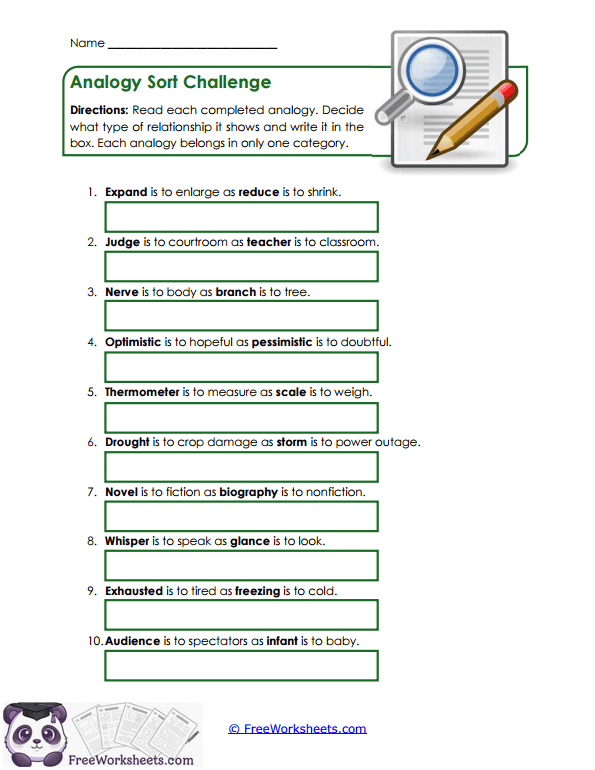
Analogy Sort Challenge
What Kids Do: Ten completed analogies require students to identify and write the relationship type demonstrated by each comparison. Learners examine pairs involving word similarities, occupations and locations, object functions, cause and effect, and differences in intensity. Each exercise includes a large response box where students record an appropriate classification without needing to supply missing vocabulary terms.
Target Skill: Classifying semantic relationships strengthens analytical vocabulary skills and the ability to recognize patterns connecting words. Students practice distinguishing synonyms from degrees of meaning, category membership from part-to-whole relationships, and objects from their associated functions. This emphasis on classification encourages precise explanations of how words connect rather than relying exclusively on familiarity with individual definitions.
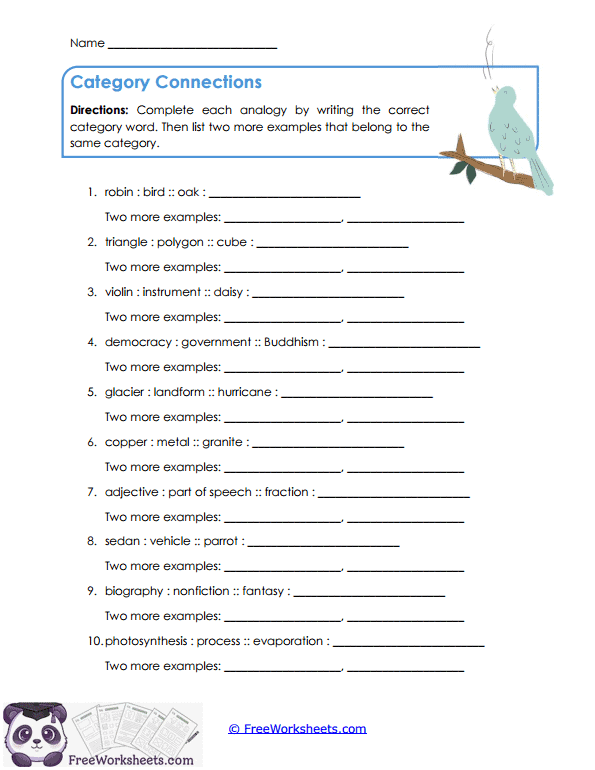
Category Connections
What Kids Do: Learners complete ten analogies by identifying broader categories associated with specific examples, then generate two additional members of each category. Comparisons involving robins and birds, triangles and polygons, and violins and instruments establish the classification patterns students must follow. Each exercise includes a separate response area for the missing category and two more examples, extending the activity beyond basic analogy completion.
Target Skill: Recognizing category membership supports semantic organization and the ability to distinguish specific examples from broader classifications. Students demonstrate their understanding by identifying a category and applying it to additional vocabulary terms. The inclusion of scientific, mathematical, geographical, and literary concepts also reinforces academic word knowledge and encourages learners to justify why their examples belong to the same group.
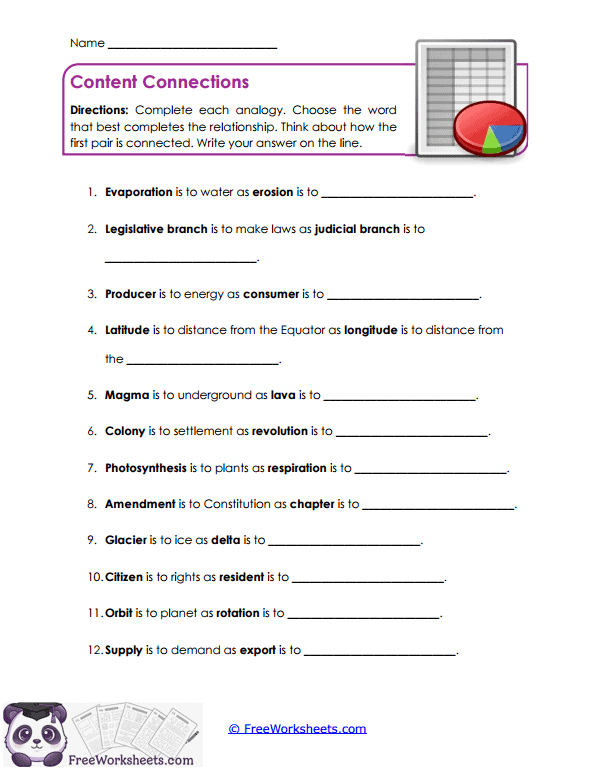
Content Connections
What Kids Do: Twelve incomplete analogies invite students to connect vocabulary from science, geography, history, government, and economics. Learners examine relationships involving evaporation, erosion, legislative and judicial branches, latitude and longitude, photosynthesis, and other academic concepts. Each question provides an open response line, requiring students to use their knowledge of the subject matter to identify a suitable word or phrase.
Target Skill: Applying analogy reasoning to content-area terminology strengthens academic vocabulary comprehension and conceptual connections across subjects. Students practice recognizing relationships involving processes, locations, functions, classifications, and related concepts. Some prompts, particularly those involving producers and consumers or photosynthesis and respiration, should be discussed carefully because their relationships may support different interpretations or require additional scientific clarification.
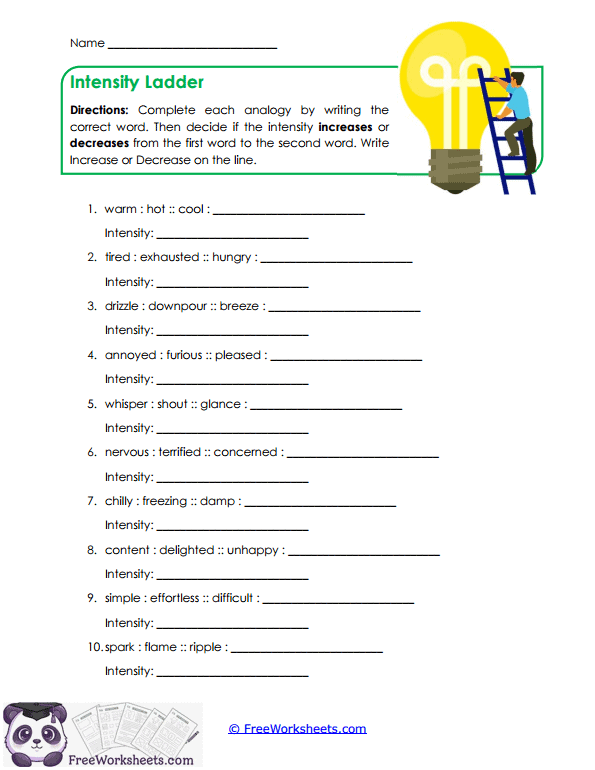
Intensity Ladder
What Kids Do: Ten vocabulary analogies ask learners to supply missing words that maintain a particular change in intensity. Each exercise presents a model relationship, such as warm to hot or tired to exhausted, followed by an incomplete comparison. Students write an appropriate word and then identify whether the intensity increases or decreases, using separate response lines for the completion and classification.
Target Skill: Understanding degrees of meaning helps learners distinguish words that share a general definition but communicate different levels of strength, severity, or emotion. Students examine how changes in vocabulary influence descriptive precision and interpretation. Classifying increases and decreases also encourages them to identify the quality being compared, particularly when the relationship involves abstract concepts such as difficulty, satisfaction, or emotional intensity.
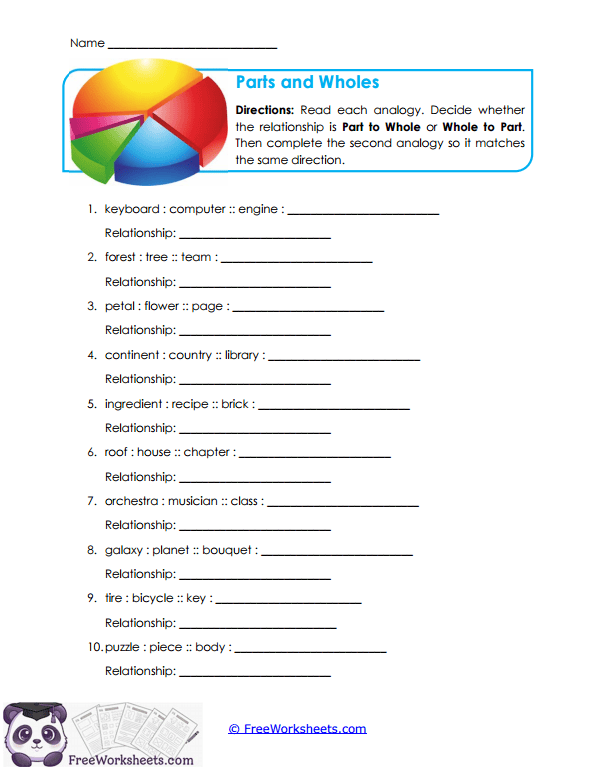
Parts and Wholes
What Kids Do: Students complete ten analogies involving relationships between individual components and larger objects, collections, or systems. Each exercise requires a missing word and a classification indicating whether the comparison moves from Part to Whole or Whole to Part. Examples involving petals and flowers, forests and trees, and keyboards and computers encourage learners to consider both the connection between words and the order in which they appear.
Target Skill: Recognizing part-to-whole relationships strengthens vocabulary organization and the ability to understand how components contribute to larger structures. Learners practice identifying whether a word represents an individual part, a member of a collection, or the larger entity containing those elements. The ingredient-to-recipe comparison also provides an opportunity to distinguish less literal relationships from physical examples such as bricks forming part of a structure.
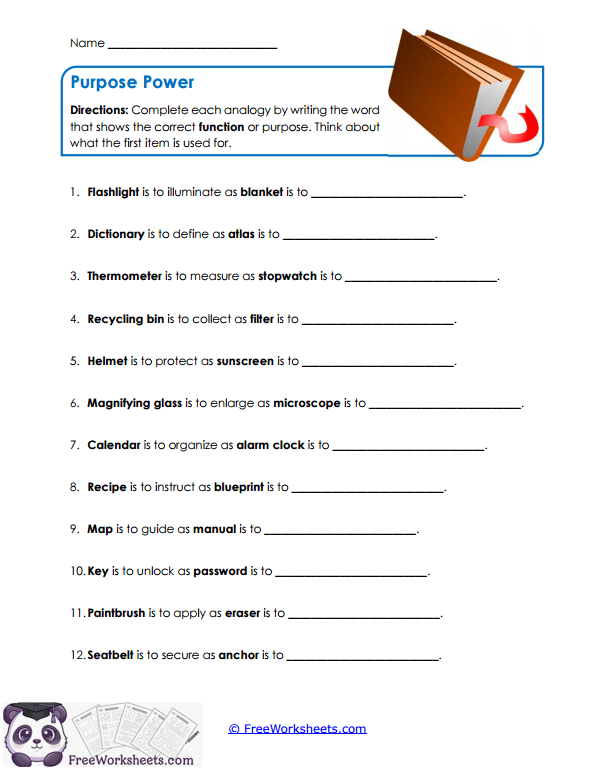
Purpose Power
What Kids Do: Twelve analogies ask learners to identify the function or purpose associated with familiar objects. Students examine comparisons involving flashlights, blankets, dictionaries, thermometers, protective equipment, navigation tools, and other everyday items. Each problem presents an object-to-action relationship and requires an independently generated word that describes the corresponding purpose of the second object.
Target Skill: Connecting objects with their functions develops semantic reasoning and a more precise understanding of action vocabulary. Learners practice interpreting how nouns relate to verbs describing measurement, protection, organization, communication, and other practical purposes. The open-ended responses encourage students to distinguish an object’s intended use from unrelated characteristics while recognizing that more than one verb may accurately describe some functions.
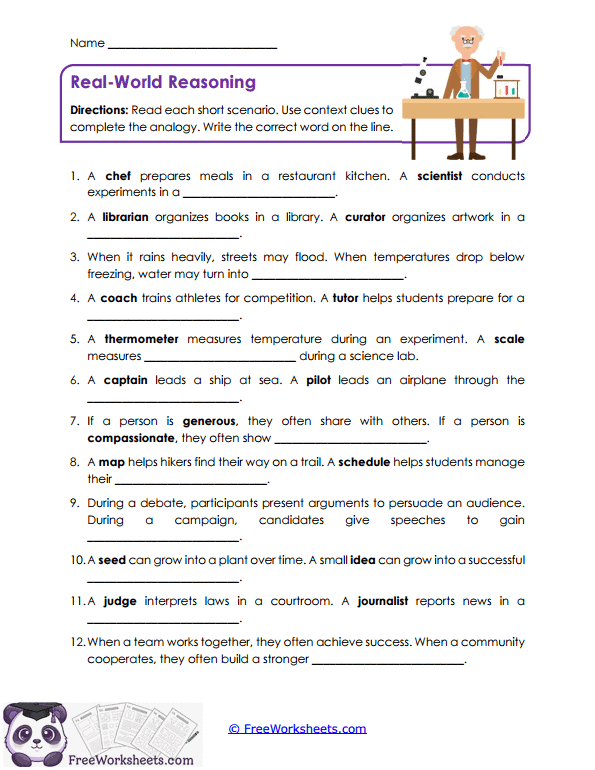
Real-World Reasoning
What Kids Do: Twelve short scenarios require students to complete analogies presented through realistic situations rather than traditional word-pair notation. Learners examine comparisons involving chefs and scientists, librarians and curators, weather conditions, professional responsibilities, and personal qualities. Each exercise includes contextual information that students must interpret before supplying the missing word or phrase that completes the relationship.
Target Skill: Interpreting contextual analogies supports reading comprehension, vocabulary application, and the ability to recognize meaningful connections within written language. Students practice identifying relationships that may involve occupations, workplaces, functions, behaviors, or consequences. The scenario-based format encourages learners to use information across complete sentences and explain why a proposed word fits the relationship rather than simply matching familiar terms.
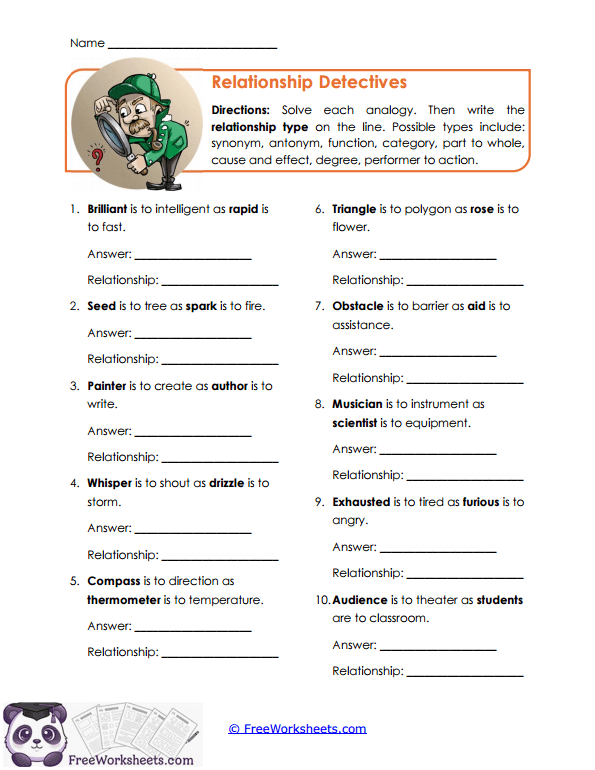
Relationship Detectives
What Kids Do: Ten completed analogies require learners to examine the relationships represented by paired vocabulary terms. The comparisons involve synonyms, antonyms, functions, categories, cause and effect, degrees of intensity, and other semantic connections. Each exercise includes separate Answer and Relationship lines, although the analogies already contain all four terms, so teachers should clarify how students are expected to use the additional Answer spaces.
Target Skill: Analyzing completed analogies develops the ability to identify and describe semantic relationships without relying on missing-word clues. Learners practice distinguishing categories of word connections, recognizing changes in intensity, and explaining how similar patterns appear across different terms. The variety of comparisons encourages precise classification while providing opportunities to discuss relationships that may reasonably fit more than one descriptive category.