
Integers Worksheets
6th grade math integers worksheets help students interpret signed values, compare and order integers, use absolute value, and plot points on coordinate planes. Free, ready-to-print worksheets in PDF format are designed for immediate classroom use, centers, guided practice, homework, or homeschool lessons. Students strengthen integer sense, number-line reasoning, and rational-number understanding while developing skills that support curriculum expectations.
About This Collection of Worksheets
Integers help 6th grade students understand quantities that extend above and below zero. Students learn how positive and negative values describe direction, position, gain, loss, temperature, elevation, and movement. They also build understanding of opposites, absolute value, number-line order, and coordinate-plane location, all of which prepare them for broader work with rational numbers and algebra.
The collection includes number-line plotting, signed real-world situations, opposite values, absolute value, comparisons, ordering, temperature and elevation contexts, error analysis, integer riddles, matching activities, and coordinate-plane plotting. Some worksheets focus on direct skill practice, while others ask students to explain relationships, interpret contexts, or use several integer concepts together.
Teachers can use these worksheets for direct instruction, guided math, centers, homework, intervention, review, or assessment preparation. Parents, tutors, and homeschool educators can begin with signed values and number lines before progressing to comparisons, ordering, absolute value, and coordinate applications. The collection aligns closely with the Grade 6 Number System standards, especially CCSS.MATH.CONTENT.6.NS.C.5, 6.NS.C.6, and 6.NS.C.7.
Paul’s Teacher Tip
Use a number line often when students are first working with negative values because it makes order and distance much easier to see. Remind students that farther right always means greater, even when both numbers are negative. For absolute value, keep the focus on distance from zero rather than on changing signs. When working with real-world situations, ask what zero represents before deciding whether a value should be positive or negative. For coordinate-plane work, have students say “x first, y second” and connect signs with left, right, up, and down movement.
Worksheet Collection Skill Spotlights
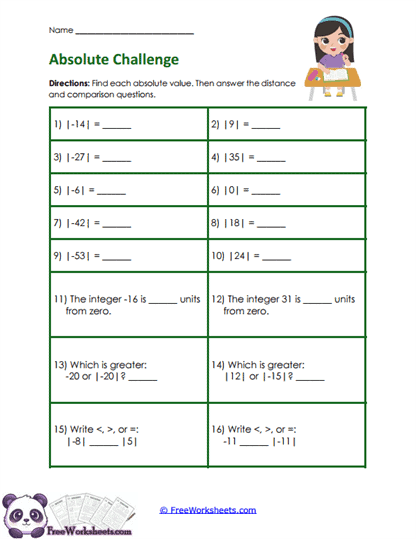
Absolute Distance
What Kids Do: Students evaluate absolute value expressions, determine how far positive and negative integers are from zero, and compare absolute values using greater-than, less-than, and equal symbols. They connect symbolic notation with visual distance on a number line.
Target Skill: This activity develops absolute-value reasoning and directly supports CCSS.MATH.CONTENT.6.NS.C.7.C. 6th grade students learn that absolute value represents distance from zero and therefore remains nonnegative regardless of the original number’s sign.
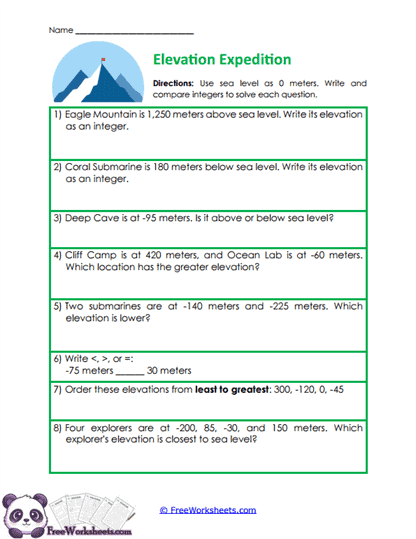
Elevation Reasoning
What Kids Do: Students interpret elevations above and below sea level as positive and negative integers. They compare locations, identify higher and lower elevations, order several values, and determine which position is closest to sea level.
Target Skill: This worksheet applies signed numbers in a real-world context and supports CCSS.MATH.CONTENT.6.NS.C.5 and 6.NS.C.7. Students strengthen understanding of zero as a reference point while comparing, ordering, and interpreting vertical position.
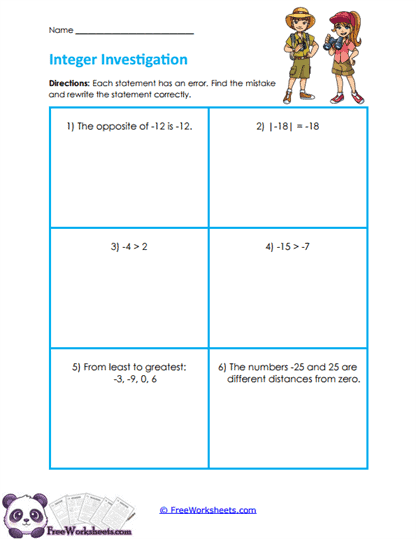
Error Detectives
What Kids Do: Students inspect incorrect statements involving opposites, absolute value, comparison, ordering, and distance from zero. They identify the mistake in each statement and rewrite it so the mathematical relationship becomes correct.
Target Skill: This activity strengthens integer reasoning across several Grade 6 standards, including 6.NS.C.6.A, 6.NS.C.7, and 6.NS.C.7.C. Students practice diagnosing misconceptions and explaining why a signed-number statement is mathematically inaccurate.
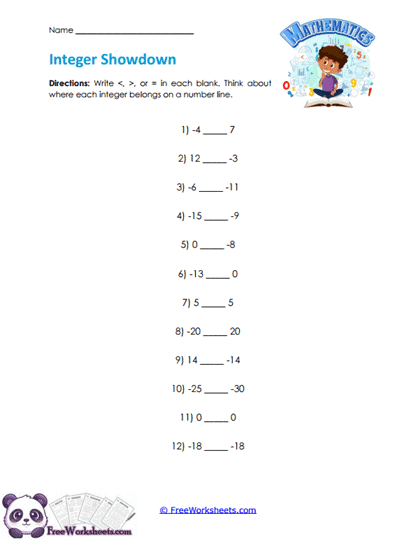
Integer Comparisons
What Kids Do: Students compare pairs of positive integers, negative integers, and zero using greater-than, less-than, or equal symbols. They consider each number’s location on a number line rather than relying only on the visible size of the digits.
Target Skill: This worksheet directly supports CCSS.MATH.CONTENT.6.NS.C.7.A by developing relative-position reasoning. Students learn that numbers farther right are greater and strengthen their ability to compare negative values accurately.
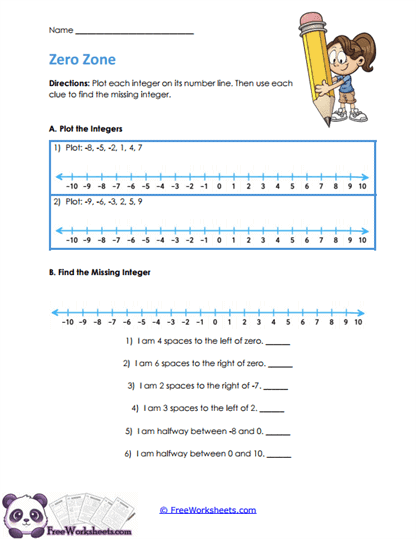
Integer Lines
What Kids Do: Students plot positive integers, negative integers, and zero on number lines and use positional clues to identify missing values. They interpret directions such as left of zero, right of zero, and between two known integers.
Target Skill: This activity supports CCSS.MATH.CONTENT.6.NS.C.6 and 6.NS.C.6.A by helping students understand signed numbers as locations relative to zero. It builds foundational number-line reasoning for later comparison and rational-number work.
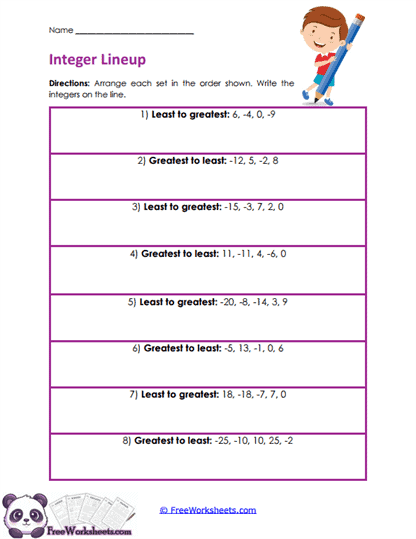
Integer Order
What Kids Do: Students arrange sets of positive integers, negative integers, and zero from least to greatest or greatest to least. They identify the farthest-left and farthest-right values and organize the remaining numbers according to their relative positions.
Target Skill: This worksheet strengthens ordering of rational numbers in alignment with CCSS.MATH.CONTENT.6.NS.C.7. Students practice comparing multiple signed values at once and reinforce the idea that more negative values are farther left and therefore smaller.
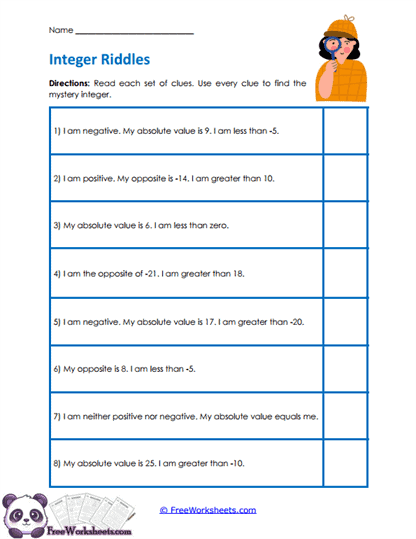
Mystery Integers
What Kids Do: Students solve integer riddles using clues about sign, opposite values, absolute value, distance from zero, and comparisons. They combine multiple conditions and eliminate possibilities until one integer satisfies every clue.
Target Skill: This activity develops multi-step reasoning with signed numbers and reinforces 6.NS.C.6.A, 6.NS.C.7, and 6.NS.C.7.C. Students use relationships among sign, distance, and order rather than relying on one memorized procedure.
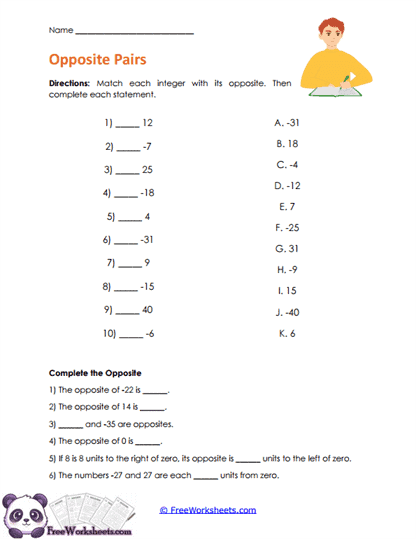
Opposite Values
What Kids Do: Students match integers with their opposites and complete statements about sign changes, number-line positions, and equal distance from zero. They also work backward from a given opposite to identify the original value.
Target Skill: This worksheet directly supports CCSS.MATH.CONTENT.6.NS.C.6.A. Students learn that opposite numbers lie the same distance from zero on different sides of the number line, building a foundation for absolute value and integer operations.
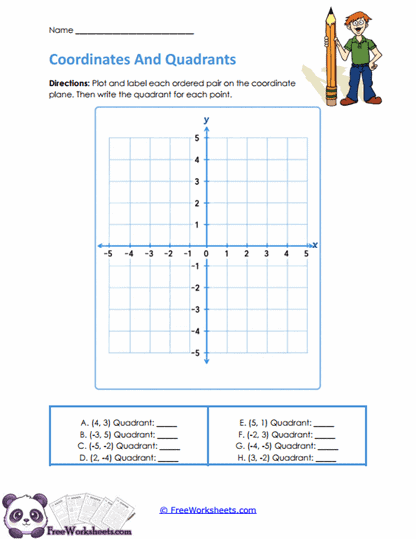
Quadrant Plotting
What Kids Do: Students plot ordered pairs containing positive and negative coordinates on a four-quadrant grid and identify the quadrant containing each point. They move horizontally using the x-coordinate and vertically using the y-coordinate.
Target Skill: This activity supports CCSS.MATH.CONTENT.6.NS.C.6.C by connecting signed numbers with coordinate-plane locations. Students practice using integer signs to determine left-right and up-down movement while reinforcing ordered-pair structure.
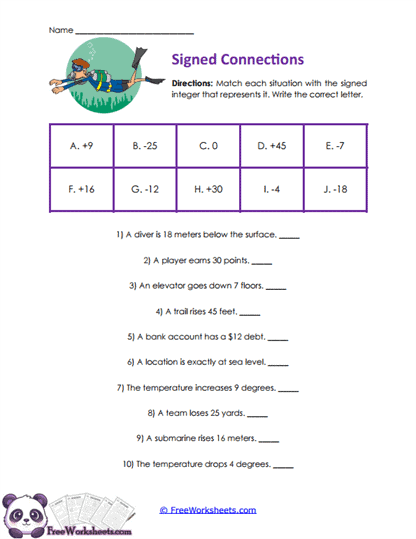
Signed Matches
What Kids Do: Students match everyday situations involving diving, elevators, debt, temperature, rainfall, sports, and movement with the correct positive, negative, or zero value. They interpret directional words before choosing the corresponding signed number.
Target Skill: This worksheet directly supports CCSS.MATH.CONTENT.6.NS.C.5. Students practice translating real-world quantities with opposite directions or meanings into signed numerical representations and strengthen understanding of zero as a reference point.
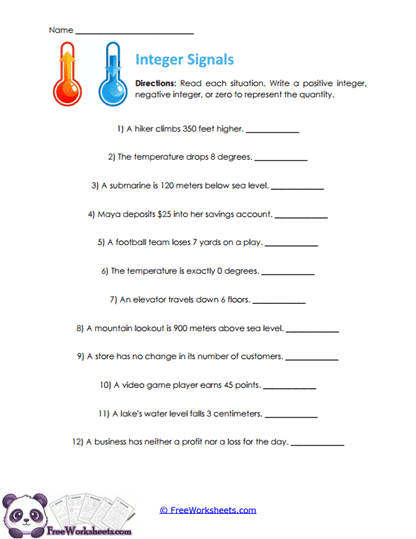
Signed Situations
What Kids Do: Students read short situations involving temperature, elevation, money, sports, and movement and write the integer that represents each one. They decide whether the described quantity belongs above, below, or exactly at a reference value.
Target Skill: This activity builds conceptual understanding of positive and negative numbers in alignment with CCSS.MATH.CONTENT.6.NS.C.5. Students learn that signs represent direction or position relative to a reference point rather than simply “good” or “bad.”
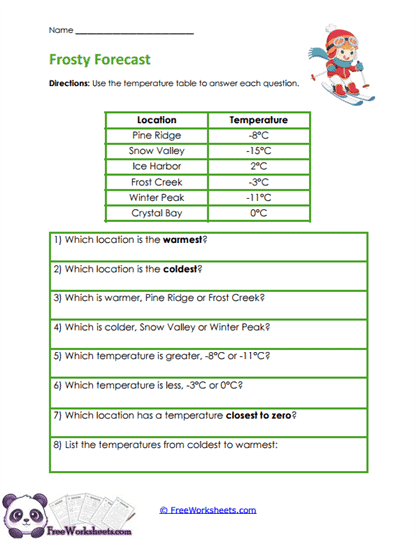
Temperature Trends
What Kids Do: Students analyze a table of winter temperatures that includes negative values, zero, and positive values. They identify warmer and colder locations, compare temperatures, determine which is closest to zero, and order the full set from coldest to warmest.
Target Skill: This worksheet applies integer comparison in a meaningful context and supports CCSS.MATH.CONTENT.6.NS.C.5, 6.NS.C.7, and 6.NS.C.7.A. Students connect signed-number order with temperature and relative position on a number line.