
Homophones Worksheets
Words that sound alike can create confusion when their spellings and meanings are different. These 6th grade homophones worksheets help learners distinguish pairs and groups such as their, there, they're, brake and break, and sight and site. Activities include definition matching, sentence completion, grammar analysis, paragraph editing, and original writing. Teachers can choose focused word-recognition exercises or more challenging proofreading tasks that show whether students can apply homophone knowledge independently.
About This Collection of Worksheets
Homophones are words that share the same pronunciation but differ in meaning and often in spelling. Understanding these distinctions requires students to consider more than how a word sounds, especially when familiar choices such as their, there, and they’re serve different grammatical purposes. Other pairs, including brake and break or sight and site, require learners to recognize differences in meaning that may not be apparent through pronunciation alone. These distinctions become increasingly important in 6th grade as students write longer responses, encounter more complex vocabulary, and are expected to edit their work independently. Developing accurate homophone usage strengthens both reading comprehension and the clarity of written communication.
The activities approach homophones through identification, comparison, sentence construction, and proofreading. Matching exercises connect familiar words with their definitions, while multiple-choice questions and sentence completions require learners to select appropriate spellings using contextual information. Other worksheets ask students to identify parts of speech, compare groups of commonly confused words, and create original sentences demonstrating their meanings. Editing activities provide a more demanding application by requiring learners to locate errors within individual sentences, connected paragraphs, and a realistic field trip email. A mixed language review incorporates capitalization, grammar, and vocabulary alongside homophones, while a reflection activity encourages students to identify their own difficulties and develop strategies for improving accuracy.
Teachers can select worksheets according to the specific homophone difficulties students demonstrate in their reading and writing. Learners who struggle to remember individual meanings may benefit from definition matching or word-chart activities before attempting contextual exercises. Sentence selection provides structured practice with recognizing the correct spelling, while original sentence writing requires students to apply those distinctions without predetermined answers. Paragraph and email editing tasks reveal whether learners can identify errors while also attending to the overall message. Combining a recognition exercise with an independent writing or proofreading task can provide a more complete understanding of whether students can transfer homophone knowledge into everyday communication.

Paul’s Teacher Tip
One effective way to teach confusing homophones is to have students test the meaning of a word by replacing it with a short explanation. For example, when choosing among their, there, and they’re, ask learners whether the sentence expresses ownership, identifies a location, or means “they are.” In “They’re bringing their backpacks over there,” each word serves a different purpose, even though all three sound identical. Have students explain why each spelling fits before writing another sentence using the same group. This strategy encourages learners to rely on meaning and grammatical function rather than pronunciation, making it easier to recognize errors when proofreading their own writing.
Worksheet Collection Skill Spotlights
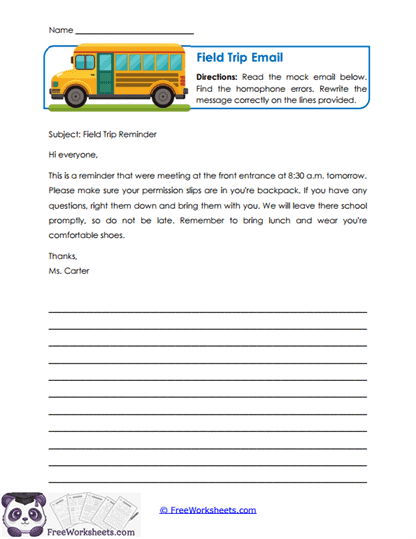
Field Trip Email
What Kids Do: Learners examine a mock email from a teacher reminding students about an upcoming field trip, including meeting times, permission slips, and necessary supplies. The message contains incorrect homophones such as were instead of we’re, you’re instead of your, and right instead of write. Students locate the errors and rewrite the complete email using the correct words while preserving its original message. The phrase “leave there school” also requires clarification because “leave our school” is more natural than changing there to their in a message written from the teacher’s perspective.
Target Skill: Proofreading an authentic communication format reinforces homophone accuracy, grammatical awareness, and attention to written clarity. Students practice identifying possessive forms, contractions, and action words by considering the meaning of complete sentences. Rewriting the email encourages learners to apply their corrections consistently while maintaining appropriate organization, punctuation, and a clear informational purpose.
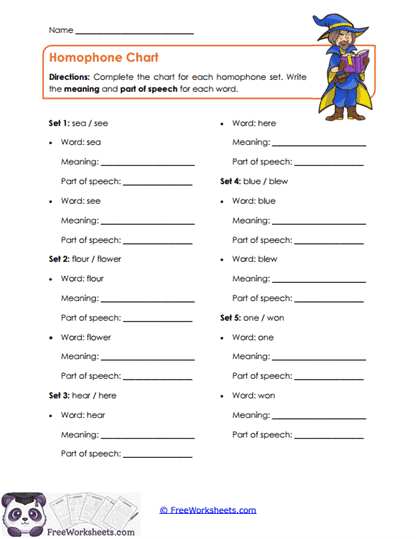
Homophone Chart
What Kids Do: Five homophone pairs are presented in a structured chart that asks learners to identify each word’s meaning and part of speech. Students examine sea and see, flour and flower, hear and here, blue and blew, and one and won. Separate response lines require definitions and grammatical classifications for every word, encouraging students to distinguish the meanings of similar-sounding terms. Teachers should accept contextually supported grammatical classifications for flexible words such as blue and one, which can serve different functions depending on their usage.
Target Skill: Connecting word meanings with grammatical functions develops a more complete understanding of homophones and how they operate within sentences. Students practice distinguishing nouns, verbs, adjectives, and other word classes while recognizing that pronunciation does not determine meaning. Analyzing both definition and part of speech supports more accurate word selection when reading, writing, and editing.
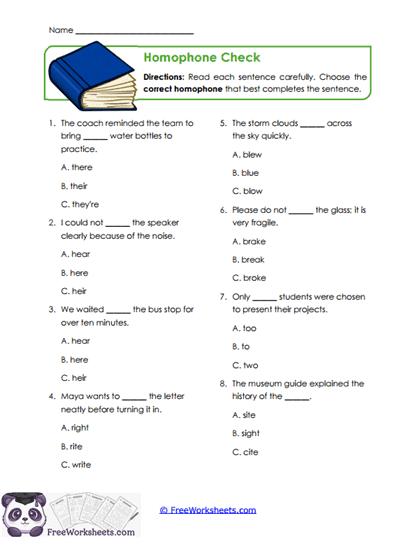
Homophone Check
What Kids Do: Eight multiple-choice sentences require students to choose the correctly spelled homophone from three lettered options. The questions include distinctions involving their and there, hear and here, blew and blue, brake and break, and site and sight. Learners examine classroom, transportation, weather, and museum scenarios to determine which word fits each sentence. Before use, question three should be revised to include the missing preposition in “We waited ___ the bus stop,” and question five needs a time clue to distinguish blew from blow.
Target Skill: Evaluating homophones within complete sentences strengthens spelling accuracy, grammatical reasoning, and contextual vocabulary comprehension. Students practice recognizing how ownership, location, actions, and other relationships determine the appropriate word choice. Comparing several answer options also develops attention to subtle distinctions that may not be apparent when words are considered only by their pronunciation.
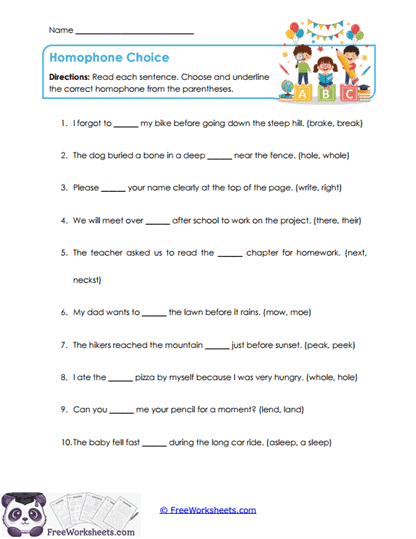
Homophone Choice
What Kids Do: Ten sentence-completion questions ask learners to select the correct word from two options printed in parentheses. The exercises feature pairs such as brake and break, hole and whole, write and right, there and their, and peak and peek. Students read each sentence, determine the intended meaning, and underline the appropriate choice. Some items also feature similarly pronounced words rather than exact homophones, providing additional practice with vocabulary distinctions.
Target Skill: Selecting accurate spellings through sentence context reinforces vocabulary knowledge and the relationship between meaning and written language. Students practice recognizing how two words can sound alike while representing different actions, objects, locations, or grammatical functions. The exercises encourage learners to evaluate the complete sentence instead of making decisions based exclusively on familiar pronunciations.
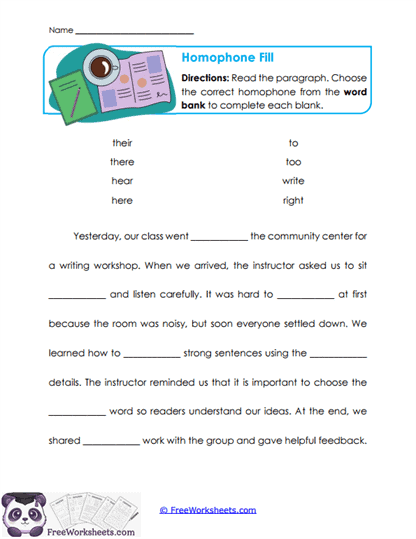
Homophone Fill
What Kids Do: Students complete a paragraph about a class attending a community center writing workshop using a supplied homophone bank. The narrative contains seven blanks involving words such as to, hear, write, right, here, there, and their. Learners select words that fit the grammatical structure and overall meaning of the passage. Teachers should clarify that right is naturally used in two blanks, that “sit ___” may accept here or there, and that “we shared ___ work” naturally calls for our, which is absent from the printed word bank.
Target Skill: Applying homophones within connected writing develops vocabulary comprehension and the ability to maintain consistent meaning across several sentences. Students practice distinguishing words associated with location, movement, listening, writing, and correctness. The paragraph format requires learners to consider both individual sentence clues and the broader narrative rather than treating each vocabulary choice as an unrelated exercise.
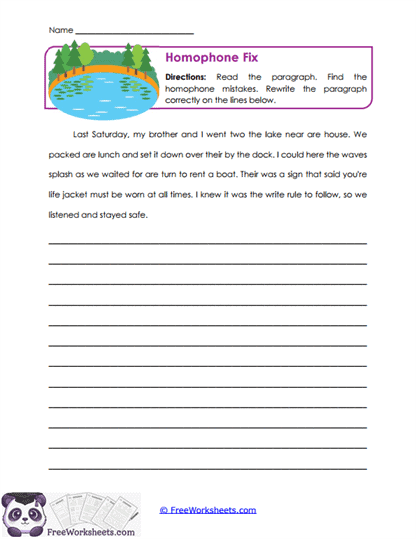
Homophone Fix
What Kids Do: A short narrative describes a family visiting a lake, waiting near a dock, renting a boat, and following safety instructions. The passage contains several incorrect homophones, including two instead of to, are instead of our, here instead of hear, and you’re instead of your. Students identify the mistakes and rewrite the complete paragraph correctly on the provided writing lines. Repeated errors involving the same word pair encourage learners to check their corrections consistently throughout the passage.
Target Skill: Editing connected text reinforces accurate homophone selection, spelling awareness, and proofreading habits. Learners must recognize when a word is correctly spelled but communicates the wrong meaning within its sentence. Rewriting the complete passage provides additional practice with grammatical accuracy, sentence structure, and preserving the intended message while correcting vocabulary errors.
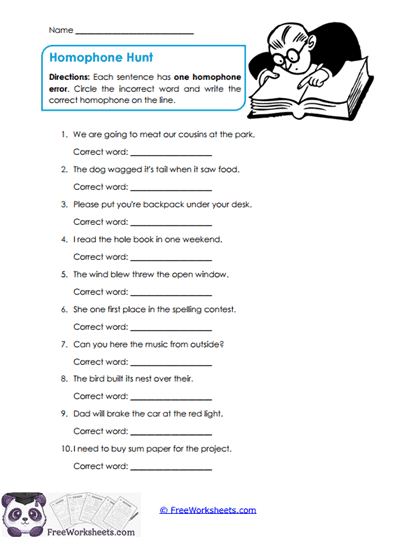
Homophone Hunt
What Kids Do: Ten numbered sentences challenge learners to identify incorrect homophones and replace them with their appropriate counterparts. Students encounter examples such as meat instead of meet, it’s instead of its, you’re instead of your, and threw instead of through. Each exercise provides a separate Correct word line for recording the replacement after identifying the mistake. The ninth sentence already uses brake correctly in “Dad will brake the car at the red light,” so teachers should revise that item to contain a genuine homophone error before assigning it.
Target Skill: Locating incorrectly used homophones strengthens vocabulary precision and sentence-level proofreading. Students practice using contextual meaning to distinguish words that share pronunciations but have different grammatical roles or definitions. The two-step process of identifying an error and supplying its correction encourages careful examination of written language instead of relying on how a sentence sounds when read aloud.
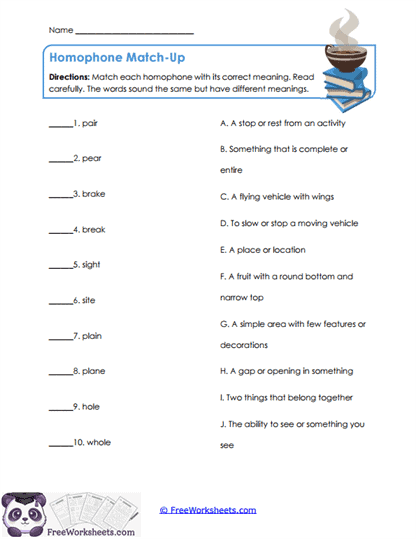
Homophone Match-Up
What Kids Do: Ten homophones must be matched with their corresponding definitions from a lettered answer bank. The vocabulary includes five pairs: pair and pear, brake and break, sight and site, plain and plane, and hole and whole. Students examine meanings associated with objects, actions, qualities, and locations before recording the correct definition letter beside each word. The matching format allows learners to focus on recognizing meaning without requiring original sentence construction.
Target Skill: Connecting homophones with precise definitions builds foundational vocabulary knowledge and spelling recognition. Students practice distinguishing familiar same-sounding words by considering what each spelling represents. Understanding these individual meanings provides a useful foundation for later activities requiring learners to select appropriate homophones within complete sentences or correct errors in connected writing.
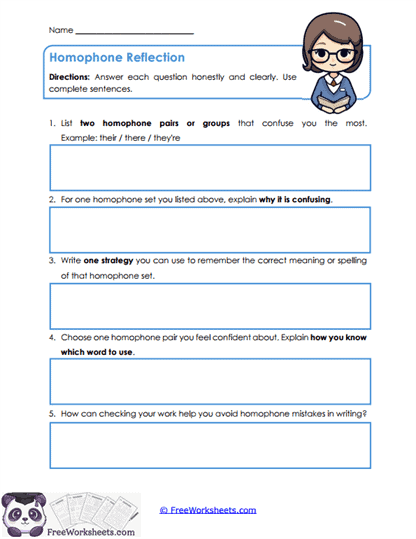
Homophone Reflection
What Kids Do: Five open-ended questions ask learners to evaluate their own understanding of commonly confused homophones. Students identify two difficult word pairs or groups, explain why one is confusing, and describe a strategy for remembering the correct spelling or meaning. They also identify a homophone pair they feel confident using and explain how proofreading can help prevent mistakes. Large response boxes provide space for thoughtful explanations rather than short selected answers.
Target Skill: Reflecting on vocabulary difficulties encourages metacognitive awareness and the development of practical spelling strategies. Learners practice identifying whether confusion results from similar pronunciations, unfamiliar meanings, or grammatical differences. Explaining a memory strategy and recognizing successful word choices can help students develop more deliberate approaches to checking homophones in their own writing.
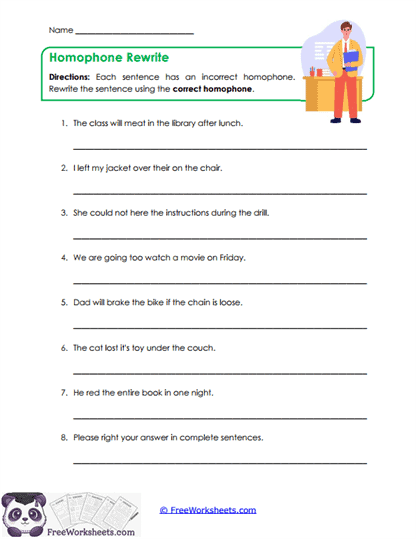
Homophone Rewrite
What Kids Do: Eight sentences require students to identify incorrectly used homophones and rewrite each statement accurately. The exercises involve distinctions such as meat and meet, their and there, hear and here, and too and to. Learners write corrected versions on separate lines, preserving the intended meaning while repairing the word choice. Teachers should revise question five, “Dad will brake the bike if the chain is loose,” and question seven, “He read the entire book in one night,” because both sentences are already correct despite directions stating that every sentence contains a homophone error.
Target Skill: Rewriting sentences with accurate homophones reinforces spelling proficiency, grammatical awareness, and editing skills. Students must identify the intended meaning of each statement and determine which spelling communicates that meaning correctly. Producing complete corrected sentences also encourages attention to capitalization, punctuation, and overall sentence clarity alongside vocabulary accuracy.
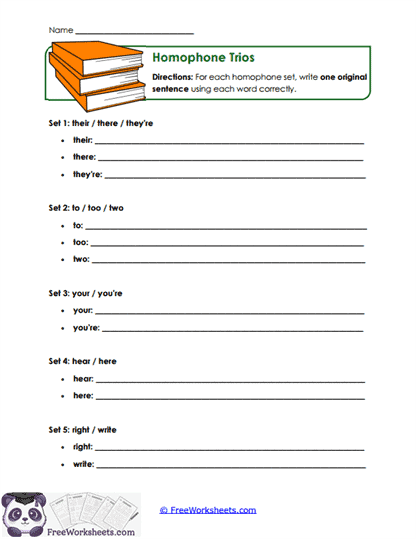
Homophone Trios
What Kids Do: Five groups of homophones challenge learners to create original sentences demonstrating the meaning of each word. The first two groups contain their, there, they’re and to, too, two, while the remaining groups feature your and you’re, hear and here, and right and write. Students write twelve individual sentences, using each spelling in a context that makes its meaning clear. The activity does not provide model sentences or answer choices, requiring learners to apply their vocabulary knowledge independently.
Target Skill: Constructing original sentences develops expressive vocabulary knowledge and accurate grammatical usage. Students practice distinguishing possessive forms, contractions, location words, numerical expressions, and actions that share pronunciations. The open-ended format requires learners to demonstrate how meaning determines spelling rather than simply recognize the correct word among predetermined options.
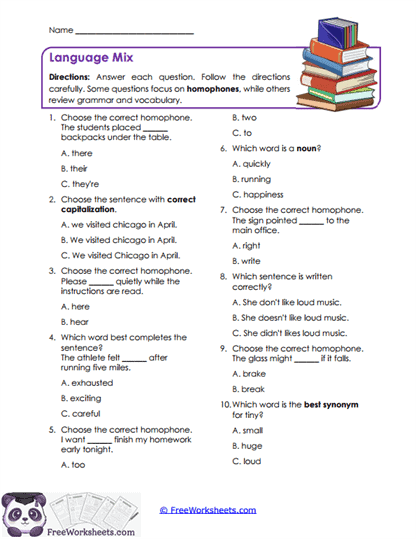
Language Mix
What Kids Do: Ten multiple-choice questions combine homophone practice with capitalization, grammar, parts of speech, and vocabulary review. Students select appropriate words in sentence completions, identify correctly capitalized statements, recognize a noun, check subject-verb agreement, and choose a synonym for tiny. The exercises include familiar homophone distinctions such as their and there, to and two, and right and write. Before assigning the activity, question three should be rewritten because none of here, hear, or her correctly completes the printed sentence, and question six should be clarified because running can function as a noun even though happiness is the intended response.
Target Skill: Reviewing several language conventions together reinforces flexible grammatical reasoning and accurate vocabulary usage. Students practice identifying which type of language knowledge a question requires before selecting an answer, rather than treating every problem as a homophone exercise. The mixed format supports proofreading readiness by encouraging learners to evaluate spelling, sentence structure, capitalization, grammatical function, and word meaning.