
About This Worksheet
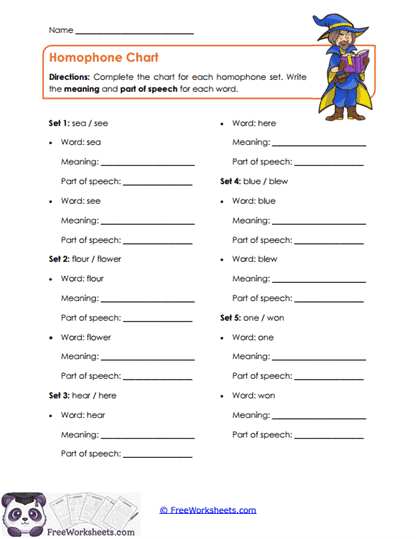
Homophone Chart encourages students to investigate how words with identical pronunciations can have different meanings and grammatical functions. This 6th grade vocabulary worksheet organizes five homophone pairs into a structured word-analysis activity requiring definitions and parts of speech. The featured pairs include sea and see, flour and flower, hear and here, blue and blew, and one and won. By examining both semantic and grammatical differences, learners develop a more complete understanding of how homophones function within English vocabulary.
Curriculum and Grade Alignment
Analyzing homophones through meaning and grammatical classification supports vocabulary development, spelling accuracy, and language conventions within the 6th grade curriculum. Students practice distinguishing nouns, verbs, adverbs, adjectives, and numerical expressions while considering how different spellings communicate different ideas. The activity reinforces relationships between vocabulary meaning and grammatical function, particularly with pairs such as hear and here or blue and blew. This approach provides supporting practice for choosing appropriate word forms when constructing sentences and interpreting written language.
Student Tasks
Learners complete a chart containing five sets of homophones, with each set presenting two words that share the same pronunciation. For every word, students write a definition and identify its part of speech on the corresponding response lines. For example, sea can be defined as a large body of salt water and classified as a noun, while see describes the action of perceiving something with the eyes and functions as a verb. Students repeat this process for flour and flower, hear and here, blue and blew, and one and won, examining how each spelling affects meaning and grammatical use.
Common Challenges and Misconceptions
Students may understand the different meanings of a homophone pair but struggle to identify the grammatical function of each word. This becomes particularly challenging when a word can serve more than one part of speech depending on its use in a sentence. For example, blue can function as an adjective or a noun, while one can operate as a numeral, determiner, or pronoun. Providing a short example sentence for words with multiple grammatical functions can help learners make accurate classifications without treating one possible answer as universally correct.
Implementation Guidance
Begin by comparing sea and see, asking learners to explain how the first names a body of water while the second describes an action. Demonstrate how a word’s meaning can help identify its part of speech, then introduce a short sentence to verify the classification. Because the worksheet presents the words without sentence context, clarify that some terms have multiple valid grammatical classifications and accept answers supported by an appropriate example. For additional practice, invite learners to write one sentence for each homophone pair that demonstrates both words being used correctly.
Details and Features
The worksheet contains five labeled homophone sets arranged in two columns, with each set identifying a pair of same-sounding words. Every individual word has two response lines labeled Meaning and Part of speech, creating a consistent structure for vocabulary analysis. The pairs represent several grammatical combinations, including nouns and verbs, words with flexible grammatical roles, and expressions relating to numbers. Unlike matching or multiple-choice exercises, this activity requires students to independently generate definitions and identify grammatical classifications without a printed answer bank.