
About This Worksheet
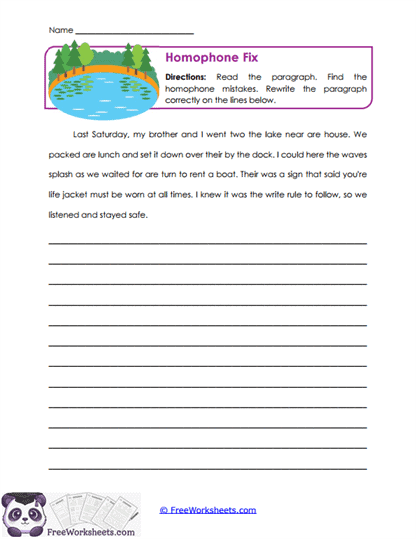
Homophone Fix challenges learners to apply their understanding of commonly confused words while editing an entire paragraph. This 6th grade vocabulary worksheet presents a short narrative about a family visiting a lake, preparing to rent a boat, and following safety instructions near the water. Several homophones have been deliberately used incorrectly throughout the passage, requiring students to interpret the surrounding context and determine the appropriate replacements. Unlike isolated sentence exercises, this activity asks learners to maintain accuracy across connected writing while producing a corrected version of the complete paragraph.
Curriculum and Grade Alignment
Editing homophones within a continuous passage supports spelling accuracy, vocabulary comprehension, and written language conventions in 6th grade. Students practice recognizing distinctions between words such as to and two, our and are, there and their, and your and you’re. The activity reinforces the importance of considering meaning and grammatical structure when choosing between words that sound alike. Rewriting the paragraph also provides practical proofreading experience by requiring learners to incorporate corrections while preserving sentence meaning, organization, and readability.
Student Tasks
Learners read a paragraph describing a Saturday trip to a lake and identify homophones that do not fit the intended meaning of the sentences. They must recognize errors such as “went two the lake,” “near are house,” and “I could here the waves,” then determine the correct words using contextual information. Additional mistakes involve references to the family’s lunch, the location of their belongings, the boat rental, and instructions about wearing life jackets. After locating the incorrect homophones, students rewrite the entire paragraph correctly on the writing lines provided beneath the passage.
Common Challenges and Misconceptions
Students may identify obvious homophone mistakes while overlooking repeated errors involving the same pair of words. The passage uses are where our is needed in several locations, requiring learners to recognize the possessive meaning consistently throughout the narrative. Other mistakes, such as their instead of there or you’re instead of your, involve grammatical distinctions that may be difficult to detect when reading quickly. Reviewing each sentence for its intended meaning and checking possessive expressions, contractions, and location words can help learners identify corrections more reliably.
Implementation Guidance
Begin by reading the paragraph aloud and asking students whether any words sound unusual, then explain why reading aloud alone may not reveal homophone errors. Model the correction of “went two the lake” to “went to the lake,” emphasizing how the grammatical context determines the appropriate spelling. Encourage students to mark all suspected errors in the original passage before rewriting it, then check their revised version for complete sentences, punctuation, and correct homophone usage. For additional practice, invite learners to compare their corrected paragraphs with a partner and explain why each replacement communicates the intended meaning more accurately.
Details and Features
The worksheet contains one continuous narrative paragraph positioned beneath the Homophone Fix title and a short set of editing directions. The passage describes a family outing involving a dock, waves, a rented boat, and a posted life jacket rule, providing a familiar setting for interpreting word meanings. Multiple incorrect homophones appear throughout the paragraph, including repeated mistakes involving are and our, and no word bank or answer choices are supplied. Ten horizontal writing lines beneath the reading provide space for rewriting the complete corrected passage rather than recording individual word substitutions.