
About This Worksheet
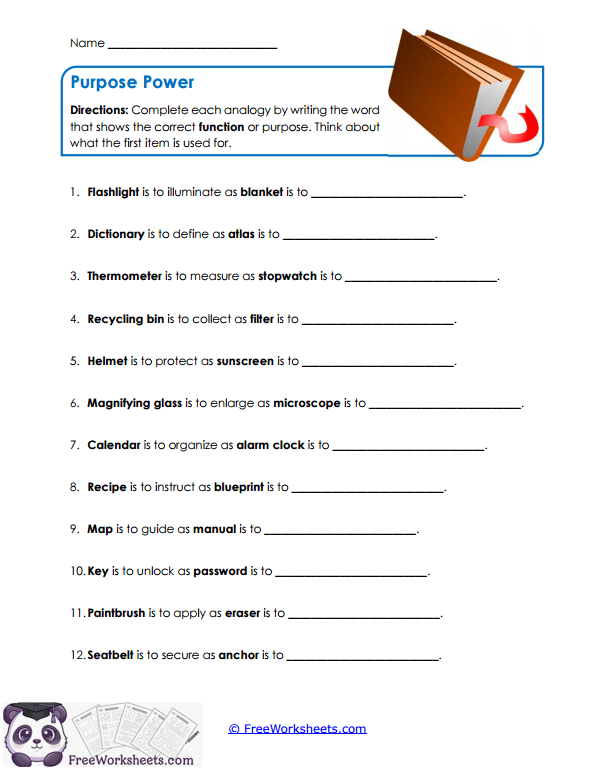
Purpose Power focuses on understanding the functions and intended uses of familiar objects through verbal analogies. This 6th grade vocabulary worksheet presents twelve incomplete comparisons that connect everyday items with the actions they perform or the purposes they serve. Students examine relationships involving tools, protective equipment, reference materials, and organizational devices to determine an appropriate missing word. By concentrating on functional relationships, the activity encourages learners to move beyond simple word definitions and consider how objects are used in practical situations.
Curriculum and Grade Alignment
Recognizing functional relationships supports vocabulary development, semantic reasoning, and language comprehension within the 6th grade curriculum. Students practice identifying how an object’s purpose connects to an action, reinforcing their understanding of verbs and the meanings associated with familiar nouns. The exercises incorporate vocabulary related to measurement, protection, navigation, communication, organization, and everyday technology. These relationships support broader language skills by helping learners interpret descriptions of objects, understand contextual clues, and explain the connections between words and their functions.
Student Tasks
Learners complete twelve numbered analogies by writing a word that identifies the function or purpose of the second object. Each exercise provides a complete first comparison and an incomplete second comparison, requiring students to recognize the functional relationship before supplying an answer. For example, “Flashlight is to illuminate as blanket is to ____” asks learners to identify how a blanket serves a purpose comparable to a flashlight’s function of providing light. Other questions involve dictionaries and atlases, thermometers and stopwatches, helmets and sunscreen, maps and manuals, and keys and passwords.
Common Challenges and Misconceptions
Students may recognize an object’s general purpose but have difficulty selecting a verb that precisely expresses the intended relationship. Some objects serve several functions, which can lead to different reasonable answers when no word bank is available. Comparisons involving a key and password or a recycling bin and filter may require more careful consideration because the objects operate differently despite serving related purposes. Encouraging learners to express each relationship as “This object is used to…” can help them identify functional similarities without becoming distracted by unrelated characteristics.
Implementation Guidance
Begin by discussing the relationship between a flashlight and the action illuminate, emphasizing that the analogy connects an object with its primary function. Ask learners to apply the same reasoning to a blanket, considering which action best describes its purpose in the comparison. For students who need additional vocabulary support, provide examples of common objects and invite them to identify the verbs associated with their uses before attempting the worksheet independently. During review, encourage students to explain their choices and accept alternative responses when the proposed word accurately preserves the functional relationship established by the first pair.
Details and Features
The worksheet contains twelve numbered analogies arranged in a single vertical column with a dedicated response line for each completion. Each question follows a consistent sentence structure that explicitly connects an object with an action or purpose, making the intended relationship type clear. Important nouns and verbs are emphasized in bold, drawing attention to the vocabulary terms students must compare. The activity includes no word bank or multiple-choice answers, allowing learners to generate their own functional vocabulary while working with a broad selection of familiar tools, devices, and everyday objects.