
About This Worksheet
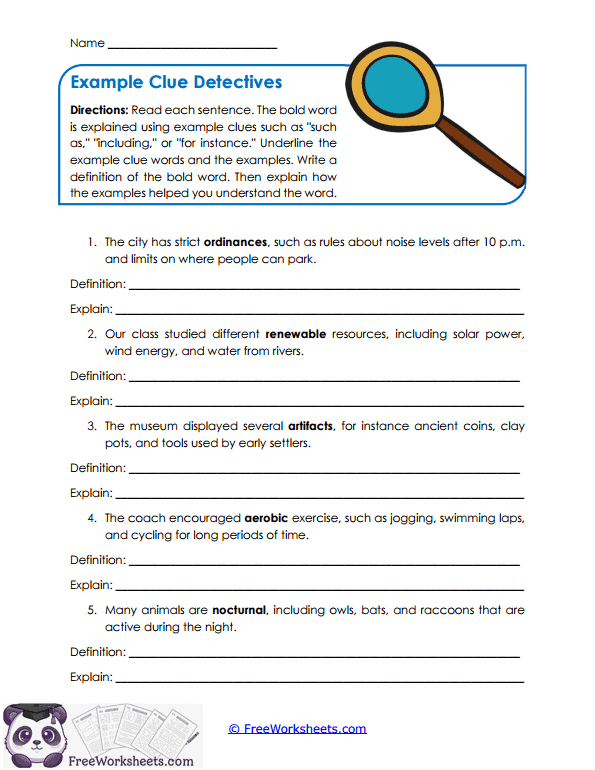
Example Clue Detectives teaches students how examples within a sentence can reveal the meaning of unfamiliar vocabulary. This 6th grade vocabulary worksheet presents five sentences containing bold academic words explained through contextual examples introduced by phrases such as “such as,” “including,” and “for instance.” Learners examine these examples to construct definitions and explain how the surrounding information supports their interpretations. The activity emphasizes recognizing example-based context clues as a specific strategy for understanding unfamiliar words in informational and descriptive texts.
Curriculum and Grade Alignment
Recognizing example clues supports vocabulary development, informational reading comprehension, and evidence-based reasoning within the 6th grade language arts curriculum. Students practice identifying signal phrases that introduce examples and connecting those examples to the meanings of unfamiliar terms. The featured vocabulary includes ordinances, renewable, artifacts, aerobic, and nocturnal, providing opportunities to interpret terminology from government, science, history, and everyday contexts. This focused practice reinforces the ability to use explanatory details within a sentence to develop accurate word meanings without relying exclusively on dictionary definitions.
Student Tasks
Learners read five numbered sentences containing bold vocabulary words and identify the examples that help explain each term. They underline both the phrases introducing the examples and the examples themselves before writing a definition on the designated response line. For instance, the sentence about artifacts describes ancient coins, clay pots, and tools used by early settlers, helping students understand that artifacts are objects connected to human activity in the past. After defining each word, students write a separate explanation describing how the examples helped them determine its meaning.
Common Challenges and Misconceptions
Students may recognize signal phrases such as “including” without understanding how the examples that follow clarify the target word. Some learners might also mistake an individual example for a complete definition, such as defining ordinances only as parking restrictions rather than recognizing them as rules or laws. Academic terms like renewable and aerobic may require additional reasoning because the examples share an underlying characteristic that is not directly stated. Encouraging students to identify what the listed examples have in common can help them construct broader, more accurate definitions.
Implementation Guidance
Begin with the sentence containing ordinances and ask students to identify the words that introduce the examples of noise restrictions and parking regulations. Demonstrate how these examples suggest that ordinances are rules or laws established by a local government. Encourage learners to underline the introductory phrase and supporting examples separately, then explain how the examples connect to their proposed definition. For additional practice, students can create original sentences using one of the featured vocabulary words and introduce their own explanatory examples with “such as” or “for instance.”
Details and Features
The worksheet contains five numbered vocabulary sentences arranged vertically, each followed by separate lines labeled Definition and Explain. Target vocabulary words appear in bold within the sentences, while recognizable signal phrases introduce examples that clarify their meanings. The activity incorporates terms associated with government regulations, natural resources, historical objects, physical exercise, and animal behavior. The two-part written response format requires students to demonstrate both vocabulary understanding and an explanation of the contextual evidence supporting their interpretation.