
About This Worksheet
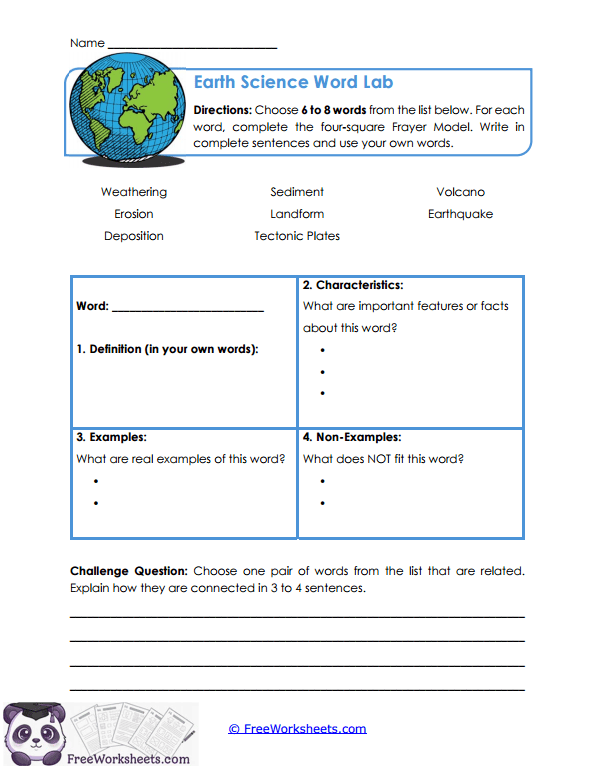
Earth Science Word Lab develops academic vocabulary through a structured word-analysis activity focused on geological processes and features of the planet. This 6th grade vocabulary worksheet uses a four-square Frayer Model to encourage students to explore scientific terms through definitions, characteristics, examples, and non-examples. The word bank includes weathering, erosion, deposition, sediment, landform, tectonic plates, volcano, and earthquake. Rather than simply memorizing definitions, learners examine what distinguishes each concept and how related terms connect within earth science.
Curriculum and Grade Alignment
Understanding domain-specific terminology supports vocabulary development and comprehension of scientific texts within the 6th grade curriculum. The Frayer Model encourages learners to examine multiple dimensions of a word’s meaning, including identifying defining characteristics and distinguishing valid examples from unrelated concepts. Earth science terms such as erosion, weathering, and deposition provide opportunities to recognize relationships between natural processes while maintaining their distinct meanings. This activity supports the interpretation of informational science passages and the accurate use of academic vocabulary when describing geological events and features.
Student Tasks
Students select six to eight vocabulary terms from the provided earth science word bank and complete a four-square Frayer Model for each selected word. Each model requires a definition written in the student’s own words, important characteristics or facts, real examples, and non-examples that do not fit the concept. The directions emphasize complete sentences and original explanations rather than copied dictionary definitions. After completing their vocabulary analysis, learners choose two related terms and write three to four sentences explaining how those concepts are connected.
Common Challenges and Misconceptions
Students may understand a scientific term well enough to provide a basic definition but struggle to distinguish its characteristics from examples. Non-examples can be particularly challenging because learners sometimes choose completely unrelated objects rather than concepts that help clarify meaningful distinctions. Weathering, erosion, and deposition may also be confused because all three involve changes to Earth’s surface, although they describe different processes. Comparing the defining actions and outcomes of these terms can help students develop more accurate explanations and choose stronger examples.
Implementation Guidance
Begin by modeling the Frayer Model with a familiar term such as volcano, demonstrating how its definition, characteristics, examples, and non-examples serve different purposes. Encourage students to explain why each example belongs to the concept and why each non-example does not, rather than simply listing associated words. The printed worksheet contains only one four-square model despite directing students to analyze six to eight terms, so teachers should provide additional copies of the template or separate recording space for the remaining words. For the final challenge, consider pairing weathering with erosion or erosion with deposition to encourage explanations of related scientific processes.
Details and Features
The worksheet displays eight earth science vocabulary terms in a three-column word bank above a large four-quadrant graphic organizer. The Frayer Model includes labeled sections for Definition, Characteristics, Examples, and Non-Examples, with guiding questions and bullet points supporting each type of response. A separate Challenge Question appears beneath the organizer, providing several writing lines for an explanation of how two vocabulary terms relate. The combination of structured vocabulary analysis and a written comparison encourages students to examine individual meanings as well as connections between scientific concepts.