
About This Worksheet
Word Breakdown Lab challenges students to investigate how different word parts contribute to the meanings of complex vocabulary terms. This 6th grade vocabulary worksheet presents five multisyllabic words for analysis through prefixes, roots, and suffixes. Words such as transportation, unpredictable, biography, microscope, and reconstruction introduce meaningful components associated with movement, prediction, writing, observation, and construction. By examining the structure of each word and explaining how its parts work together, learners develop a more detailed understanding of vocabulary formation.
Curriculum and Grade Alignment
Analyzing prefixes, roots, and suffixes strengthens morphological awareness and academic vocabulary comprehension within the 6th grade language arts curriculum. Students practice recognizing meaningful word components and determining how those components influence the definition of a complete term. The activity introduces a mixture of words containing familiar affixes and words formed from Greek or Latin combining elements, offering opportunities to explore different kinds of word construction. Explaining the relationship between word parts and meaning also supports the interpretation of unfamiliar terminology encountered in informational and academic texts.
Student Tasks
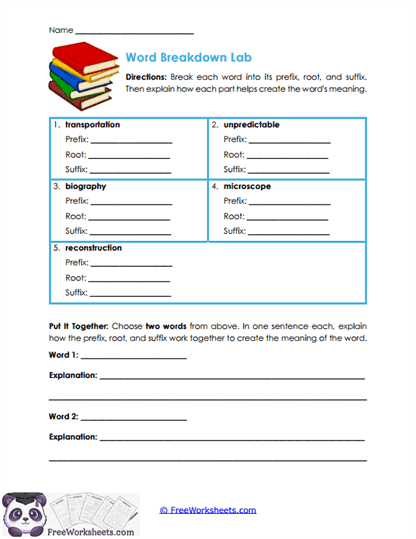
Learners examine five numbered vocabulary words and attempt to identify the prefix, root, and suffix associated with each term. Each word has three labeled response lines where students record the components they identify. For example, transportation can be examined through trans-, port, and -ation, with each component contributing to the word’s overall meaning. After completing the breakdowns, students select two words from the activity and write explanations describing how their meaningful parts combine to create the complete vocabulary terms.
Common Challenges and Misconceptions
Students may assume that every complex word contains exactly one prefix, one root, and one suffix. This can create confusion when analyzing words such as microscope, which contains Greek-derived combining elements that do not fit neatly into all three categories. Learners may also confuse a root with a prefix or identify letter combinations that resemble common affixes but do not function that way in the selected word. Examining the meaning and grammatical role of each proposed component can help students avoid dividing words at arbitrary letter boundaries.
Implementation Guidance
Begin with transportation and demonstrate how trans- contributes the idea of across, port relates to carrying, and -ation forms a noun describing an action or process. Encourage learners to explain what each component contributes before attempting to interpret the entire word. The printed directions require a prefix, root, and suffix for every word, but microscope consists of the combining elements micro- and -scope without a separate conventional suffix, so teachers should clarify that not every response line must contain an independent morpheme. For the final explanations, have students select two words with different structures and describe how their components work together rather than simply restating dictionary definitions.
Details and Features
The worksheet contains five vocabulary-analysis sections arranged inside a large outlined organizer. Each numbered word appears above three response lines labeled Prefix, Root, and Suffix, providing a consistent framework for examining word structure. A concluding Put It Together section asks students to select two of the analyzed words and explain how their components contribute to meaning. Separate spaces for Word 1 and Word 2, along with multiple writing lines, support extended morphological explanations beyond the initial word breakdowns.