
About This Worksheet
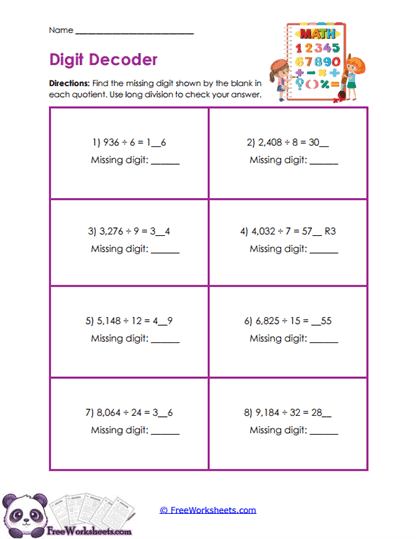
A single missing digit turns each partially completed quotient in Digit Decoder into an answer learners must investigate. The 6th grade math task pairs division expressions with incomplete quotients and asks children to determine the absent digit. For 6,825 divided by 15, the missing hundreds digit is 4 because the quotient is 455. Long division is the required checking method, making the supplied digits clues rather than substitutes for carrying out the calculation.
Curriculum and Grade Alignment
Digit Decoder practices the standard-algorithm component of Common Core 6.NS.B.2 because its directions require long division to check the missing-digit answer. Within 6th grade math, the response format also provides an opportunity to examine how learners track hundreds, tens, and ones in their quotients. Before independent work, check that a child can read a three-digit quotient containing a zero and carry out division with one- and two-digit divisors. A subsequent activity could shift from missing quotient digits to missing dividends or divisors, requiring learners to use the relationship between multiplication and division.
Student Tasks
Learners locate the blank within each partially written quotient and calculate the original division to determine which digit belongs there. They record their selection on the separate “Missing digit” line rather than supplying only an unmarked completed answer. The directions require long division to check that selection. Blanks appear in different positions across the page, so the unknown digit may represent hundreds, tens, or ones.
Common Challenges and Misconceptions
A blank inside a quotient represents one digit, not a separate number to be divided. Guessing from the surrounding digits may produce a plausible-looking answer that does not match the original dividend. The visible zero in one quotient also needs to retain its place value rather than being treated as an unnecessary space. Ask learners to name the missing digit’s position and point to the long-division step that determines its value.
Implementation Guidance
Before assigning the page, correct item 4: it prints “4,032 ÷ 7 = 57_ R3,” although the exact quotient is 576 with no remainder. Removing “R3” preserves the intended missing-digit task and makes 6 the correct entry. In a classroom, ask learners to identify the blank’s place value before checking the calculation. During home review, have the child explain how the written division supports the selected digit instead of accepting an answer based only on the printed pattern. To increase the challenge, cover the supplied quotient digits until the complete calculation is finished.
Details and Features
Eight numbered exercises are arranged in four rows of two magenta-bordered boxes. Each partially completed quotient is followed by a separate line labeled “Missing digit.” The lower portion of each box provides open space for written calculations rather than a preformatted long-division setup. Despite the “Decoder” title, the page contains no letter key or hidden-message activity; the task is to reconstruct numerical answers.