
About This Worksheet
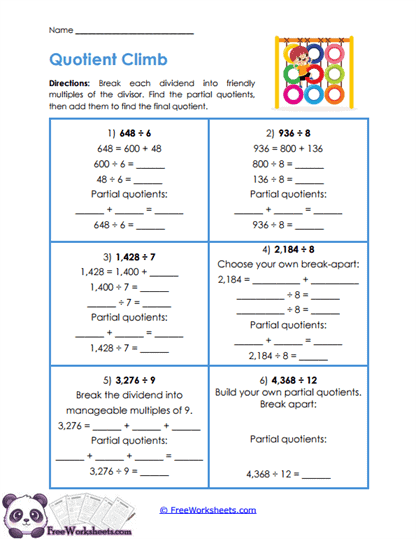
Quotient Climb makes the parts of a division calculation visible before learners combine them into a final answer. In this 6th grade math activity, whole-number dividends are separated into convenient multiples of the divisor, and the resulting partial quotients are added. The opening problem breaks 648 into 600 and 48, so dividing both parts by 6 produces 100 and 8, which total 108. Later questions leave more of the decomposition to the learner, ending with an open setup for 4,368 divided by 12.
Curriculum and Grade Alignment
Within a 6th grade math sequence, this page can serve as a conceptual review of how smaller division calculations contribute to a larger quotient. Its use of number decomposition and properties of operations connects to Common Core 5.NBT.B.6, which addresses division strategies with dividends of up to four digits and divisors of up to two digits. This work provides preparation for 6.NS.B.2, but partial quotients alone do not assess the standard-algorithm fluency specified by that standard. Before assigning the page independently, check whether learners can recognize multiples and rewrite a number as a sum without changing its value. A useful next step is to connect one completed decomposition to the corresponding calculation in standard long division.
Student Tasks
The first two problems ask learners to complete division statements for number breaks already supplied on the page. For 1,428 divided by 7, they fill in the missing addend alongside 1,400 before finding and combining the partial quotients. The next tasks require choosing a two-part decomposition for 2,184 divided by 8 and a three-part decomposition for 3,276 divided by 9. The final workspace leaves the break-apart strategy to the learner, who records partial quotients and a completed answer for 4,368 divided by 12.
Common Challenges and Misconceptions
Some learners may split a number into its written digits without preserving each digit’s place value. Others might choose addends that total the dividend but do not divide conveniently by the divisor. Another possible slip is calculating the partial quotients correctly but recording only one of them as the final answer. Before division begins, ask learners to check that their chunks reconstruct the original dividend and identify a multiplication fact that makes each chunk useful.
Implementation Guidance
Model the opening calculation by describing 600 as one hundred groups of six and 48 as eight more groups of six. When the page reaches the first fully student-chosen decomposition, compare two valid ways to break apart the same dividend. A homeschool lesson could pause here for the child to explain why different chunks still produce the same total number of groups. Offer a list of useful multiples when additional support is needed, or extend the discussion by asking which decomposition makes the mental calculation easiest.
Details and Features
Six blue-bordered workspaces are arranged in two columns. The earlier boxes supply number decompositions and individual division statements, while the last box provides labeled space for a student-generated strategy. Separate partial-quotient and final-answer lines distinguish the smaller calculations from the completed solution. A name line appears above the directions, with a colorful ring illustration beside the heading.