
About This Worksheet
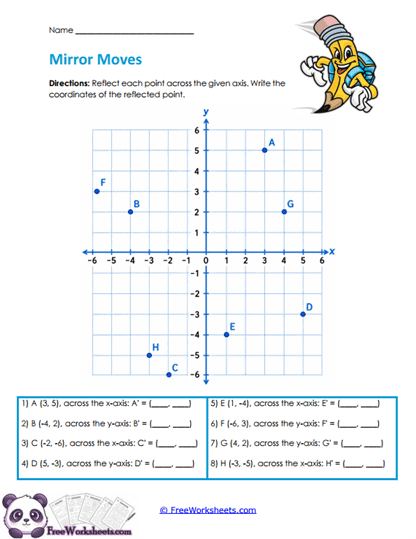
This worksheet teaches students how points change when they are reflected across the x-axis or y-axis. A reflection creates a mirror image by keeping one coordinate the same and changing the sign of the other coordinate. For example, reflecting (3,5)(3,5) across the x-axis becomes (3,-5)(3,-5). This activity helps students connect coordinate signs with movement and symmetry on the coordinate plane.
Curriculum and Grade Alignment
This fifth-grade activity builds on CCSS.MATH.CONTENT.5.G.A.1 by strengthening student understanding of ordered pairs and coordinate relationships. Students should already know how to read positive and negative coordinates in all four quadrants. The next step is using reflections and transformations to describe how figures move on a coordinate plane. This worksheet gives students an early and visual introduction to those transformation ideas.
Student Tasks
On this worksheet, students will study eight labeled points already plotted on a coordinate plane. Each problem tells them whether to reflect the point across the x-axis or y-axis. Students then write the ordered pair for the reflected location. The mix of reflections helps them notice which coordinate changes sign and which one stays the same.
Common Challenges
Students may change both coordinate signs instead of only one. Another common mistake is changing the wrong coordinate when reflecting across a specific axis. Some children also think a reflection means moving the same distance in the same direction rather than crossing over the chosen axis. Teachers can help by drawing a short line from the original point straight across the reflection axis before writing the new coordinates.
Teaching Tips
This page works well after students are comfortable reading points in all four quadrants. A teacher can model one x-axis reflection and one y-axis reflection side by side so students can compare what changes. At home, parents can ask, “Which coordinate stays the same?” before the child writes the reflected point. That question helps students focus on the rule instead of guessing.
Worksheet Features
The worksheet includes eight labeled points spread across the coordinate plane. Each item names the axis of reflection and provides a space for the new ordered pair. The visual graph allows students to check whether the reflected location makes sense. The page is useful for guided practice, homework, intervention, or an introduction to coordinate transformations.