
About This Worksheet
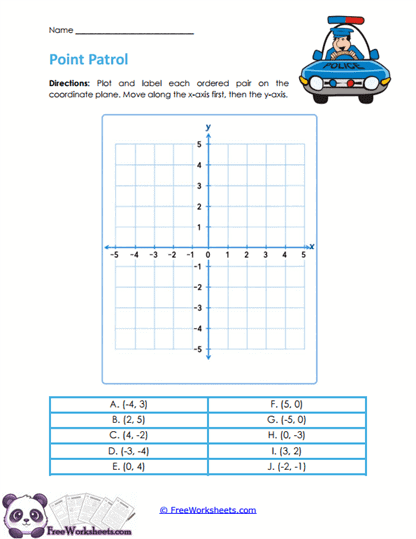
This worksheet turns the skill around and asks students to place ordered pairs onto an empty coordinate plane. Plotting an ordered pair means using the first number to move along the x-axis and the second number to move along the y-axis. For example, (-4,3)(-4,3) means move 4 spaces left and then 3 spaces up before placing the point. Students work with positive numbers, negative numbers, and zero, helping them see how many different locations can be represented on the coordinate grid.
Curriculum and Grade Alignment
This fifth-grade activity supports coordinate-plane understanding and connects with CCSS.MATH.CONTENT.5.G.A.1. The main goal is for students to correctly use two perpendicular axes and understand that the order of the numbers in an ordered pair matters. Before beginning, students should know the difference between the x-axis and y-axis and should be able to read integers on a number line. Once they can confidently plot points, they can move into quadrant classification, coordinate shapes, distance problems, and other geometry activities on the plane.
Student Tasks
On this worksheet, students will plot and label ten ordered pairs on the blank coordinate plane. Each ordered pair is matched with a letter from A through J, so students must place both the point and its correct label. The coordinates include values in all four quadrants as well as points that fall directly on one of the axes. Students therefore practice deciding whether to move left or right for x and up or down for y before marking each location.
Common Challenges
Students sometimes reverse the two coordinates and plot (3,-4)(3,-4) when the problem actually gives (-4,3)(-4,3). Points containing zero can also cause trouble because children may not realize that a zero coordinate places the point directly on an axis. Negative values are another common source of mistakes, especially when students move right instead of left or up instead of down. Teachers can help by having students quietly say, “x first, y second,” every time they plot a new point.
Teaching Tips
A teacher can introduce this page by plotting one positive-positive point and one point containing a negative coordinate as a class. Encourage students to put their pencil at the origin each time before following the ordered pair so they do not accidentally count from the previous point. Parents can use the same method at home and ask, “Where does x take us first?” followed by, “Where does y take us next?” Once the page is complete, have the child choose two plotted points and read their coordinates back to you as an extra check.
Worksheet Features
The worksheet includes a clean coordinate grid with values from negative 5 through positive 5 on both axes. Ten ordered pairs are provided in an easy-to-read table below the graph, leaving plenty of room for students to plot and label each point. The mix includes coordinates with positive values, negative values, and zeros so children practice several types of locations. This makes the page useful for guided lessons, independent practice, homework, or coordinate-plane review.