
About This Worksheet
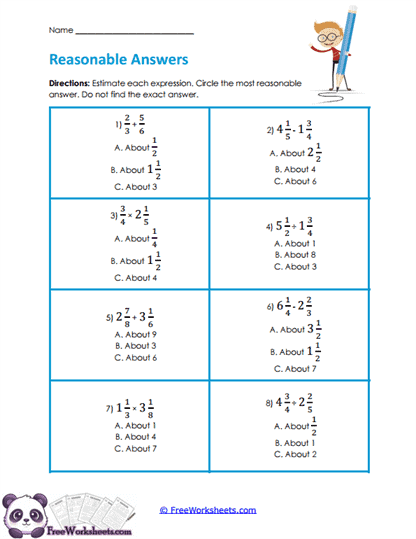
This worksheet helps sixth-grade students use estimation to judge the reasonableness of answers involving fractions and mixed numbers. Instead of solving every expression exactly right away, students first look at the numbers and choose the estimate that makes the most sense. The problems include addition, subtraction, multiplication, and division, so students must think about both the operation and the approximate size of each value. This builds number sense rather than relying only on exact algorithms. It is especially helpful for students who can calculate accurately but do not always notice when an answer is unreasonable.
What Students Practice
Students estimate the value of fraction and mixed-number expressions by using familiar benchmark numbers. They may think of values as being close to zero, one-half, one, two, or another easy whole number before choosing an approximate answer. The multiple-choice format asks them to compare several possible estimates and decide which one fits best. Students then use their knowledge of how each operation affects a quantity to support that decision. This gives them practice with magnitude, benchmarks, operation sense, and reasonableness.
Why This Matters
Estimation gives students a powerful way to check their own fraction work. If an exact calculation produces an answer that is far from the expected estimate, they know they should look for a mistake. This is especially useful with mixed numbers, where conversion or reciprocal errors can lead to answers that look complicated but are clearly too large or too small. Estimation also helps students become less dependent on written procedures for every decision. Over time, it strengthens the mental number sense they will need in algebra, ratios, measurement, and real-world problem solving.
Teaching Tips
Encourage students to replace each fraction with a nearby benchmark before thinking about the operation. For example, a fraction close to one-half can be treated as about one-half, while a mixed number near three can be thought of as about three. Ask students whether the operation should make the result larger, smaller, or somewhere between the starting values. If they choose an unreasonable estimate, have them explain what each number is approximately worth before trying again. You can also follow the activity by having students solve one or two problems exactly and compare the result with the estimate.
Curriculum Standards
This worksheet reinforces the fraction reasoning needed for CCSS.MATH.CONTENT.6.NS.A.1 by asking students to think about the size of fraction quotients and other mixed-operation results. It also builds on earlier fraction computation skills and supports the Standards for Mathematical Practice through estimation and reasonableness. The activity is useful as a warm-up, review page, intervention tool, or mental-math exercise. It can also help teachers identify students who know procedures but need stronger fraction number sense. That makes it a valuable companion to exact computation practice.