
About This Worksheet
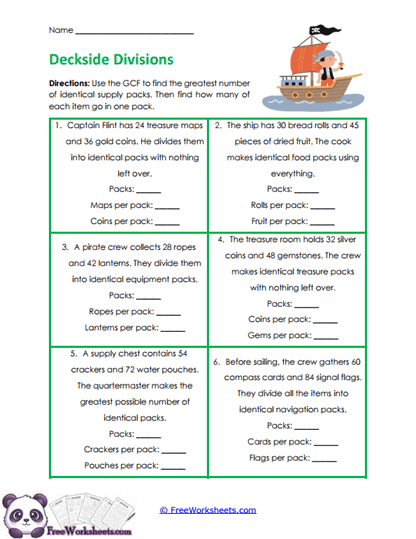
This worksheet helps sixth-grade students apply greatest common factor reasoning to equal-group situations with a pirate theme. Students work with quantities such as maps, coins, food, ropes, lanterns, gems, crackers, compasses, and flags. In each problem, they find the greatest number of identical packs that can be made with nothing left over. The activity gives GCF a clear real-world meaning by connecting it to fair and equal grouping. It is especially helpful for students who need to understand why the greatest common factor is useful.
What Students Practice
Students identify the GCF of two given quantities and use it to determine how many identical groups can be formed. They then divide each original quantity by the GCF to find how many of each item belongs in one pack. This means each problem has two connected parts: finding the number of groups and finding the contents of each group. Students practice factor reasoning, division, and interpreting answers in context. The repeated structure helps them see how GCF controls the largest possible equal grouping.
Why This Matters
GCF is easier to understand when students can see what the number actually represents. In these problems, the GCF is not just an answer in a box; it tells how many identical packs can be created with no leftovers. Students then use division to understand how much of each item belongs in one group. This strengthens the connection between factors and equal sharing. It also prepares students for simplifying fractions, using the distributive property, and solving other grouping problems.
Teaching Tips
Ask students to first find the common factors of the two quantities and identify the greatest one. Then have them explain what that GCF means in the story before dividing. Encourage them to check that the number of packs divides both quantities evenly. If a remainder appears, that is a clue that the GCF was not chosen correctly. A quick table showing “number of packs” and “items per pack” can help keep the two parts organized.
Curriculum Standards
This worksheet directly supports CCSS.MATH.CONTENT.6.NS.B.4 by asking students to find the greatest common factor of two whole numbers. It also extends the skill into real-world applications involving equal grouping. The division step reinforces the meaning of factors and helps students interpret the GCF rather than treating it as an isolated computation. The activity is a strong fit for guided practice, independent work, homework, or small-group support.