
About This Worksheet
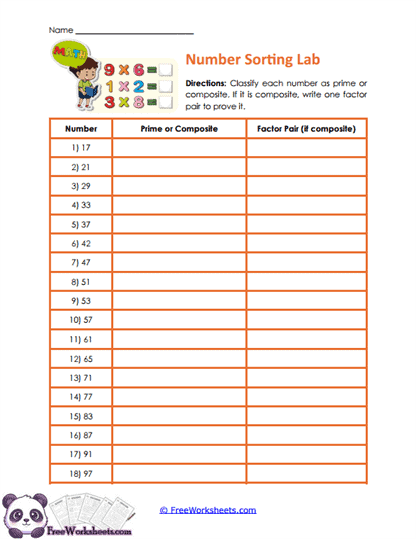
This worksheet helps sixth-grade students distinguish between prime and composite numbers by examining their factor structure. Students classify each number and, when the number is composite, provide a factor pair to prove why it belongs in that category. A prime number has exactly two positive factors, while a composite number has more than two, so the activity asks students to use factors as evidence rather than simply memorizing a list. The numbers include several values that may look prime at first glance, which encourages careful checking. This makes the worksheet a thoughtful introduction or review of one of the most important ideas in elementary number theory.
What Students Practice
Students decide whether each listed number is prime or composite and record the classification in a table. For every composite number, they also write a factor pair that shows the number can be broken into smaller whole-number factors. This forces students to justify the classification instead of relying only on intuition. They may use divisibility rules, multiplication facts, or systematic factor testing to make their decisions. The activity also gives students repeated opportunities to recognize common prime-number patterns and common composite-number traps.
Why This Matters
Prime and composite numbers are central to understanding how whole numbers are built. Students use prime numbers when they break values into prime factorizations and when they later find greatest common factors and least common multiples. Knowing that a composite number can be represented by a nontrivial factor pair also strengthens multiplication and division reasoning. This worksheet encourages students to support an answer with mathematical evidence, which is an important habit well beyond number theory. It also helps reduce the common mistake of assuming that every odd number is prime.
Teaching Tips
Encourage students to test divisibility systematically rather than guessing whether a number looks prime. For smaller numbers, checking divisibility by 2, 3, 5, and 7 will often be enough to reveal whether a factor pair exists. Remind students that 1 is neither prime nor composite, even though it is not included among the values on this page. If a student marks a number as composite, ask them to prove it by multiplying the factor pair they wrote. For prime numbers, have them explain why no factor pair other than 1 and the number can be found.
Curriculum Standards
This worksheet provides important support for CCSS.MATH.CONTENT.6.NS.B.4, which asks sixth-grade students to work with greatest common factors and least common multiples. Understanding prime and composite numbers helps students recognize factor structure and prepares them for prime factorization methods that can be used to find GCF and LCM. The page also reviews earlier whole-number concepts while raising the level of reasoning by asking students to justify composite classifications with factor pairs. It works well for classroom instruction, independent practice, homework, or review at the beginning of a Grade 6 number theory unit.