
About This Worksheet
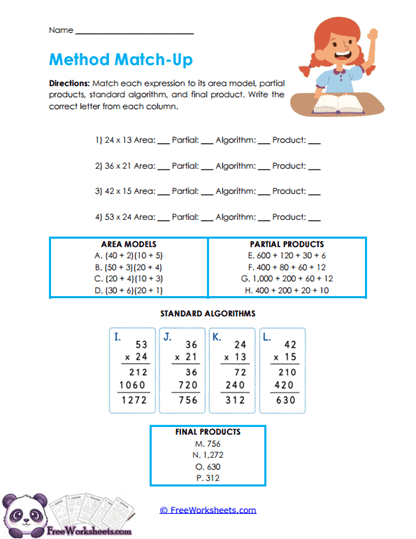
Method Match-Up explores how different multiplication representations can describe the same mathematical calculation. Four two-digit multiplication expressions serve as starting points for connecting area-model expressions, expanded partial products, standard algorithms, and final answers. This 6th grade math activity emphasizes the relationship between numerical decomposition and written multiplication procedures. By matching equivalent representations, learners examine how place-value concepts remain consistent across different calculation methods.
Curriculum and Grade Alignment
Recognizing equivalent multiplication representations strengthens conceptual understanding of the distributive property and whole-number operations. Within 6th grade mathematics, this activity provides supporting review of how decomposed factors relate to partial products and the standard multiplication algorithm. Learners connect expressions such as (50 + 3)(20 + 4) with the corresponding multiplication problem and its intermediate calculations. These connections can help students explain why different multiplication strategies produce the same answer, preparing them to reason more flexibly with numerical and algebraic expressions.
Student Tasks
Students examine four multiplication problems: 24 × 13, 36 × 21, 42 × 15, and 53 × 24. For each expression, they select the matching letter from four groups labeled Area Models, Partial Products, Standard Algorithms, and Final Products. The area-model choices show factors written as sums, while the partial-product choices display expanded calculations that must correspond to the original multiplication expression. Learners record four letters for each problem, connecting the original factors with their equivalent representations and numerical results.
Common Challenges and Misconceptions
Students may recognize the correct final product without understanding how the corresponding expanded expression represents the original factors. Confusion can also arise when matching place-value components, particularly when a tens digit must be interpreted as a multiple of ten rather than a single digit. Some learners might match partial-product expressions based on familiar numbers without checking whether all components belong to the same multiplication problem. Comparing each decomposed factor with the original expression before selecting a match can help prevent these errors.
Implementation Guidance
Begin by showing how 53 × 24 corresponds to (50 + 3)(20 + 4), then connect the expanded factors to the standard multiplication algorithm. Encourage learners to explain how the individual products combine to create the final result rather than relying only on answer matching. A correction is needed in the printed Partial Products section: choice F shows 400 + 80 + 60 + 12, which equals 552, but it should read 200 + 60 + 40 + 12, which equals 312, to match 24 × 13. Correct this entry before distributing the activity so every multiplication expression has a valid match in each category.
Details and Features
The worksheet presents four numbered multiplication expressions near the top, each followed by labeled blanks for four matching letters. A reference section beneath the questions contains four area-model expressions and four expanded partial-product expressions, organized into separate columns. Four completed vertical multiplication algorithms appear in individual boxes, followed by a final answer bank containing four numerical products. Lettered choices from A through P allow learners to complete the matching activity without rewriting the displayed calculations.