
About This Worksheet
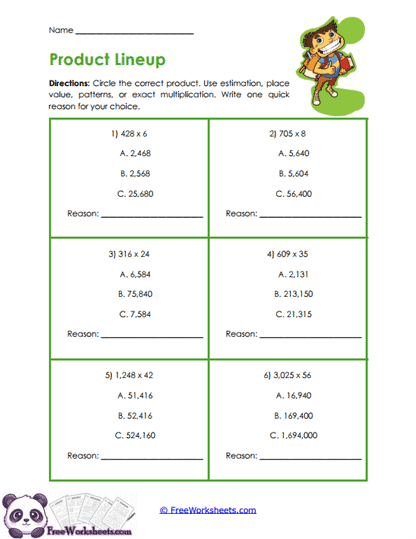
Choosing the correct product from several possibilities requires more than performing a multiplication calculation. Product Lineup presents six multi-digit multiplication problems with three possible answers for each, challenging learners to distinguish accurate results from common computational errors. The 6th grade math activity encourages the use of estimation, place-value patterns, and exact multiplication to evaluate competing answers. Students must also provide a brief explanation for each selection, connecting computational accuracy with mathematical reasoning.
Curriculum and Grade Alignment
Evaluating multiplication results reinforces whole-number operations and numerical reasoning within the 6th grade math curriculum. The exercises revisit multiplication fluency while emphasizing the importance of recognizing reasonable product sizes and maintaining correct place values. Several answer choices differ by a factor of ten, making the activity useful for examining how misplaced digits affect a calculation. The requirement to explain each selection also supports mathematical communication and the ability to justify numerical conclusions.
Student Tasks
Six numbered problems ask learners to multiply three-digit or four-digit numbers by single-digit or two-digit factors. Each multiplication expression is accompanied by three lettered answers, and students must circle the correct product. For example, the problem 705 × 8 offers 5,640, 5,604, and 56,400, requiring students to distinguish the correct calculation from errors involving digit placement and magnitude. After selecting an answer, learners write one short reason explaining their choice in the space provided.
Common Challenges and Misconceptions
Some learners may select an answer because its digits look familiar without checking whether the value is reasonable. Others might overlook place-value errors when the choices contain similar digits but different numerical arrangements. Multiplication problems involving larger factors, such as 3,025 × 56, can also expose regrouping difficulties or confusion about the placement of partial products. Comparing an estimate with the answer choices before calculating exactly provides an effective way to eliminate clearly unreasonable results.
Implementation Guidance
Begin with 428 × 6 and ask students to estimate the product before examining the three possible answers. Discuss how an estimate near 2,400 makes 25,680 unreasonable and helps narrow the selection. Encourage students to support their choices with different approaches, such as an exact algorithm, expanded multiplication, or a place-value explanation. For additional practice, learners can examine an incorrect answer choice and describe the likely mistake that produced it.
Details and Features
The worksheet contains six multiplication questions arranged in a two-column, three-row grid. Each section provides one multiplication expression, three lettered answer choices, and a labeled line for a written explanation. The problems include three-digit and four-digit multiplicands, with multipliers ranging from single digits to two-digit numbers. Incorrect choices incorporate plausible computational mistakes, allowing the answer options themselves to support discussion about multiplication accuracy.