
About This Worksheet
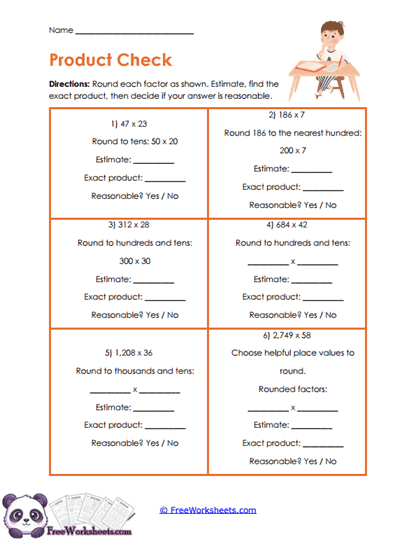
Product Check connects multiplication accuracy with estimation and numerical reasoning. Rather than calculating answers alone, students working at the 6th grade math level must consider whether their exact products make sense when compared with rounded estimates. The opening exercise provides 47 × 23 and its rounded expression, 50 × 20, demonstrating how convenient numbers can establish an approximate result. Subsequent problems gradually transfer responsibility for choosing appropriate rounding values to the learner.
Curriculum and Grade Alignment
Estimating products reinforces number sense while supporting accurate whole-number multiplication in 6th grade mathematics. Learners practice rounding factors to specified place values and recognizing the relationship between approximate and exact answers. This connection encourages students to evaluate the magnitude of their results instead of relying exclusively on written calculations. The activity works particularly well alongside multiplication-algorithm review because estimation provides an additional method for detecting unreasonable answers.
Student Tasks
Each of the six exercises requires learners to work with rounded factors, calculate an estimated product, and determine the exact answer. Students then select Yes or No to indicate whether their calculated product is reasonable. Earlier questions specify rounding decisions, including rounding 186 to the nearest hundred while leaving the multiplier of 7 unchanged. Later exercises involve larger numbers, culminating in 2,749 × 58, where students select helpful place values for their estimate.
Common Challenges and Misconceptions
Some students may confuse an estimated product with an exact answer and accidentally multiply the rounded factors in both response spaces. Others may round to an incorrect place value or struggle to choose convenient numbers without changing the estimate excessively. A difference between the estimate and exact product can also be misinterpreted as evidence that the calculation is wrong. Comparing the size of the original factors with their rounded counterparts can clarify why reasonable estimates do not need to match exact results.
Implementation Guidance
Start with the provided 47 × 23 example and discuss why 50 × 20 gives a useful approximation before performing exact multiplication. As students encounter questions with less rounding guidance, encourage them to explain which place values make the calculation easier and why. When an answer appears inconsistent with its estimate, have learners review both their rounding choices and multiplication steps before making a reasonableness judgment. As an extension, students can create a second estimate using different rounded factors and compare its usefulness with their original approximation.
Details and Features
Six numbered problems are distributed across a two-column grid with separate spaces for estimation and exact calculation. Each exercise includes a reasonableness question with Yes and No response options. The earliest items supply rounded factors, while later questions provide blank expressions that students must complete independently. The final exercise introduces greater flexibility by allowing learners to choose helpful rounding values rather than following a prescribed place-value instruction.