
About This Worksheet
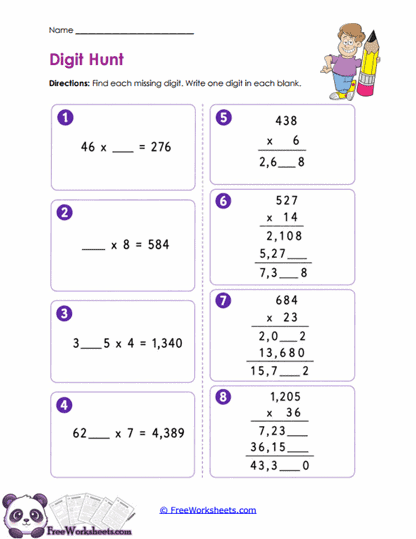
Digit Hunt challenges students to reconstruct multiplication expressions by determining which numbers or digits are missing. Instead of completing calculations from fully provided factors, learners use known products and partial calculations to work backward through multiplication relationships. This 6th grade math worksheet combines missing-factor equations with incomplete standard multiplication algorithms. The format emphasizes how individual digits contribute to the overall calculation and requires students to use place-value reasoning to complete each problem accurately.
Curriculum and Grade Alignment
Finding missing values within multiplication problems reinforces arithmetic fluency and the relationship between multiplication and division. For 6th grade learners, this activity provides supporting practice with inverse operations, regrouping, and the structure of the standard multiplication algorithm. The partially completed algorithms also reinforce the meaning of intermediate products and their alignment with the appropriate place values. Teachers can use these exercises to determine whether students understand how multiplication calculations are constructed rather than simply following a memorized sequence of steps.
Student Tasks
Eight numbered problems ask learners to fill in missing values within multiplication equations and vertical algorithms. The first four exercises present equations with incomplete factors, including 46 × ___ = 276 and 3_5 × 4 = 1,340. The remaining four problems display vertical multiplication setups containing blank positions within partial products or final answers. Students use the given factors, multiplication relationships, and surrounding digits to determine the missing entries and complete each calculation.
Common Challenges and Misconceptions
Working backward from a known product can be difficult for learners who are accustomed to multiplying only from left to right. Students may confuse the missing factor with a missing digit, particularly when an equation contains an incomplete multi-digit number. The vertical algorithm problems introduce another challenge because an incorrect digit in an intermediate product can affect the final sum. Encouraging learners to check each completed expression using multiplication or division can help reveal inconsistencies before they move to the next problem.
Implementation Guidance
Begin with 46 × ___ = 276 and demonstrate how division can identify the missing factor before multiplication verifies the result. For the vertical algorithms, teachers can model how the visible digits constrain the possibilities for each blank, working from the ones column toward higher place values. Clarify one inconsistency in the printed directions: although they specify one digit per blank, problem 2 requires the two-digit factor 73 to complete ___ × 8 = 584. As an additional challenge, invite students to create a partially completed multiplication problem for a partner, making sure the missing entries can be determined from the provided information.
Details and Features
The worksheet organizes eight exercises into two columns, with each numbered problem enclosed in its own outlined box. The left column contains four missing-factor equations, while the right column presents four multiplication algorithms with incomplete intermediate or final products. Several right-column problems show correctly positioned partial products, giving learners place-value information to use when determining missing digits. The combination of horizontal equations and vertical calculations offers two distinct formats for practicing mathematical deduction.