
About This Worksheet
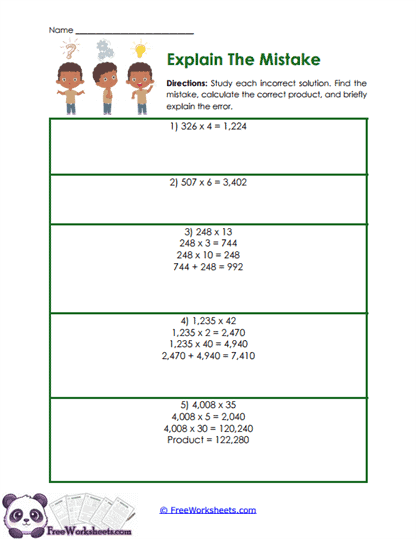
Examining incorrect multiplication solutions encourages learners to think critically about how calculations work rather than focusing exclusively on final answers. This 6th grade math worksheet presents five multiplication problems containing intentional errors that students must identify, correct, and explain. The mistakes involve incorrect products, place-value misunderstandings, and inaccurate partial-product calculations. By evaluating someone else’s mathematical work, students practice recognizing the reasoning behind errors and applying more reliable multiplication strategies.
Curriculum and Grade Alignment
Error analysis strengthens conceptual understanding of whole-number multiplication while reinforcing computational accuracy in 6th grade mathematics. The activity connects the standard multiplication algorithm with partial-product methods and the distributive property. Students must understand multiplication facts, regrouping, and place-value relationships to determine why the presented solutions are incorrect. This form of practice also supports mathematical communication because learners explain the reasoning behind their corrections instead of supplying numerical answers alone.
Student Tasks
Five numbered exercises present incorrect multiplication solutions that students must investigate. The first two problems show multiplication equations with inaccurate final products, requiring learners to determine the correct answers and explain what may have gone wrong. Later exercises display intermediate calculations, including a problem where 248 × 10 is incorrectly calculated as 248. For every exercise, students identify the mistake, calculate the correct product, and briefly explain the error in the available workspace.
Common Challenges and Misconceptions
Students may recognize that an answer is incorrect without being able to identify the specific calculation that caused the problem. Multiplying by multiples of ten is a particular source of difficulty because learners sometimes treat the tens digit as though it represents ones. Other students may correct the final answer but overlook an earlier error involving regrouping or partial products. Reviewing each intermediate calculation separately can help distinguish the original mistake from errors that appear later in the solution.
Implementation Guidance
Introduce the activity by analyzing 326 × 4 = 1,224 and inviting students to determine whether the stated product is reasonable before recalculating it. Encourage explanations that identify where the original reasoning failed, rather than accepting a corrected answer of 1,304 without supporting analysis. For the expanded multiplication problems, teachers can have learners compare each printed partial product with its correct value, such as recognizing that 1,235 × 40 equals 49,400 rather than 4,940. As an extension, partners can create their own intentionally incorrect multiplication solutions and exchange them for error analysis.
Details and Features
The worksheet features five large response sections arranged vertically, with each problem positioned above an open writing area. Earlier questions display only an incorrect multiplication equation, while later exercises include multiple calculation lines showing how the inaccurate product was obtained. The problems incorporate three-digit and four-digit multiplicands, single-digit multipliers, and two-digit multipliers. Generous response spaces accommodate corrected calculations alongside written explanations of the mathematical mistakes.