
About This Worksheet
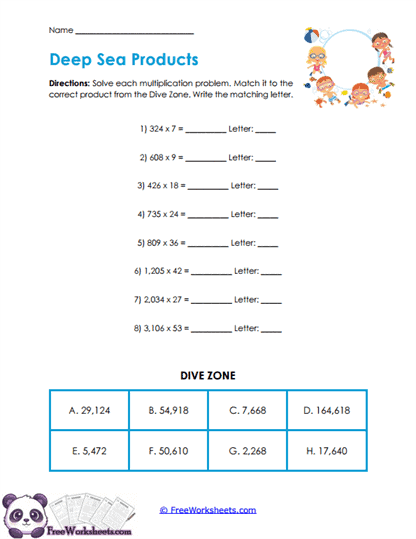
Deep Sea Products combines whole-number multiplication with a matching activity that requires both calculation accuracy and careful answer comparison. Students solve eight multiplication expressions and locate their corresponding products in a labeled answer bank called the Dive Zone. This 6th grade math activity includes single-digit and two-digit multipliers, with calculations involving hundreds and thousands. The matching format provides a different approach to multiplication practice by requiring learners to connect each calculated result with an independently displayed numerical choice.
Curriculum and Grade Alignment
Accurate multiplication of multi-digit whole numbers supports computation skills used throughout 6th grade mathematics. This worksheet reinforces standard-algorithm procedures, regrouping, and the place-value relationships involved in multiplying by tens and ones. Matching calculated answers to an answer bank also requires students to compare numbers carefully and recognize differences in their digits and magnitude. The activity is suitable for reviewing established multiplication methods or checking whether learners can apply them independently to larger factors.
Student Tasks
Learners complete eight multiplication problems, beginning with 324 × 7 and continuing through expressions such as 1,205 × 42 and 3,106 × 53. Each problem provides a blank for the calculated product and another blank for the corresponding answer-bank letter. After finding a product, students search the Dive Zone for the matching number and record its identifying letter. All eight listed products correspond to the multiplication problems, allowing learners to complete a full set of numerical matches.
Common Challenges and Misconceptions
Multiplying four-digit numbers by two-digit factors can lead to incorrect regrouping or misplaced partial products. Zeros within multiplicands, such as 608 and 1,205, may create additional difficulty when students organize their calculations. Learners might also calculate correctly but choose the wrong answer-bank entry after misreading a digit or comma. Encouraging an independent calculation before examining the answer choices helps reduce guessing and makes mismatches more useful for identifying errors.
Implementation Guidance
Have students solve the first multiplication problem before directing their attention to the Dive Zone, emphasizing that the answer bank is intended for checking and matching completed calculations. When a student cannot locate a calculated product, suggest reviewing the multiplication process from the ones column through the final addition of partial products. Teachers can encourage learners to cross out or mark matched answer choices to make the remaining comparisons more manageable. For additional practice, students can select one two-digit multiplier problem and explain how each intermediate product contributes to the final answer.
Details and Features
Eight numbered multiplication expressions appear in a vertical sequence with separate blanks for numerical products and matching letters. A clearly labeled Dive Zone occupies the lower portion of the page and contains eight lettered answer choices arranged in a two-row grid. The answer bank includes products ranging from four-digit to six-digit numbers, reflecting the increasing size of the multiplication calculations. Underwater-themed illustrations accompany the page without interfering with the arithmetic or response spaces.