
About This Worksheet
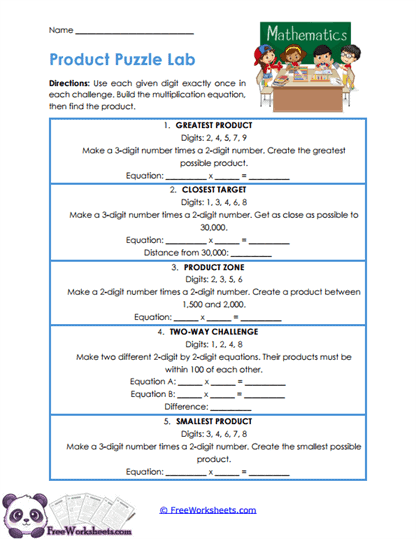
Product Puzzle Lab challenges learners to think strategically about how digit placement affects the size of a multiplication product. Instead of calculating expressions with predetermined factors, students construct their own multiplication equations using specific digit sets and mathematical constraints. The five challenges in this 6th grade math worksheet involve creating maximum and minimum products, approaching a target value, meeting a numerical range, and comparing two different multiplication results. Each puzzle encourages experimentation, estimation, and mathematical reasoning alongside accurate multi-digit multiplication.
Curriculum and Grade Alignment
Exploring how digit arrangements influence multiplication results reinforces place-value understanding and numerical relationships in 6th grade mathematics. The activity connects whole-number computation with problem-solving strategies that require comparing possible solutions rather than completing a single assigned calculation. Learners apply multiplication algorithms, estimation, and numerical comparison while working within clearly defined mathematical constraints. These challenges also support mathematical justification because students can explain why a particular digit arrangement satisfies the conditions of a problem or produces a more desirable result.
Student Tasks
Five distinct multiplication puzzles require learners to use the supplied digits exactly once when constructing each requested equation. The first challenge provides the digits 2, 4, 5, 7, and 9 and asks students to arrange them into a three-digit number multiplied by a two-digit number to create the greatest possible product. Additional challenges involve producing a result closest to 30,000, creating a product between 1,500 and 2,000, and constructing two different multiplication equations whose products are within 100 of each other. The final challenge asks learners to arrange five digits into a three-digit factor and a two-digit factor to generate the smallest possible product.
Common Challenges and Misconceptions
Students may assume that placing the largest available digits into the first factor always creates the greatest product, without considering how the second factor influences the result. Finding a product near a specified target can also be challenging because the closest answer may require testing several combinations rather than choosing the largest or smallest possible factors. Another potential misunderstanding involves reusing digits or overlooking the requirement to use every supplied digit exactly once in each equation. Comparing estimated products before performing exact calculations can help learners eliminate unsuitable arrangements and make more deliberate choices.
Implementation Guidance
Introduce the puzzles by discussing how moving a digit between the tens, hundreds, and ones positions changes the value of a multiplication expression. Encourage learners to estimate the effects of different arrangements before calculating their exact products, recording promising combinations for comparison. For the challenge involving 30,000, suggest subtracting each calculated product from the target and comparing the absolute differences to identify the closest result. In the two-way challenge, clarify that each equation uses the complete digit set once and that the goal is to produce two different equations with products no more than 100 apart.
Details and Features
The worksheet contains five separately outlined challenges arranged vertically, each with a descriptive heading and its own prescribed set of digits. The activities are labeled Greatest Product, Closest Target, Product Zone, Two-Way Challenge, and Smallest Product. Response spaces include multiplication equations and product blanks, with additional fields for recording the distance from 30,000 and the difference between two calculated products. The varying constraints require learners to construct original expressions rather than complete prewritten multiplication problems, providing opportunities for both computation and strategic mathematical exploration.