
About This Worksheet
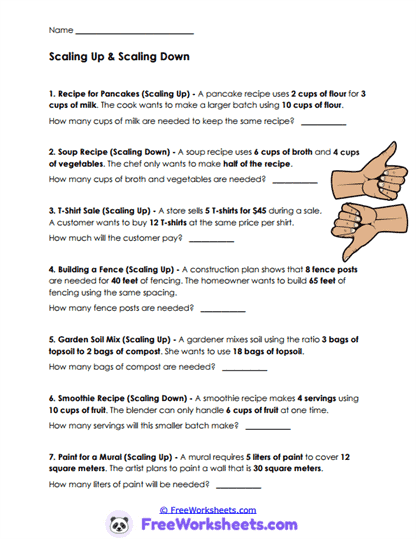
This worksheet helps students apply proportional reasoning to practical real-world situations involving recipes, shopping, travel, sports, subscriptions, and production rates. Learners solve problems using unit rates, equivalent relationships, and proportional scaling strategies. Students analyze everyday scenarios and determine reasonable solutions using proportional thinking. For example, students compare subscription costs, calculate travel distances, and determine ingredient amounts in scaled recipes. This activity strengthens practical mathematical application and proportional reasoning fluency.
Curriculum and Grade Alignment
This worksheet focuses on applying proportional relationships and unit rates to real-world contexts. Students should already understand equivalent relationships, rates, and proportional scaling before beginning this activity. The primary learning goal is helping learners connect proportional reasoning to practical everyday situations. After mastering these skills, students are better prepared for financial literacy, algebraic modeling, and advanced applications of proportional reasoning. The worksheet aligns with Common Core standards 7.RP.A.1, 7.RP.A.2, and 7.RP.A.3, along with TEKS 7.4A involving proportional relationships and problem solving.
Student Tasks
On this worksheet, students will
solve real-world problems involving recipes, travel rates, shopping comparisons, subscriptions, and production schedules. Students use proportional reasoning to determine missing values and compare choices. Learners calculate unit rates and analyze whether situations remain proportional. Several activities encourage students to justify reasoning and explain conclusions. Students also practice interpreting mathematical relationships in practical contexts.
Common Challenges and Misconceptions
Some students may confuse additive relationships with proportional relationships. Others can struggle identifying which quantities should be compared. Learners sometimes forget to maintain consistent units during calculations. Students may also overlook whether situations are proportional before solving. Teachers can support understanding by modeling how to organize proportional comparisons visually.
Implementation Guidance
Teachers may use this worksheet during application lessons, review activities, or real-world problem-solving discussions. The practical contexts help students see the usefulness of proportional reasoning outside the classroom. Parents and homeschool educators can complete one example together before independent work begins. Students often benefit from discussing multiple strategies with peers. This worksheet also works well for enrichment, tutoring, or collaborative learning activities.
Details and Features
This printable worksheet includes practical proportional reasoning problems connected to everyday experiences and decision-making situations. The structured layout supports organized calculations and written reasoning. Real-world applications encourage students to connect mathematics to authentic situations. Problems are designed to strengthen analytical thinking and proportional reasoning accuracy. The worksheet prints clearly for classroom instruction, tutoring support, or homeschool learning.