
About This Worksheet
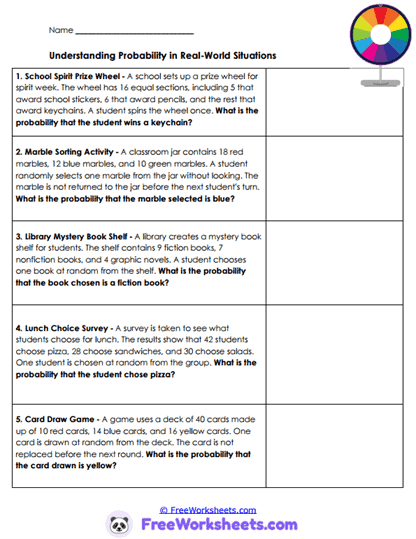
This worksheet helps students solve probability problems using real-world situations and random events. Learners work through practical scenarios involving prize wheels, marble jars, book shelves, lunch surveys, and card games. Students determine the likelihood of outcomes by comparing favorable outcomes to total possible outcomes. For example, students may calculate the probability of selecting a blue marble from a jar containing multiple colors. This activity strengthens probability reasoning and analytical thinking skills.
Curriculum and Grade Alignment
This worksheet focuses on calculating simple probabilities in practical real-world contexts. Students should already understand fractions and ratios before beginning this activity. The primary learning goal is helping learners identify favorable outcomes and determine probabilities accurately. After mastering these skills, students are better prepared for compound probability, statistics, and data analysis. The worksheet aligns with Common Core standards 7.SP.C.5 and 7.SP.C.7, along with TEKS 7.6A involving probability and real-world applications.
Student Tasks
On this worksheet, students will
solve probability problems involving random selections, surveys, spinning wheels, and card draws. Students calculate probabilities by comparing favorable outcomes to total outcomes. Learners organize information clearly and simplify probabilities when appropriate. Several activities encourage students to explain how randomness affects outcomes. Students also practice interpreting probability language within practical contexts.
Common Challenges and Misconceptions
Some students may incorrectly identify the total number of outcomes. Others can confuse favorable outcomes with unfavorable ones while calculating probabilities. Learners sometimes forget to simplify probability fractions. Multi-step descriptions may also lead students to overlook important information. Teachers can help by modeling how to organize outcomes visually before solving.
Implementation Guidance
Teachers can use this worksheet during probability units, review sessions, or real-world application lessons. The engaging scenarios help students understand probability in everyday life. Parents and homeschool educators may solve one example together before independent practice begins. Students often benefit from drawing charts or listing outcomes before calculating probabilities. This worksheet also works well for tutoring, intervention groups, or homework assignments.
Details and Features
This printable worksheet includes real-world probability problems with organized space for showing work. The structured layout supports logical reasoning and accurate calculations. Practical scenarios encourage students to connect probability concepts to everyday experiences. Problems are designed to strengthen analytical thinking and probability fluency. The worksheet prints clearly for classroom instruction, tutoring support, or homeschool learning.