
About This Worksheet
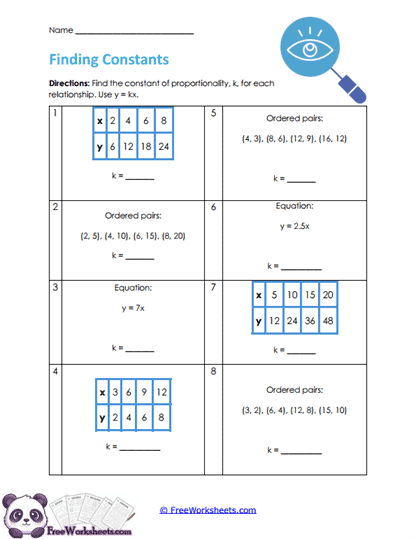
This worksheet helps 7th grade students find the constant number that connects x and y in a proportional relationship. Students see the same idea shown in several forms, including tables, ordered pairs, and equations. Their job is to identify the constant of proportionality, often called k, that makes the relationship follow the rule y = kx. This shows students that a proportional relationship can look different on the page while still following the same basic multiplication rule. It is a thoughtful way to build flexibility before students begin more formal work with rates and equations.
What Students Practice
Students find k from tables by comparing y-values with their matching x-values. In other problems, they examine ordered pairs and determine what number consistently changes x into y. They also work backward from equations such as y = 7x or y = 2.5x and identify the value of k directly. Because the representation changes from problem to problem, students cannot depend on one memorized layout. Instead, they learn to recognize the same mathematical relationship whether it is written as a table, a set of points, or an equation.
Why This Matters
Students often understand a pattern when it is shown one way but become confused when the exact same idea is presented differently. This worksheet helps them see that a table, an equation, and a group of ordered pairs can all describe one relationship. The constant of proportionality tells how much y is produced for every one unit of x, so it becomes the key number connecting all of these forms. Understanding that idea prepares students for unit rates, graphs, and eventually slope. It also encourages students to look for meaning in the numbers instead of treating each representation as a separate skill.
Teaching Tips
Start with a table and ask your child or student to choose one column and figure out how x becomes y. Then check another column to make sure the same rule works again. For ordered pairs, remind them that the first number is x and the second number is y, so dividing y by x can reveal k. Equations are often the easiest examples because the number multiplying x is already the constant. If students become confused, keep returning to the simple question, “How many y’s do we get for one x?”
Curriculum Standards
This worksheet can be used as Grade 7 enrichment because identifying a formal constant of proportionality is generally introduced more directly in Grade 8. It strengthens the pattern and relationship thinking found in CCSS.MATH.CONTENT.7.OA.B.3 while preparing students for CCSS.MATH.CONTENT.7.RP.A.2, which introduces unit rates, and CCSS.MATH.CONTENT.7.RP.A.3, which asks students to use ratio and rate reasoning in different forms. The mix of tables, equations, and ordered pairs also gives students valuable early experience connecting multiple representations. That preparation can make later proportional-reasoning lessons feel much less unfamiliar.