
About This Worksheet
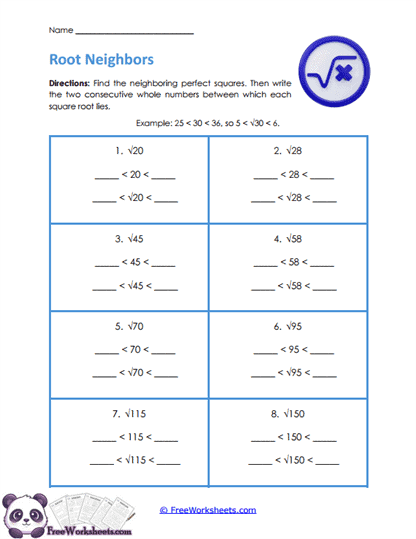
This worksheet helps seventh-grade students estimate square roots that are not perfect squares by locating them between two neighboring perfect squares. Students work with values such as √20, √28, √45, √58, √70, √95, √115, and √150. For each one, they first identify the perfect squares on either side and then write the two consecutive whole numbers between which the square root must lie. This helps students understand that square roots can fall between integers even when they are not whole numbers. It is an important step toward more advanced radical estimation.
What Students Practice
Students compare each radicand with nearby perfect squares. For example, if a number lies between 16 and 25, then its square root must lie between 4 and 5. They write both the perfect-square inequality and the matching square-root inequality. This gives them practice with perfect squares, inequality symbols, estimation, and number-line reasoning. It also reinforces the inverse relationship between squaring and taking square roots.
Why This Matters
Not every square root gives a whole-number answer. Students need a way to estimate where values like √20 or √70 belong before they begin working with decimals or irrational numbers. Using neighboring perfect squares gives them a reliable method. This number sense becomes important in later work with radicals, irrational numbers, and the Pythagorean theorem. It also helps students judge whether a calculator answer is reasonable.
Teaching Tips
Have students identify the two nearest perfect squares before thinking about the square root. Then ask which whole numbers produce those squares. Encourage them to write the perfect-square comparison first and use it to create the square-root comparison. If students skip straight to guessing, bring them back to the known square facts. This method helps them reason rather than rely on estimation alone.
Curriculum Standards
This worksheet is strong preparation for CCSS.MATH.CONTENT.8.NS.A.2, where students estimate the values of irrational numbers and locate them approximately on a number line. At the Grade 7 level, it works well as enrichment and readiness practice. The activity reinforces perfect-square fluency, inequalities, and radical reasoning. It is especially useful for advanced review, intervention, or preparation for Grade 8 square-root concepts.