
About This Worksheet
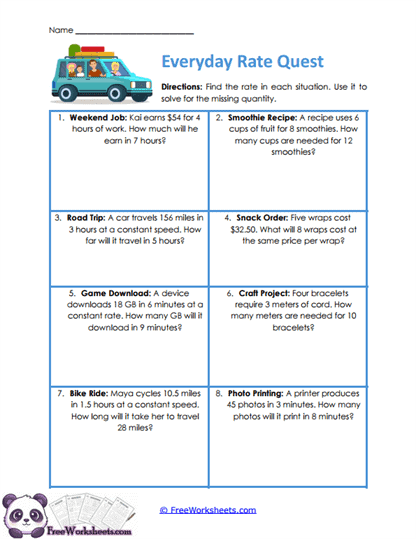
This worksheet helps seventh-grade students use unit rates to solve practical everyday problems. Students work with situations involving hourly earnings, smoothie recipes, road trips, snack prices, downloads, craft supplies, bike rides, and photo printing. Each problem gives enough information to find a rate and then asks students to use that rate to determine a missing quantity. This makes the activity more complete than a basic unit-rate page because students must both calculate and apply the rate. It is a strong real-world review of proportional reasoning.
What Students Practice
Students first find the unit rate in each situation, such as dollars per hour, cups per smoothie, miles per hour, cost per wrap, downloads per minute, meters per bracelet, miles per hour, or photos per minute. They then use that rate to solve for a new total or missing amount. Some problems require multiplication after the rate is found, while others may involve division. This gives students practice moving from “for one” to “for many” or working backward from a larger amount. The variety of contexts helps them see how unit rates can be used as practical problem-solving tools.
Why This Matters
Finding a unit rate is only the first step in many real-world problems. Students also need to know how to use that rate to predict another value in the same proportional relationship. This skill appears in travel, shopping, work, recipes, and production problems all the time. It also connects directly to equations in the form y = kx, where the unit rate becomes the constant of proportionality. Understanding this connection makes later proportional and linear reasoning much easier.
Teaching Tips
Have students write the unit rate first and label it clearly before trying to solve the final question. Then ask whether they need to scale the rate up or work backward to find the missing amount. Encourage them to write a simple multiplication or division sentence so the relationship stays visible. If an answer seems too large or too small, compare it with the original rate and quantity. This quick reasonableness check can catch many setup mistakes.
Curriculum Standards
This worksheet supports CCSS.MATH.CONTENT.7.RP.A.1 through unit-rate computation and CCSS.MATH.CONTENT.7.RP.A.2 through application of proportional relationships. It also connects naturally with CCSS.MATH.CONTENT.7.RP.A.2.C because students are effectively using relationships of the form y = kx to find missing values. The real-world contexts strengthen mathematical modeling and interpretation. It works well for cumulative review, homework, intervention, or end-of-unit practice.