
About This Worksheet
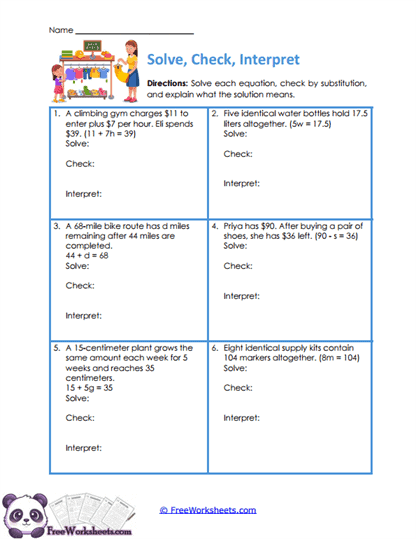
This worksheet helps seventh-grade students complete the full equation-solving process from beginning to end. Each problem gives a real-world situation and an equation, then asks students to solve, check the solution by substitution, and interpret what the answer means. The situations include climbing gym fees, water bottles, bike routes, shopping, plant growth, and supply kits. Because students must handle all three parts, the worksheet works as a strong cumulative review of algebraic problem solving. It shows that a complete solution is more than just finding a value for the variable.
What Students Practice
Students solve one-step and two-step equations using inverse operations. After finding the variable, they substitute the value back into the original equation to confirm that both sides are equal. They then write a short interpretation explaining what the solution represents in the real-world situation. This gives them practice with algebraic procedures, verification, units, and contextual meaning. The repeated solve-check-interpret structure helps students build a reliable routine they can use on more complicated problems later.
Why This Matters
Students often treat solving, checking, and interpreting as three separate skills, but strong algebra work uses all three together. Solving finds the value, checking confirms that the value works, and interpreting explains why the answer matters. This worksheet helps students see how those steps support one another. It also builds better habits because students learn not to stop at the first number they find. That fuller process is important in later algebra, science, and real-world modeling.
Teaching Tips
Encourage students to keep the three parts of each problem separate on the page. First solve the equation, then substitute the answer back into the original equation, and only after that explain the meaning. If the check does not work, have them return to the solving steps before writing an interpretation. Remind them to include the correct unit in the final sentence. This structure helps students stay organized and understand what a complete algebraic solution should look like.
Curriculum Standards
This worksheet strongly supports CCSS.MATH.CONTENT.7.EE.B.4 by asking students to solve equations arising from real-world situations and interpret the results. The substitution check reinforces the meaning of a solution as a value that makes the equation true. The interpretation step strengthens mathematical communication and quantitative reasoning. The activity is especially useful as cumulative review, homework, intervention, or an end-of-unit assessment.