
About This Worksheet
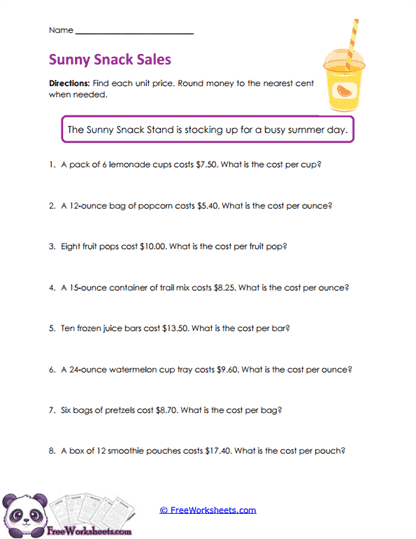
This worksheet helps seventh-grade students use unit prices to make sense of everyday snack stand purchases. Students calculate the cost for one cup, ounce, pop, bar, bag, or pouch using total prices and package quantities. The worksheet also asks them to round money to the nearest cent when needed, which makes the answers realistic. This gives students useful practice with decimal division in a context they can easily understand. It also shows how unit rates can help shoppers compare and understand prices.
What Students Practice
Students divide the total cost by the number of items or ounces to find the cost per one unit. The problems include lemonade cups, popcorn, fruit pops, trail mix, frozen juice bars, watermelon cups, pretzel bags, and smoothie pouches. Some calculations produce repeating or longer decimals, so students need to round appropriately for money. This gives them practice with unit pricing, decimal computation, rounding, and correct money notation. The repeated “cost per one” structure helps strengthen unit-rate fluency.
Why This Matters
Unit pricing is one of the most practical ways students use ratios and rates outside the classroom. Knowing the cost per item or ounce helps people understand how much they are really paying and makes later comparisons between products much easier. Students also get a natural reason to round decimals correctly because prices are usually written to the nearest cent. This connects proportional reasoning with financial literacy in a meaningful way. It also builds confidence with decimal division, which is used throughout middle-school math.
Teaching Tips
Ask students to identify the total cost and total quantity before dividing. Then have them say the rate aloud, such as “dollars per cup” or “dollars per ounce,” so the setup stays clear. When the answer has more than two decimal places, remind them that money should be rounded to the nearest cent. You can extend the activity by asking which snacks seem inexpensive or expensive per unit once the calculations are finished. This makes the math feel connected to real shopping choices.
Curriculum Standards
This worksheet directly supports CCSS.MATH.CONTENT.7.RP.A.1 by having students compute unit rates involving quantities measured in different units. It also connects with CCSS.MATH.CONTENT.7.RP.A.3 through practical applications of proportional relationships in money situations. Decimal computation and rounding reinforce important number skills used throughout Grade 7. The worksheet works well for independent practice, financial-literacy lessons, homework, or real-world ratio review.