
About This Worksheet
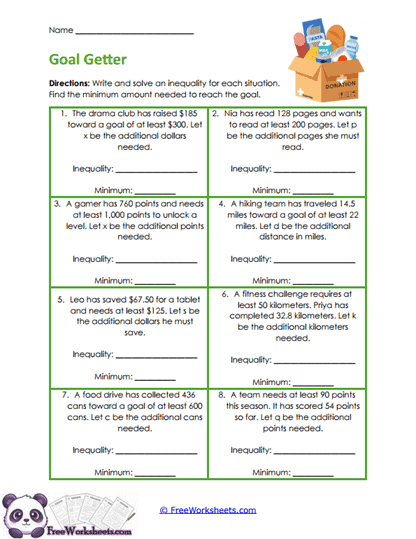
This worksheet helps seventh-grade students write and solve inequalities when a person or group is trying to reach a minimum goal. The situations include fundraising, reading, game points, travel distance, saving money, fitness, food drives, and team scoring. In each problem, students identify how much has already been completed and how much more is still needed to meet or exceed the goal. This makes the idea of a minimum very clear because students are solving for the extra amount required. The worksheet gives inequalities a practical purpose instead of treating them as isolated algebra exercises.
What Students Practice
Students define a variable for the additional amount needed and write an inequality that represents the goal. They then solve for the minimum value that will make the inequality true. The problems use phrases such as “at least,” “needs,” “goal,” and “must complete,” so students practice connecting these words with inclusive inequality symbols. Because the starting amount is already known, students also practice building expressions with a constant plus an unknown. This helps them see how inequalities can describe progress toward a target.
Why This Matters
Many real-world goals do not require one exact number; they require a minimum amount. A student may need at least a certain number of points, dollars, miles, pages, or cans, and any amount above that goal also works. This worksheet helps students understand that an inequality can describe all of those possible solutions at once. It also reinforces the idea that the boundary value is included when the wording says “at least.” That understanding is important for later algebra and for interpreting solution sets correctly.
Teaching Tips
Have students first identify the goal and the amount that has already been completed. Then ask, “How much more is needed to reach at least the goal?” Encourage them to write the inequality before doing any subtraction so they keep the algebra connected to the story. After solving, ask whether the boundary value itself should count. If the answer is yes, remind them that the inequality symbol needs the equality bar.
Curriculum Standards
This worksheet supports CCSS.MATH.CONTENT.7.EE.B.4 by having students use variables to represent unknown quantities in real-world problems. It especially aligns with CCSS.MATH.CONTENT.7.EE.B.4.B, which asks students to solve word problems leading to inequalities and interpret the solution set in context. The repeated focus on minimum values also strengthens students’ understanding of inclusive inequality symbols. The worksheet works well for guided practice, independent work, homework, or intervention during a Grade 7 inequalities unit.