
About This Worksheet
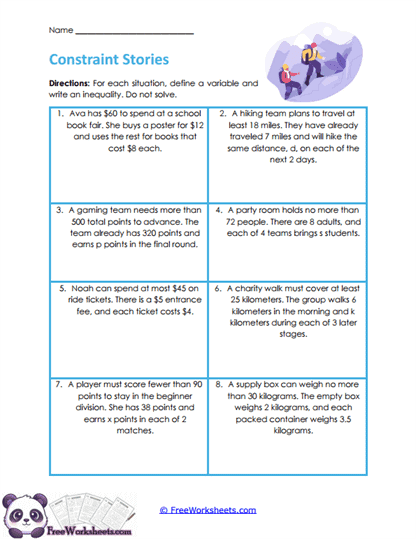
This worksheet helps seventh-grade students build inequalities from complete real-world situations that include more than one piece of information. Students define a variable, write an inequality, and then solve problems involving school spending, hiking distance, team scores, room capacity, ride tickets, charity walking, tournament points, and shipping weight. The activity goes beyond simply matching a phrase with a symbol because students must organize the whole story first. They need to decide what the variable means, how the quantities are combined, and what limit the situation creates. This makes the page a strong bridge from basic inequality language into real problem solving.
What Students Practice
Students identify an unknown quantity and choose a sensible variable to represent it. They then build expressions such as a starting amount plus or minus a repeated amount and compare that expression with a stated limit. Some problems involve “at most” or “no more than,” while others use “at least” or “more than,” so students must choose the correct inequality symbol as well. After writing the inequality, they solve to find the range of values that satisfy the situation. This gives them practice with modeling, variable use, operations, and inequality reasoning all together.
Why This Matters
Real-life inequality problems are rarely presented as a neat expression with a blank symbol. Students need to pull the important information out of a story and decide how it fits together mathematically. This worksheet helps them learn that an inequality can describe many possible answers, such as how many days, people, rides, or kilometers are allowed. That idea is central to algebra because constraints often matter more than one exact value. It also helps students see why inequalities are useful for planning, budgeting, and setting limits.
Teaching Tips
Ask students to write what their variable means in words before they create the inequality. Then have them identify the starting amount, the repeated amount, and the boundary or goal in the problem. Encourage them to read the inequality back as a sentence before solving to see whether it matches the story. If students are unsure about the symbol, ask whether the boundary value itself is allowed. This keeps the focus on meaning rather than memorizing rules.
Curriculum Standards
This worksheet directly supports CCSS.MATH.CONTENT.7.EE.B.4, which asks students to use variables to represent quantities in real-world problems and construct simple equations and inequalities to solve them. It also supports CCSS.MATH.CONTENT.7.EE.B.4.B because students solve word problems that lead to inequalities and interpret the solution in context. The multi-step setup gives students valuable practice modeling situations rather than only solving prewritten inequalities. This worksheet is especially useful for class practice, homework, small-group instruction, or an applied assessment.