
About This Worksheet
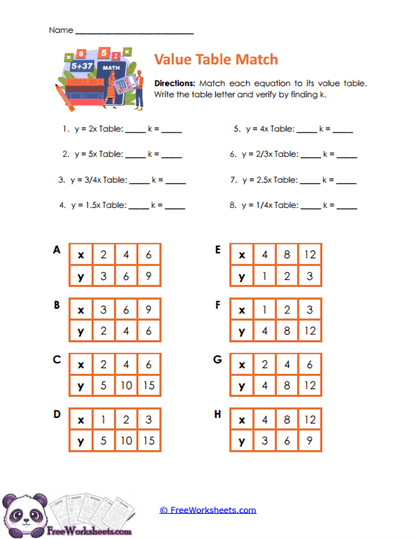
This worksheet helps 7th grade students connect proportional equations with the value tables that represent the same rule. Students are given equations such as y = 2x, y = 5x, and y = 3/4x, along with several possible x-and-y tables. They solve the relationship, match each equation to the correct table, and then identify the constant of proportionality. This teaches students that an equation is really a short way of describing what happens to every pair of values in a table. The matching format makes the relationship between multiplication rules and numerical patterns much easier to see.
What Students Practice
Students examine the multiplier in each equation and use it to predict what the corresponding y-values should be. They then compare those expected values with the tables labeled by letters and choose the table that follows the same rule. After making the match, students record the constant of proportionality, or k, for the relationship. The problems include whole-number, decimal, and fractional constants, so students get practice recognizing proportional patterns in several forms. This makes the activity more thoughtful than simply filling in a table because students must compare and connect two different representations.
Why This Matters
Children sometimes think of equations as complicated symbols that are separate from the number patterns they already understand. This worksheet helps show that an equation such as y = 4x simply means that every y-value is four times its matching x-value. When students can move comfortably between an equation and a table, they are beginning to understand how one relationship can be represented in different ways. That becomes important when graphs and coordinate points are added later. It also lays useful groundwork for algebra because students start seeing equations as rules that generate predictable values.
Teaching Tips
Before matching anything, have students underline or circle the number multiplying x in each equation. Explain that this number tells them what should happen to every x-value in the correct table. They can test just one pair first, but remind them to check another pair before making the final match. When fractions or decimals appear, let students work slowly and use multiplication on scratch paper if needed. After completing a match, ask them to say the relationship aloud, such as, “y is five times x,” because putting the rule into words often makes the pattern much clearer.
Curriculum Standards
This worksheet extends Grade 7 pattern work from CCSS.MATH.CONTENT.7.OA.B.3 by asking students to connect a numerical relationship with an equation and a table. The formal proportionality language serves as preparation for CCSS.MATH.CONTENT.7.RP.A.2 and 7.RP.A.3, where students work directly with unit rates and proportional relationships. It also gives students an early bridge into algebraic representation by showing that a multiplication rule can describe an entire set of number pairs. For Grade 7 learners, this makes the worksheet particularly useful for enrichment, advanced practice, or preparation for middle-school mathematics.