
About This Worksheet
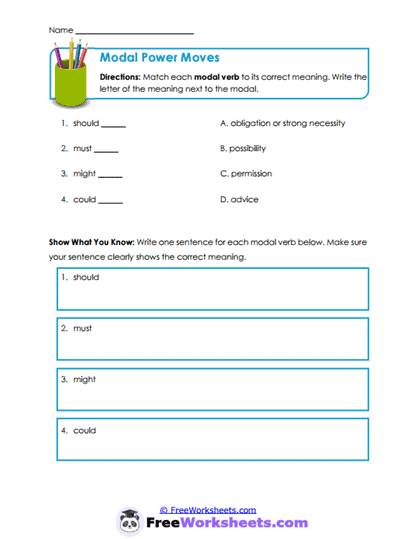
This Grade 7 Language Arts worksheet helps students understand how modal verbs express advice, necessity, possibility, and permission. Students work with should, must, might, and could, first matching each one to its common meaning. They then write original sentences that clearly show how each modal is being used. For example, “You must wear safety goggles” expresses a strong requirement, while “It might rain later” shows possibility.
Learning Goals
The main goal is to help students recognize that modal verbs change the meaning and strength of the main verb that follows them. Students should already understand that helping verbs work with main verbs to create a complete verb phrase. This activity moves them toward distinguishing between a suggestion, a firm obligation, an uncertain possibility, and permission. It supports CCSS.ELA-LITERACY.L.7.1 and CCSS.ELA-LITERACY.L.7.3 through accurate verb use and careful control of meaning.
Student Tasks
On this worksheet, students will match four modal verbs with the meanings they most commonly express. They will then write one original sentence for each modal. Every sentence should make the intended meaning easy to recognize without needing an extra explanation. Students must also make sure the modal is followed by the correct base form of the main verb.
Common Challenges
Some students may treat might and could as though they always mean the same thing. While both can express possibility, could may also show ability or permission depending on the context. Others may add an incorrect ending to the main verb after the modal, such as writing “must studies.” Remind students that modal verbs are followed by the plain form of the verb.
Teaching Suggestions
A teacher can read several short situations and ask which modal would fit best. For example, a classroom rule calls for must, friendly advice calls for should, and an uncertain prediction may use might. At home, a parent can ask the child to give one rule, one suggestion, one possibility, and one polite request using the four target words. This makes the differences easier to hear and remember.
Worksheet Features
The page combines a matching section with four large original-writing boxes. This allows students to learn the meanings first and then prove that they can use each modal correctly. The small number of target words keeps the lesson focused while still covering several important shades of meaning. This worksheet works well for direct instruction, writing practice, homework, or a quick review.