
About This Worksheet
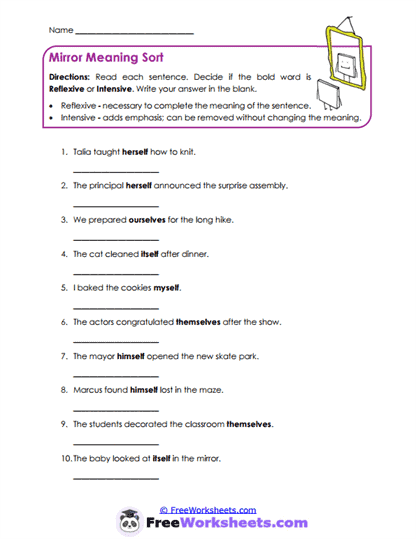
This Grade 7 Language Arts worksheet helps students tell the difference between reflexive and intensive pronouns. Both types end in -self or -selves, but they do different jobs. A reflexive pronoun is necessary because the action turns back toward the subject, while an intensive pronoun simply adds emphasis and can be removed without changing the main meaning. For example, herself is reflexive in “Talia taught herself to knit,” but intensive in “The principal herself announced the surprise.”
Learning Goals
The main goal is to help students classify pronouns by function instead of appearance alone. Students should already recognize forms such as myself, yourself, himself, herself, itself, ourselves, and themselves. This activity moves them toward testing whether the pronoun completes the sentence’s meaning or merely stresses who performed the action. It supports CCSS.ELA-LITERACY.L.7.1, which focuses on accurate pronoun use and grammatical function.
Student Tasks
On this worksheet, students will read ten sentences containing bold -self or -selves pronouns. They will decide whether each one is reflexive or intensive and write the answer on the line. The examples involve teaching, announcing, preparing, cleaning, baking, congratulating, opening, getting lost, decorating, and looking in a mirror. Students should remove the pronoun mentally and ask whether the sentence still keeps its basic meaning.
Common Challenges
Students often assume that every pronoun ending in -self is reflexive. Others may remove the pronoun and decide the sentence sounds less natural, even though the grammar is still complete. The key question is not whether the emphasis disappears, but whether the core action and meaning remain. Encourage students to ask, “Does the subject perform the action on itself, or is the pronoun only stressing the subject?”
Teaching Suggestions
A teacher can write one reflexive and one intensive example side by side, then cross out the bold pronoun in each. In the intensive sentence, the main idea remains complete; in the reflexive sentence, the meaning changes or becomes incomplete. At home, a parent can ask the child to act out sentences such as “He introduced himself” and “He himself opened the door.” The physical difference can make the grammar easier to understand.
Worksheet Features
The worksheet includes ten short sentences with bold target pronouns and simple answer lines. The title and mirror image reinforce the idea that some actions reflect back to the subject. A balanced mix of reflexive and intensive examples prevents students from relying on one answer pattern. This page works well for pronoun-function instruction, review, homework, or a quick comprehension check.