
About This Worksheet
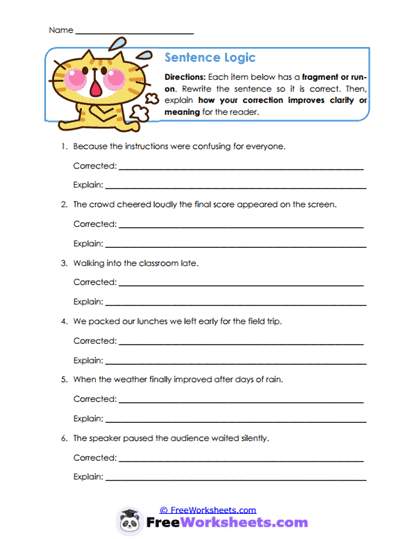
This Grade 7 Language Arts worksheet helps students correct fragments and run-ons while also explaining how the revision improves meaning. Students are not finished after fixing the grammar; they must tell why the new version is clearer for the reader. For example, “Because the instructions were confusing for everyone” needs an independent clause, while “The crowd cheered loudly the final score appeared on the screen” needs a clear connection between two complete ideas.
Learning Goals
The main goal is to help students connect sentence correctness with clear communication. Students should already know several ways to repair fragments and run-ons. This activity moves them toward explaining how punctuation, conjunctions, and complete clauses guide the reader through an idea. It supports CCSS.ELA-LITERACY.L.7.1 and CCSS.ELA-LITERACY.L.7.3, which focus on sentence structure and effective language choices.
Student Tasks
On this worksheet, students will correct six sentences containing fragments or run-ons. After each revision, they will explain in one or two sentences how the change improves clarity or meaning. The examples involve confusing instructions, cheering crowds, walking to class, preparing for a field trip, improving weather, and a speaker pausing before an audience. Students should identify the structural problem before choosing the best repair.
Common Challenges
Some students may correct the grammar accurately but write a vague explanation such as “It sounds better.” Others may explain the problem without actually fixing it. Run-ons can also be repaired in several ways, so students need to focus on whether their chosen punctuation or connector matches the meaning. Encourage them to mention the specific improvement, such as completing the thought, separating ideas, or showing a cause-and-effect relationship.
Teaching Suggestions
A teacher can model a full response with three parts: identify the problem, revise the sentence, and explain the benefit. Students can use a sentence frame such as, “This revision improves clarity because it…” At home, a parent can ask the child what the reader misunderstood before the correction and what becomes clear afterward. That question keeps the explanation focused on communication.
Worksheet Features
The worksheet includes six substantial editing tasks with separate spaces for corrections and explanations. The examples mix fragments and run-ons, so students must choose different repair strategies. Requiring an explanation adds a reasoning step that goes beyond mechanical grammar practice. This page works well for assessment, writing conferences, homework, or end-of-unit review.