
About This Worksheet
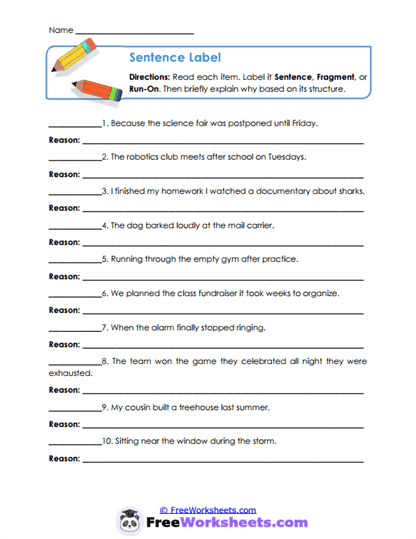
This Grade 7 Language Arts worksheet helps students tell the difference between a complete sentence, a fragment, and a run-on. A complete sentence has a subject, a verb, and a finished thought. A fragment is missing an important part or leaves the reader waiting for more information. A run-on pushes two or more complete thoughts together without the punctuation or connecting words they need. For example, “The robotics club meets after school on Tuesdays” is complete, while “Because the science fair was postponed until Friday” is only a fragment.
Learning Goals
The main goal is to help students look closely at sentence structure instead of deciding by length alone. Some fragments can be long, and some complete sentences can be very short. Students should already be able to identify a basic subject and verb. This activity moves them toward checking whether a thought is complete and whether multiple ideas have been joined correctly. It supports CCSS.ELA-LITERACY.L.7.1 and CCSS.ELA-LITERACY.L.7.2, which focus on sentence structure, grammar, and punctuation.
Student Tasks
On this worksheet, students will read ten examples and label each one as a sentence, fragment, or run-on. They must then give a brief reason for every choice. The examples include dependent clauses beginning with words such as because and when, participial phrases beginning with running or sitting, and run-ons containing several complete ideas. Students are expected to explain what is missing or what needs to be corrected instead of simply writing a label.
Common Challenges
Students often assume that any group of words ending with a period must be a sentence. Others may mistake a long run-on for a correct sentence because it contains plenty of information. Fragments beginning with because, when, or an -ing word can also sound almost complete when read quickly. Encourage students to ask three questions: “Who or what is this about? What happened? Does the thought feel finished?”
Teaching Suggestions
A teacher can model the first three examples and think aloud while checking for a subject, verb, and complete thought. For a run-on, draw a line between the places where one complete idea ends and another begins. At home, a parent can read each item aloud and pause at the end. If the child naturally asks, “Then what happened?” the item is probably a fragment. If the sentence feels breathless because several ideas are packed together, it may be a run-on.
Worksheet Features
The worksheet mixes all three sentence types instead of grouping them separately, so students must make a fresh decision each time. Every item includes a space for reasoning, which gives teachers a better look at whether the student truly understands the structure. The examples use familiar school, sports, and family situations that keep the focus on grammar. This page works well for review, homework, small-group instruction, or an informal assessment.