
About This Worksheet
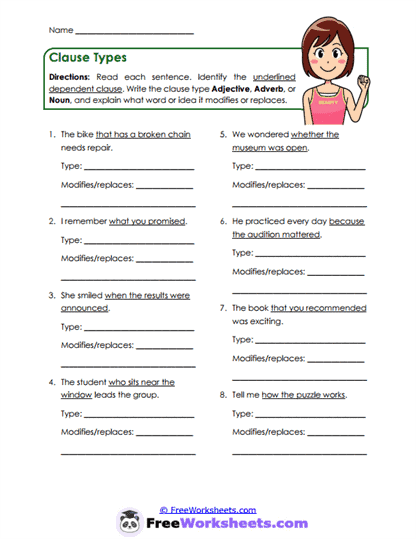
This Grade 7 Language Arts worksheet helps students identify three kinds of dependent clauses and explain the job each one performs. Adjective clauses describe nouns, adverb clauses tell when, why, how, or under what condition something happens, and noun clauses take the place of a noun. Students examine each underlined clause in a complete sentence and decide what it modifies or replaces. For example, “that has a broken chain” is an adjective clause because it describes the bike.
Learning Goals
The main goal is to help students connect clause type with clause function. Students should already understand the difference between independent and dependent clauses. This activity moves them toward analyzing how a dependent clause works inside a larger sentence. It supports CCSS.ELA-LITERACY.L.7.1, which focuses on using and understanding phrases and clauses in sentence structure.
Student Tasks
On this worksheet, students will read eight sentences and classify each underlined dependent clause as adjective, adverb, or noun. They will then explain what word or idea the clause modifies or replaces. The examples include clauses that describe objects and people, explain reasons and timing, or function as sentence objects. Students must consider the whole sentence instead of relying only on the first word of the clause.
Common Challenges
Some students may identify a clause by its opening word rather than by its actual job. Words such as “that,” “what,” “when,” and “whether” can introduce different clause types depending on the sentence. Others may correctly name the type but struggle to explain what it modifies or replaces. Encourage students to substitute a single noun for a noun clause or point directly to the noun described by an adjective clause.
Teaching Suggestions
A teacher can model one example from each clause type and place it beside a plain-language question. Ask, “Which noun does it describe?” for adjective clauses, “What does it tell about the action?” for adverb clauses, and “What noun job does it perform?” for noun clauses. At home, a parent can help the child cover the clause and notice what information disappears. This makes the clause’s job easier to see.
Worksheet Features
The worksheet includes eight varied dependent clauses with spaces for both type and function. Its two-part response format requires deeper thinking than simple labeling. The examples cover several common clause signals and sentence positions. This page works well for advanced grammar instruction, independent review, homework, or assessment.