
About This Worksheet
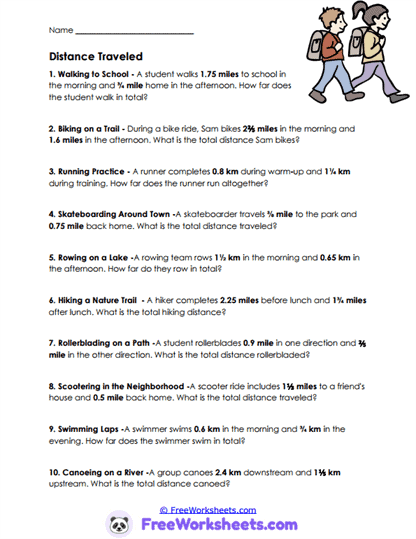
This worksheet helps students solve real-world distance problems using fractions, decimals, and mixed numerical forms. Learners calculate total distances traveled while combining measurements written in miles and kilometers. These activities help students understand how rational numbers appear in everyday movement and measurement situations. For example, students may add 1.75 miles and 1/4 mile to find a total walking distance. This activity strengthens decimal operations, fraction understanding, and practical problem-solving skills.
Curriculum and Grade Alignment
This worksheet focuses on adding fractions and decimals while solving real-world measurement problems. Students should already understand decimal addition and fraction operations before beginning this activity. The primary learning goal is helping learners combine rational numbers written in different forms accurately and efficiently. After mastering this skill, students are better prepared for measurement applications, proportional reasoning, and algebraic thinking. The worksheet aligns with Common Core standards 7.NS.A.1 and 7.RP.A.3, along with TEKS 7.3A involving operations with rational numbers in real-world situations.
Student Tasks
On this worksheet, students will
calculate total distances traveled in situations involving walking, biking, hiking, rowing, and swimming. Students add fractions and decimals written in miles or kilometers. Learners solve word problems by organizing measurements carefully before combining values. Several activities encourage students to rewrite fractions and decimals into compatible forms when necessary. Students also practice checking whether answers are reasonable in real-world contexts.
Common Challenges and Misconceptions
Many students struggle when adding fractions and decimals together in the same problem. Some learners forget to line up decimal points correctly when solving. Others may make mistakes converting mixed numerical forms before adding. Students can also overlook units such as miles or kilometers while solving. Teachers can help by modeling one mixed-format distance problem before independent practice begins.
Implementation Guidance
Teachers may use this worksheet during rational-number operations lessons, measurement review, or real-world application activities. The travel and sports themes help students connect mathematics to everyday experiences. Parents and homeschool educators can solve one example together before assigning independent work. Students often benefit from underlining important measurements before solving. This worksheet also works well for homework, intervention groups, or tutoring support.
Details and Features
This printable worksheet includes real-world distance problems involving fractions, decimals, and mixed numerical forms. The organized layout supports mathematical reasoning and rational-number fluency. Friendly graphics create an engaging learning environment while maintaining focus on mathematics. Problems are designed to strengthen operational accuracy and practical problem-solving skills. The worksheet prints clearly for classroom instruction, tutoring sessions, or homeschool use.