
Concept of Size Worksheets
These preschool early math worksheets help children explore the concept of size by comparing objects, noticing differences, and using clear measurement words. Every activity is free, ready-to-print, available in PDF format, and designed for immediate classroom use. Children strengthen observation, comparison, sequencing, classification, and early measurement language through simple visual activities.
About This Collection of Worksheets
This collection helps preschool children understand that size can be described in several different ways. Learners compare objects as big or small, taller or shorter, longer or shorter, and largest or smallest. The pictures make these ideas easy to see before children are expected to measure with numbers or tools.
The worksheets give children many ways to practice size thinking. They may circle the bigger object, match items that are the same size, sort pictures into groups, find the biggest or smallest choice, compare height and length, or put several objects in order. Some activities also ask children to find a size pattern or use size as a sorting rule.
These printable activities work well during math centers, small-group lessons, homeschool practice, early intervention, and preschool measurement units. They help build the foundation for later work with measurement, ordering, direct comparison, and using more precise size words. As children become comfortable describing visible differences, they are better prepared to compare length, height, and overall size more formally.
Paul’s Teacher Tip
Use real objects whenever possible before moving to pictures. Put two or three toys, books, cups, or blocks side by side and ask your child to describe what is different about their sizes. Be clear about the word you are practicing because bigger, taller, and longer do not always mean the same thing. When ordering several objects, have children find the smallest and largest first, then work on the middle choices. Encourage them to say the comparison aloud so the measurement words become part of their everyday language.
Worksheet Collection Skill Spotlights
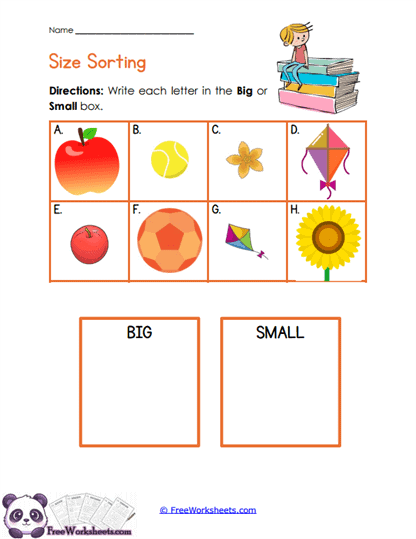
Big Small
What Kids Do: Children study eight lettered pictures and decide whether each one belongs in the BIG or SMALL group. They compare similar objects, then write each picture letter in the correct sorting box.
Target Skill: This activity combines size comparison with classification. Children learn to use one clear feature-overall size-as the sorting rule while also strengthening simple measurement vocabulary.
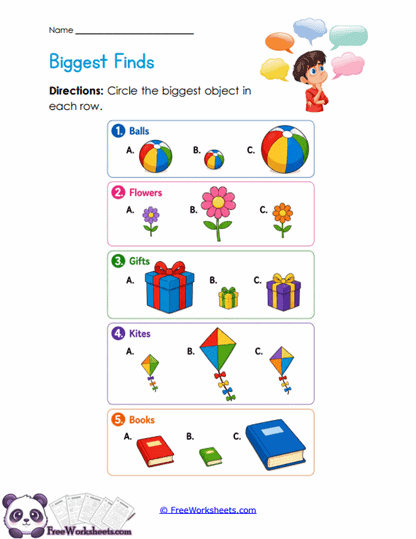
Biggest Choice
What Kids Do: Children compare three versions of the same object in each row and circle the one that is biggest. Balls, flowers, gifts, kites, and books give repeated practice with identifying the largest choice.
Target Skill: Learners move beyond comparing only two objects and begin judging several sizes at once. The worksheet strengthens understanding of the word biggest and helps children focus on overall size rather than color or decoration.
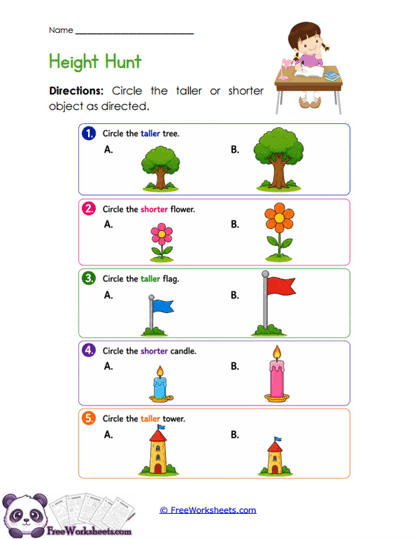
Height Match
What Kids Do: Children compare paired objects such as trees, flowers, flags, candles, and towers. They follow directions asking them to circle either the taller or shorter item.
Target Skill: This page introduces height as a specific way to compare size. Children learn that taller means reaching higher, which helps separate height from broader words such as bigger.
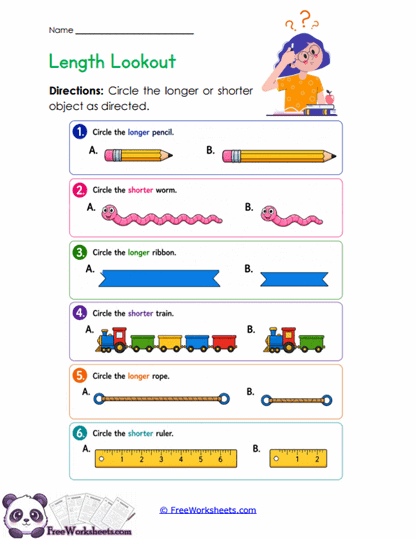
Length Match
What Kids Do: Children look at pairs of pencils, worms, ribbons, trains, ropes, and rulers and decide which one is longer or shorter. They circle the item named in each direction.
Target Skill: Learners focus on how far an object stretches from one end to the other. This builds early length vocabulary and helps children distinguish length from height or overall size.
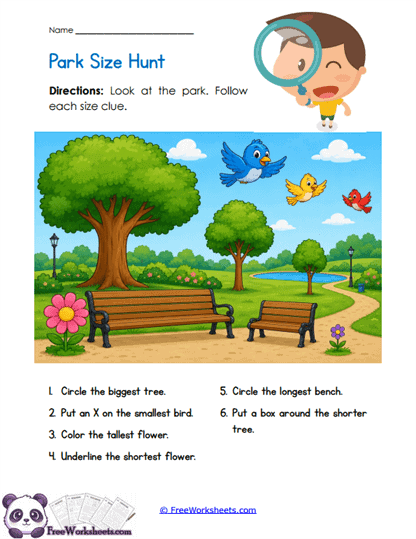
Park Sizes
What Kids Do: Children search a busy park scene and follow several size clues. They find the biggest tree, smallest bird, tallest flower, shortest flower, and longest bench using different markings.
Target Skill: This activity helps children apply several comparison words in one setting. It strengthens visual scanning, careful observation, and the ability to choose the correct size concept for each type of object.
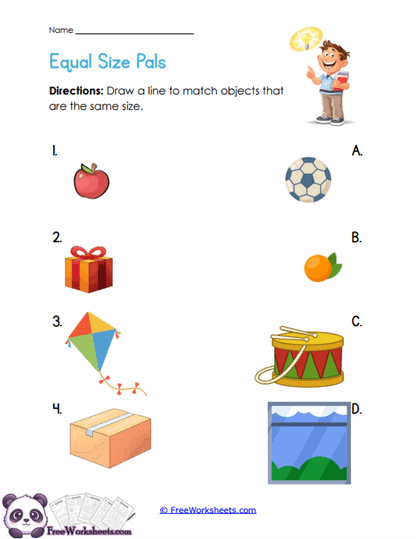
Same Size
What Kids Do: Children compare objects on opposite sides of the page and draw lines between items that are shown at about the same size. The matching pairs use different object types so children must focus on size rather than category.
Target Skill: Learners begin recognizing equal or similar size through direct visual comparison. The page shows that two objects can be very different in purpose or shape and still be about the same size.
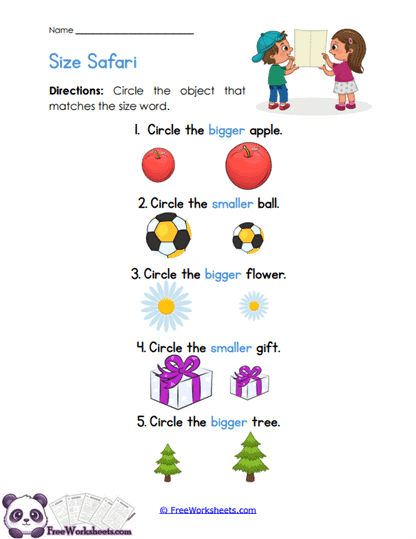
Size Choices
What Kids Do: Children study simple picture pairs and circle either the bigger or smaller object as directed. Apples, balls, flowers, gifts, and trees provide clear and repeated size differences.
Target Skill: This worksheet builds the basic vocabulary of bigger and smaller. Children practice making direct comparisons and describing which object takes up more or less overall space.
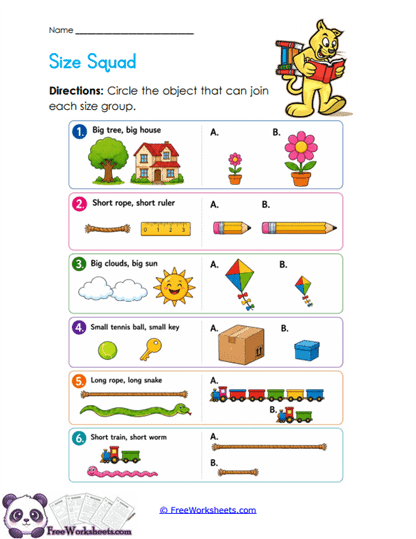
Size Groups
What Kids Do: Children study example objects that share a size feature such as big, small, long, or short. They then choose which new picture belongs with that group based on the same size clue.
Target Skill: This activity combines measurement language with classification and reasoning. Learners must first understand the size rule and then apply it to a new object rather than simply comparing a pair.
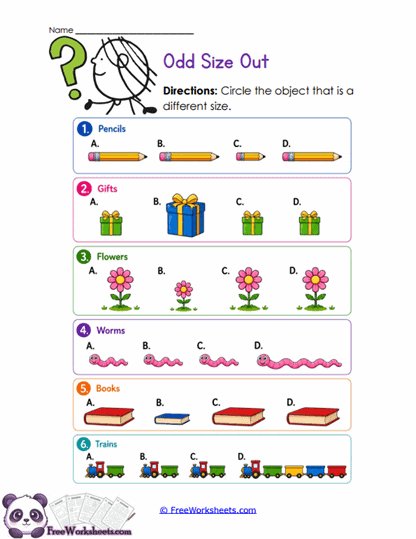
Size Oddity
What Kids Do: Children examine rows of four matching objects and circle the one that is a different size from the other three. Pencils, gifts, flowers, worms, books, and trains provide several kinds of comparison.
Target Skill: Learners practice recognizing a size pattern and finding the exception. The activity develops observation, comparison, and the ability to explain why one item does not match the rest.
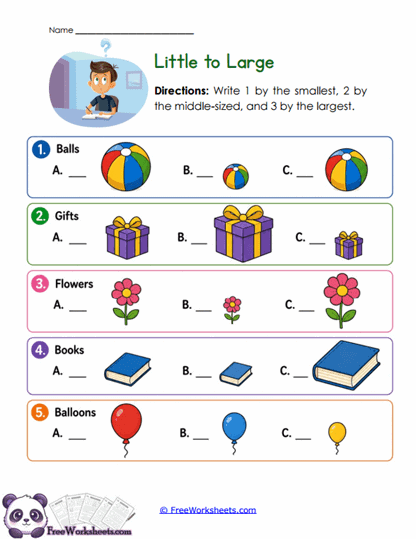
Size Order
What Kids Do: Children compare three matching objects and label them 1, 2, and 3 from smallest to largest. They work with balls, gifts, flowers, books, and balloons in mixed-size arrangements.
Target Skill: This worksheet introduces sequencing by size. Children practice finding the smallest and largest first, then identifying the middle-sized object to complete the order.
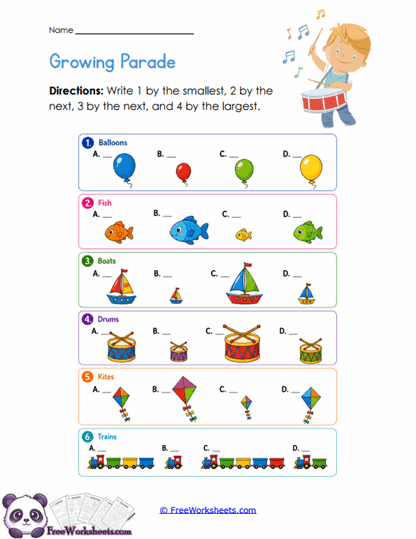
Size Parade
What Kids Do: Children compare four versions of the same object and write numbers 1 through 4 to arrange them from smallest to largest. Balloons, fish, boats, drums, kites, and trains provide repeated practice.
Target Skill: Learners extend size ordering to four levels instead of three. The activity builds stronger visual comparison, sequencing, and number-writing skills while preparing children for more formal ordering tasks.
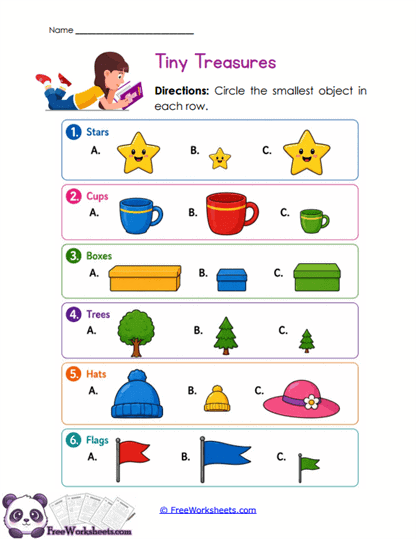
Smallest Choice
What Kids Do: Children compare three similar objects in each row and circle the one that is smallest. Stars, cups, boxes, trees, hats, and flags provide clear examples with different overall shapes.
Target Skill: This page strengthens understanding of the word smallest and teaches children to compare all choices before deciding. Learners focus on the object that takes up the least overall space rather than simply the shortest one.