
Solid Shapes Worksheets
Preschool early math learners can use these SOLID shapes worksheets to explore cubes, spheres, cylinders, cones, and other three-dimensional forms. These free, ready-to-print activities come in PDF format for immediate classroom use during centers, small groups, or home practice. Children strengthen solid-shape recognition, classification, spatial reasoning, and geometry vocabulary aligned with early math skills.
About This Collection of Worksheets
Learning about solid shapes helps preschool children understand that many objects have height, width, and depth rather than being flat. These worksheets introduce cubes, spheres, cylinders, cones, and other three-dimensional forms through clear pictures and familiar real-world examples. Children begin connecting geometry words with objects they can hold, turn, roll, slide, and stack.
The collection includes matching, sorting, coloring, searching, comparing, and picture-based activities. Children may find spheres in a mixed group, match solids to household objects, compare shapes after they have been rotated, sort examples into shape families, or decide whether an object can roll, slide, or stack. Other activities encourage children to study solid-shape shadows and recognize the same form even when its color, size, or position changes.
Across the collection, learners strengthen shape recognition, visual discrimination, classification, spatial awareness, and early geometry reasoning. They also begin noticing important features such as curved surfaces, flat faces, pointed tops, and the ways different solids move. These experiences provide early preparation for Common Core geometry skills including K.G.A.1, K.G.A.2, K.G.A.3, and K.G.B.4.
Paul’s Teacher Tip
Solid shapes are easiest to understand when children can handle real objects before working with pictures. Try showing a ball, block, can, box, and cone-shaped item and let children turn, roll, slide, or stack each one. Ask them to describe what they notice instead of focusing only on memorizing the shape name. When two solids look similar, encourage children to compare their whole form and decide whether they have flat faces, curved surfaces, or pointed parts. Returning to the same real objects while completing a worksheet can help preschool learners connect printed geometry with something they already understand.
Worksheet Collection Skill Spotlights
Playroom Shapes
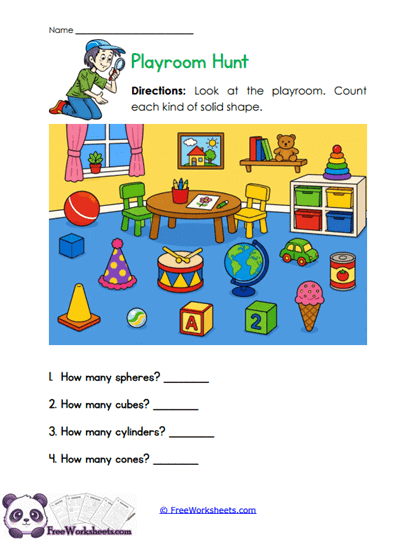
What Kids Do: Children search a colorful playroom scene for familiar objects shaped like spheres, cubes, cylinders, and cones. They focus on one solid-shape type at a time, count every matching object they can find, and record each total on the corresponding answer line.
Target Skill: This activity combines solid-shape recognition with counting, visual scanning, and numeral writing in a familiar real-world setting. It supports preparation for Common Core K.G.A.1, K.G.A.2, and K.G.A.3 by helping children identify three-dimensional forms in their surroundings.
Real Shapes
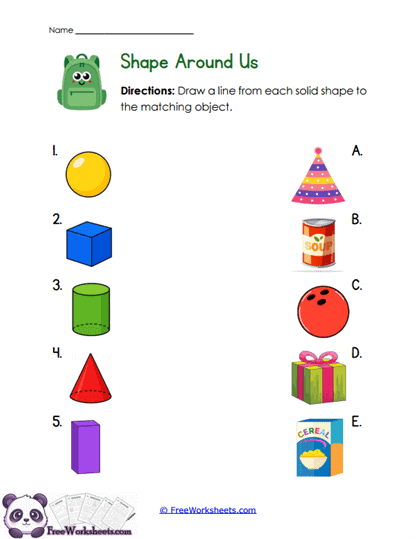
What Kids Do: Children compare a sphere, cube, cylinder, cone, and box-shaped solid with familiar objects such as a bowling ball, gift box, soup can, party hat, and cereal box. They draw lines between each geometric form and the everyday object that shares its shape.
Target Skill: Learners connect formal three-dimensional shape names with recognizable objects from daily life while practicing visual comparison. The page supports preparation for Common Core K.G.A.1, K.G.A.2, and K.G.A.3 by strengthening identification of solid shapes in familiar surroundings.
Shape Actions
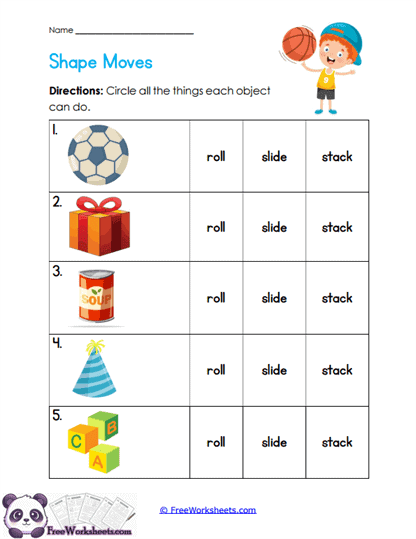
What Kids Do: Children study familiar solid-shaped objects such as a ball, gift box, can, party hat, and building blocks and decide whether each one can roll, slide, stack, or perform more than one action. They circle every movement that correctly applies to each object.
Target Skill: This activity develops early reasoning about solid-shape properties by connecting curved and flat surfaces with how objects move or rest. Children begin comparing three-dimensional forms based on observable features rather than appearance alone, building a foundation for later geometry work.
Shape Baskets
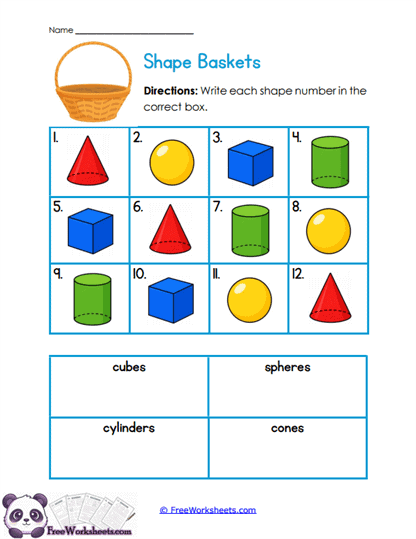
What Kids Do: Children examine twelve numbered cubes, spheres, cylinders, and cones shown in different colors and positions. They identify the solid-shape family for each picture and record its number in the correct sorting area at the bottom of the page.
Target Skill: Learners strengthen classification, three-dimensional shape recognition, and geometry vocabulary while learning that color and orientation do not change a solid’s identity. The activity supports preparation for Common Core K.G.A.2 and K.G.A.3 through repeated identification and grouping of common solids.
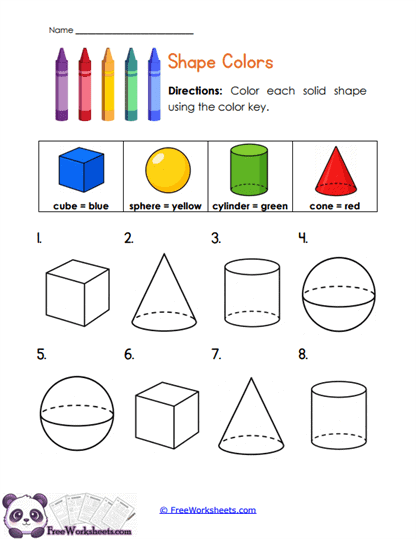
Shape Colors
What Kids Do: Children use a four-part color key to identify cubes, spheres, cylinders, and cones and then color each outlined solid with the assigned color. Eight examples provide repeated practice recognizing the same shapes even when their position or appearance changes.
Target Skill: This page strengthens three-dimensional shape identification, visual discrimination, and direction-following while reinforcing key geometry vocabulary. It supports early preparation for Common Core K.G.A.2 and K.G.A.3 by helping children consistently recognize common solid shapes.
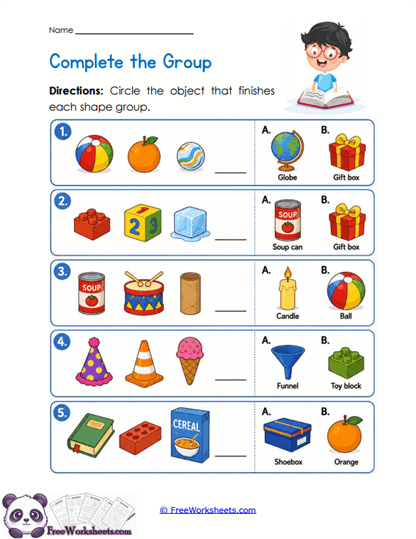
Shape Finish
What Kids Do: Children study three everyday objects that share the same solid shape and then compare two possible choices to find another object that belongs in the group. Each row requires learners to identify the shared three-dimensional form before selecting the matching picture.
Target Skill: Learners practice solid-shape classification, visual comparison, and reasoning by identifying common geometric features across different real-world objects. The activity supports preparation for Common Core K.G.B.4 by encouraging children to compare forms according to their visible shape characteristics.
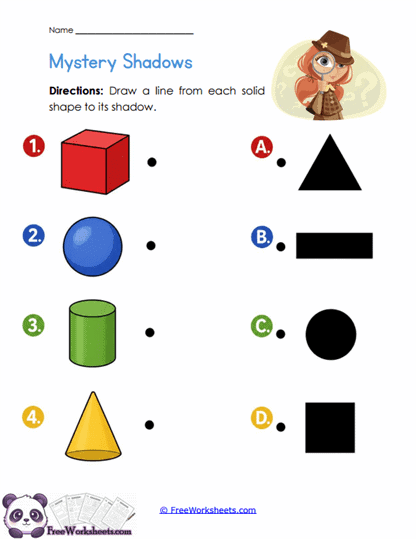
Shape Shadows
What Kids Do: Children look at a cube, sphere, cylinder, and cone and compare each solid with several bold black silhouettes. They draw a line between each three-dimensional shape and the flat-looking shadow that best matches its outline from the shown view.
Target Skill: This activity builds spatial reasoning and early understanding of the relationship between three-dimensional objects and two-dimensional views. It supports preparation for Common Core K.G.A.3 by helping learners notice that solid shapes can produce flat-looking outlines or shadows.
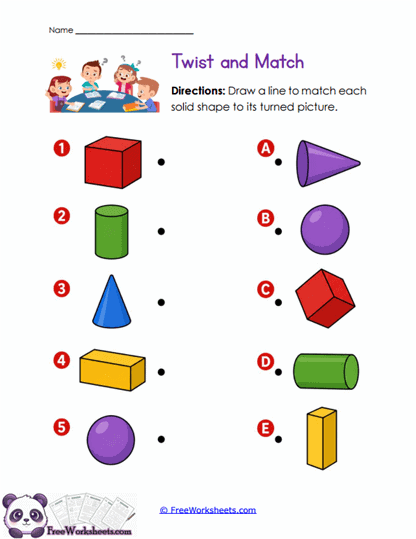
Shape Turns
What Kids Do: Children compare upright solid shapes with matching forms that have been rotated, tilted, or turned in another direction. They draw lines between corresponding cubes, cylinders, cones, spheres, and box-like solids while ignoring changes in orientation.
Target Skill: Learners develop flexible shape recognition and spatial awareness by understanding that a solid remains the same shape after it is turned. The activity supports preparation for Common Core K.G.A.2 and K.G.B.4 by encouraging comparison based on geometric form instead of position.
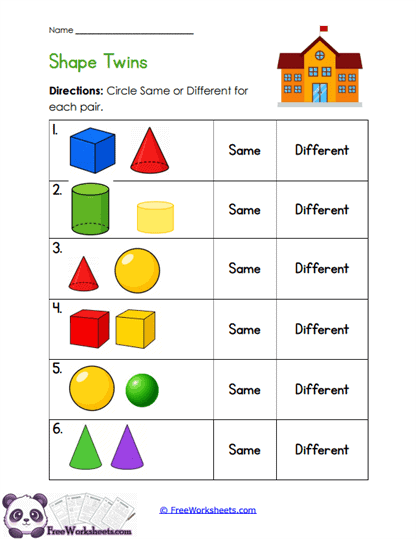
Shape Twins
What Kids Do: Children examine six pairs of solid shapes and decide whether the two examples in each row belong to the same shape family or are different. Color, size, and position may change, so learners must focus closely on the overall three-dimensional form.
Target Skill: This page strengthens solid-shape comparison and visual reasoning while reinforcing the idea that color, orientation, and size do not determine shape identity. It supports early preparation for Common Core K.G.B.4 by helping children compare geometric forms according to their visible features.
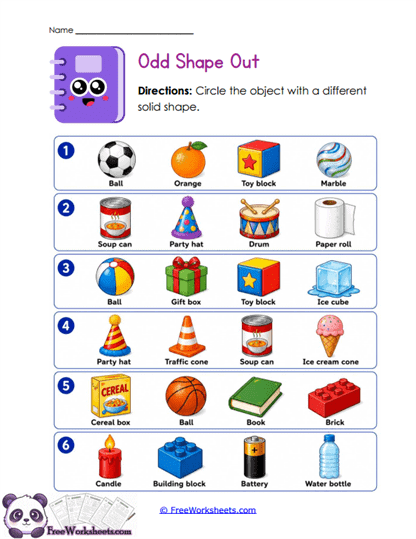
Solid Oddity
What Kids Do: Children study rows of four familiar objects and identify which three share a similar solid form and which one has a different shape. They circle the odd object after comparing balls, boxes, cans, cones, blocks, bottles, drums, and other recognizable items.
Target Skill: Learners strengthen classification and three-dimensional shape comparison by finding shared geometric features across real-world objects. The activity supports preparation for Common Core K.G.A.2 and K.G.B.4 while encouraging children to explain why one form differs from the others.
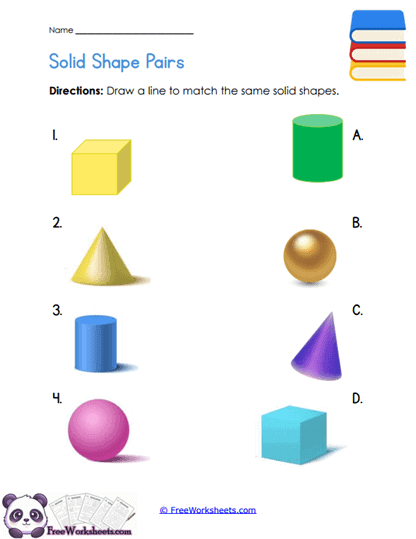
Solid Pairs
What Kids Do: Children look at cubes, cones, cylinders, and spheres on one side of the page and find the matching solid shapes on the other side. Different colors and positions encourage them to match according to form rather than surface appearance.
Target Skill: This activity develops basic solid-shape recognition and visual matching while reinforcing important geometry vocabulary. It supports preparation for Common Core K.G.A.2 and K.G.A.3 by helping children identify common three-dimensional figures regardless of color or orientation.
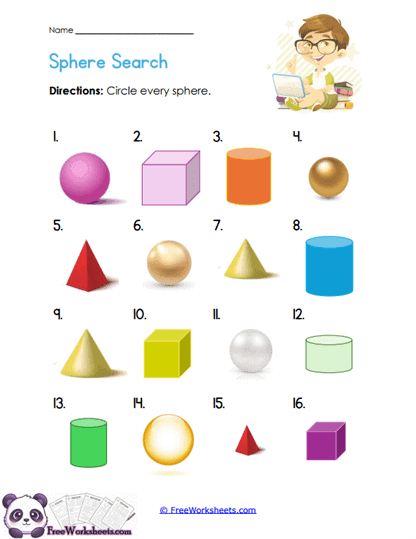
Sphere Search
What Kids Do: Children scan sixteen mixed solid shapes and circle every sphere they can find among cubes, cylinders, and cones. The spheres vary in color and size, requiring learners to focus on the completely round form rather than one particular visual example.
Target Skill: Learners build accurate sphere recognition and visual discrimination by distinguishing a fully rounded solid from other three-dimensional forms. The activity supports preparation for Common Core K.G.A.2 and K.G.A.3 while strengthening attention to defining shape features.