
Numbers and Counting to 5 Worksheets
These preschool early math worksheets help children practice numbers and counting to 5 by connecting numerals with small groups, pictures, frames, and hands-on counting tasks. Every activity is free, ready-to-print, available in PDF format, and designed for immediate classroom use. Children strengthen one-to-one counting, numeral recognition, quantity matching, comparison, and early number sense aligned with beginning counting skills.
About This Collection of Worksheets
This collection helps preschool children connect the numbers 1 through 5 with real quantities they can see and count. Learners point to pictures, trace numerals, match groups, color exact amounts, and work with simple five-frames. Keeping the number range small gives children time to understand what each number means instead of rushing into larger counts.
The worksheets offer several ways to practice the same early number ideas. Some pages ask children to circle a matching numeral, while others use tracing, matching lines, number searches, picture scenes, set building, coloring, comparison, or mixed review. These different formats help children practice counting again and again without every activity feeling the same.
These printable activities work well during math centers, small-group lessons, homeschool practice, early intervention, and short independent work. The collection supports beginning Common Core skills connected with K.CC.A.3, K.CC.B.4, K.CC.B.5, and early comparison ideas from K.CC.C.6. As children become confident with quantities to 5, they build a strong foundation for larger counting, comparison, and beginning addition.
Paul’s Teacher Tip
Encourage children to touch or point to every object as they count. This helps prevent skipped pictures and double-counting while building one-to-one matching. After counting, ask, “What was the last number you said?” so children begin understanding that the final counting word tells how many objects are in the whole group. When working with numerals, have the child say the number aloud before circling or tracing it. Keep practice short and playful so numbers 1 through 5 become familiar rather than something children feel they need to memorize all at once.
Worksheet Collection Skill Spotlights
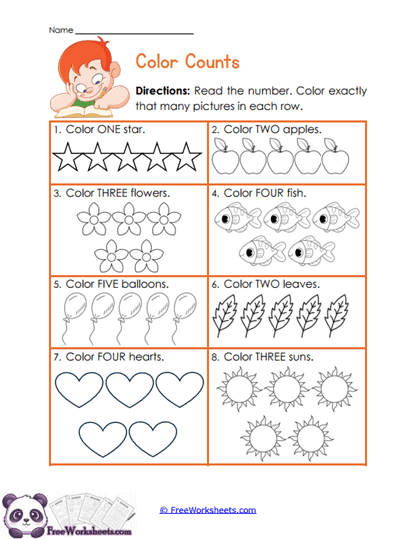
Color Counts
What Kids Do: Children listen to or read a number direction and color exactly that many stars, apples, flowers, fish, balloons, leaves, hearts, or suns. They stop coloring when they reach the target amount.
Target Skill: This activity helps children count out a specific quantity instead of simply counting what is already there. Learners connect number words with real amounts while practicing one-to-one counting and stopping at the correct number.
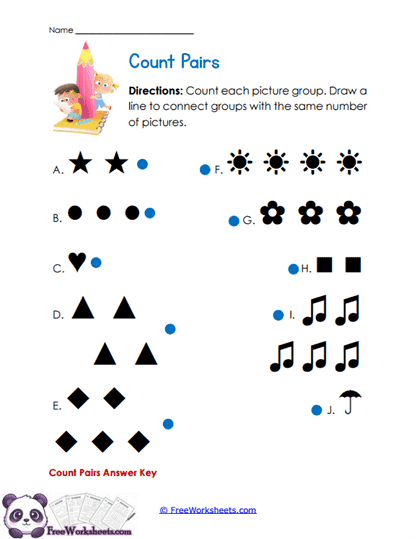
Count Matches
What Kids Do: Children count picture groups on both sides of the page and draw lines between groups that contain the same number of items. The objects may look different, so children must compare the quantities rather than the pictures themselves.
Target Skill: Learners begin understanding equal quantities and that the number of objects stays the same even when the object type changes. This strengthens counting, matching, and early comparison thinking.
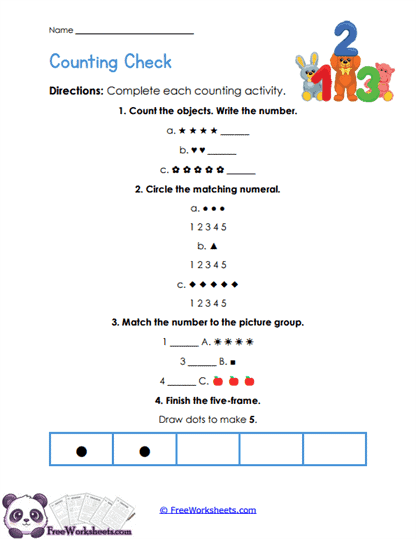
Counting Review
What Kids Do: Children complete several short activities on one page, including counting picture groups, choosing matching numerals, connecting numbers to sets, and adding dots to a five-frame.
Target Skill: This worksheet checks whether children can use number knowledge in more than one way. It brings together counting, numeral recognition, quantity matching, and organized number models within the familiar 1-to-5 range.
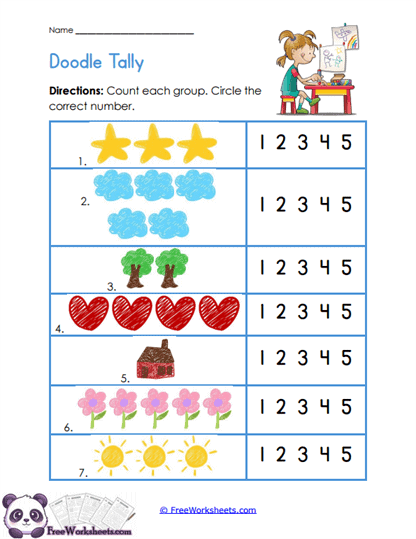
Doodle Counts
What Kids Do: Children count friendly picture groups such as stars, clouds, trees, hearts, flowers, and suns. They then circle the numeral from 1 through 5 that matches each counted amount.
Target Skill: This activity develops the important connection between a quantity and its written numeral. Children practice touching each object once, finding the total, and recognizing the number symbol that represents it.
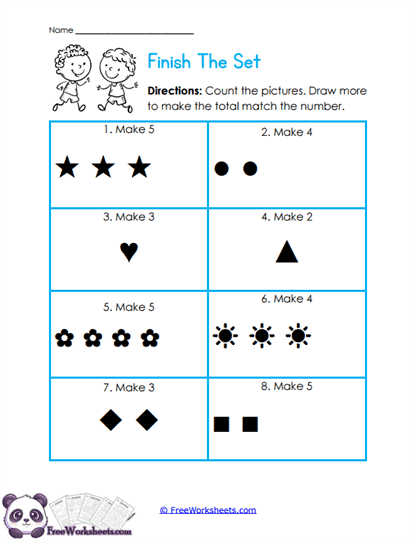
Finish Sets
What Kids Do: Children count the shapes already shown in each box, look at the target number, and draw enough new shapes to complete the group. They recount the finished set to make sure it matches the target.
Target Skill: Learners begin seeing numbers as quantities that can be built from smaller amounts. The activity also introduces early missing-part thinking that will later support beginning addition.
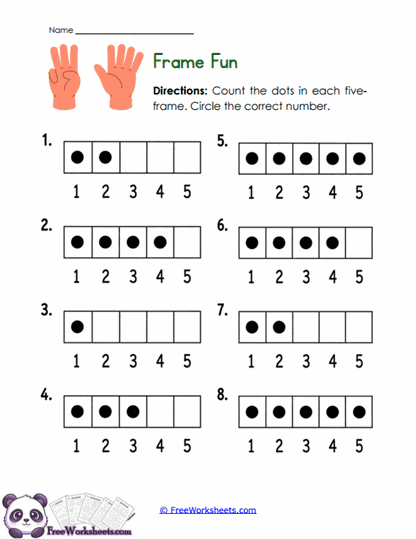
Five Frames
What Kids Do: Children count black dots placed inside simple five-frames and circle the numeral that matches the amount. Eight problems give repeated practice with quantities from 1 through 5.
Target Skill: This page introduces an organized number model that helps children see how many spaces are filled and empty. Over time, learners may begin recognizing some amounts without needing to count every dot individually.
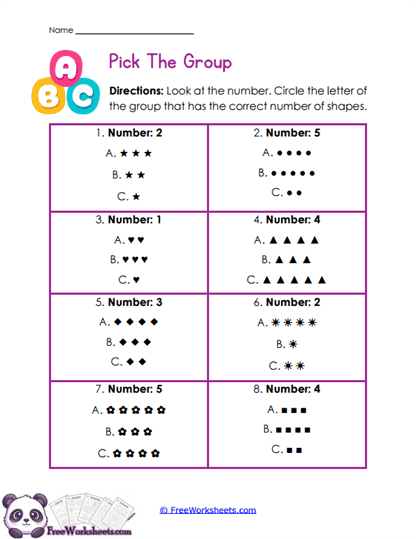
Group Picks
What Kids Do: Children look at a target number and count the objects in choices A, B, and C. They circle the letter of the group containing exactly the requested number of shapes.
Target Skill: This activity strengthens quantity matching and careful comparison. Children learn that the target numeral tells the exact number of objects needed, not simply which group looks largest or fullest.
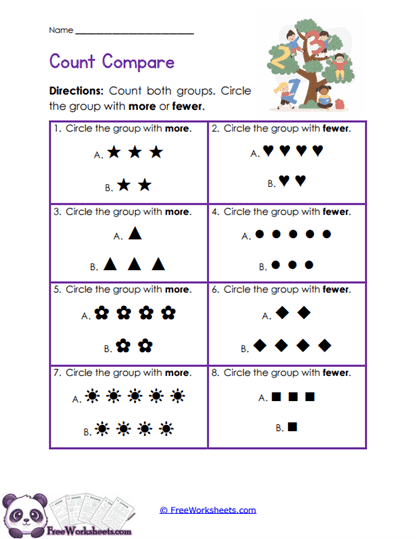
More Fewer
What Kids Do: Children count two small groups of stars, hearts, dots, flowers, squares, and other simple symbols. They then circle the group named by the direction as having more or fewer objects.
Target Skill: Learners connect counting with early comparison vocabulary. This helps children understand that groups can be described by quantity and prepares them for later work comparing written numbers.
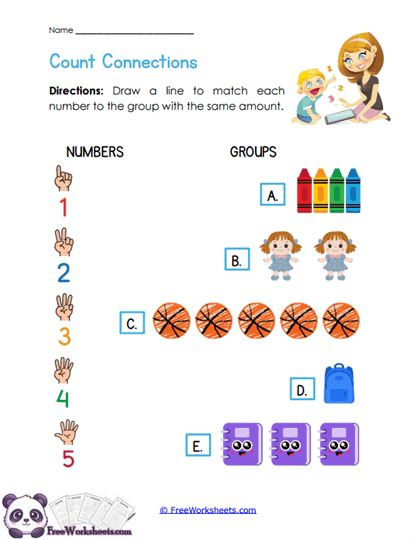
Number Matches
What Kids Do: Children look at numerals and finger pictures from 1 through 5, count picture groups on the opposite side, and draw lines between matching quantities.
Target Skill: This worksheet shows that one number can be represented in several ways. Children connect numerals, fingers, and object groups while strengthening counting and number recognition.
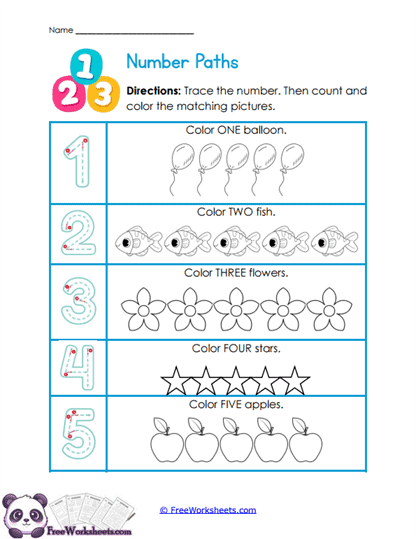
Number Paths
What Kids Do: Children trace dotted numerals from 1 through 5 and then color the same number of pictures in each row. Balloons, fish, flowers, stars, and apples keep the quantity practice varied.
Target Skill: Learners connect numeral formation with quantity. Tracing, saying, and then showing the number with pictures helps reinforce what each written numeral actually means.
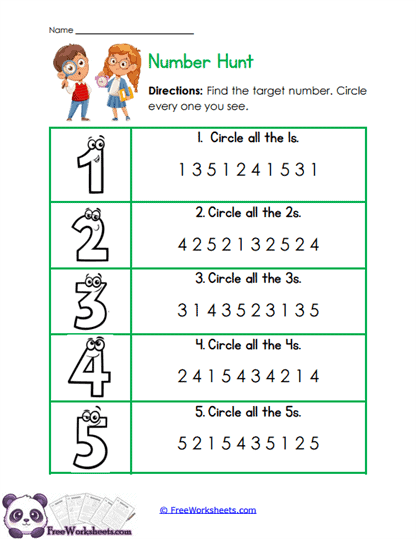
Number Search
What Kids Do: Children look at a target numeral and scan a mixed row of numbers to find every matching example. They circle all appearances of 1, 2, 3, 4, and 5 in separate sections.
Target Skill: This activity builds quick numeral recognition and visual discrimination. Children practice identifying a number even when it appears among several other similar-looking numerals.
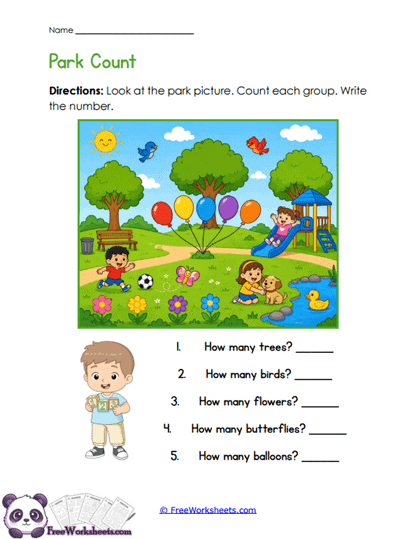
Park Counting
What Kids Do: Children search a colorful park scene for trees, birds, flowers, butterflies, and balloons. They count each type of object and write the matching total on an answer line.
Target Skill: Learners practice counting when objects are spread through a larger scene rather than neatly arranged in a row. The activity develops visual scanning, one-to-one counting, number writing, and careful attention.