
Dot to Dot Worksheets
Dot to dot activities for preschool fine motor skills help young children practice pencil control, sequencing, visual tracking, and careful hand movements. These free, ready-to-print PDF worksheets are prepared for immediate classroom use, fine motor centers, homeschool lessons, quiet work, or practice at home. Children strengthen line control, number and letter sequencing, shape recognition, and hand-eye coordination while working toward important preschool fine motor goals.
About This Collection of Worksheets
Dot-to-dot activities give preschool children a playful way to practice guiding a pencil from one clear target to the next. Simple connections help children learn where to start, how to move in a planned direction, when to stop, and how to change direction without losing control. These movements support later tracing, drawing, letter formation, number writing, and other early pre-writing tasks.
This collection gradually increases the challenge while keeping the activities playful and easy to understand. Children connect simple paired dots, follow numbers in order, complete a kite, rocket, snowman, and ice cream cone, sequence letters to form a star, build basic shapes, follow a treasure trail and bunny path, trace a looping bee journey, and practice zigzags and waves. The mix of straight, angled, curved, and looping paths gives children varied fine motor practice across the set.
Teachers can use these pages in preschool fine motor centers, number and letter review, pre-writing lessons, seasonal units, or independent practice. Parents and homeschool educators can choose simpler activities with short sequences first and then move toward longer trails and more complex curves as pencil control improves. Because the worksheets blend movement with familiar pictures and early academic skills, children can practice several developmental areas without the pages feeling overly formal.
Paul’s Teacher Tip
Encourage children to look at the next dot before moving the pencil. That small habit helps improve both visual tracking and line control. For younger children, let them trace the path with a finger first so they understand where the line is going. If a pencil feels too difficult, a thick crayon or marker can make the movement easier while the child builds hand strength. Remind children to pause at numbered or lettered points before changing direction, especially on zigzags or sharp corners. When a page includes coloring after the dot-to-dot portion, treat that as extra fine motor practice rather than just decoration.
Worksheet Collection Skill Spotlights
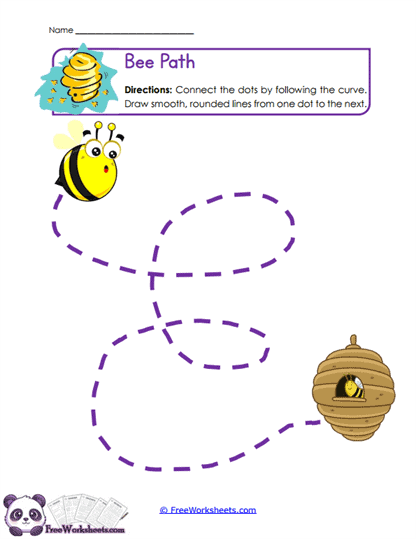
Bee Journey
What Kids Do:
Children begin near a bee and follow a long looping path toward its hive. They guide a pencil through large curves, tighter turns, and nearby sections of the trail while trying to stay close to the printed route from beginning to end.
Target Skill:
This activity develops smooth curved pencil movement and sustained visual tracking. Children practice coordinating their eyes and hands through changing turns while building the control needed for later tracing, drawing, and handwriting tasks.
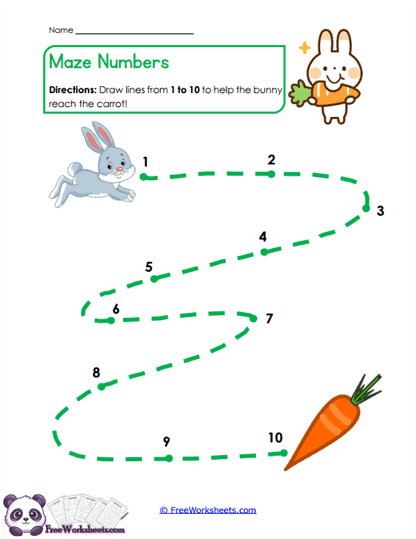
Bunny Maze
What Kids Do:
Children follow a winding numbered trail from a bunny to a carrot by connecting the numbers 1 through 10 in order. They move through several back-and-forth turns while looking ahead for the next number instead of drawing directly to the end.
Target Skill:
The worksheet combines number sequencing with controlled pencil movement. Children strengthen counting order, visual attention, hand-eye coordination, and the ability to change direction smoothly while remaining on a guided path.
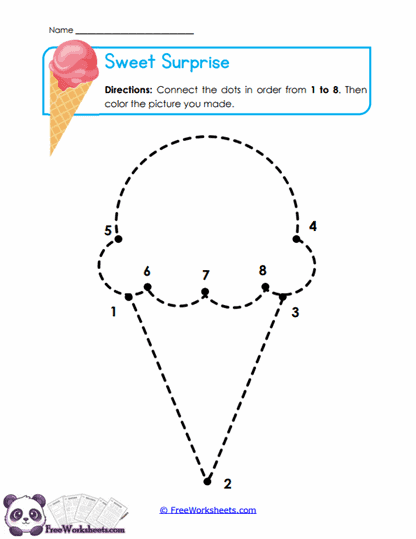
Ice Cream
What Kids Do:
Children connect numbered dots from 1 through 8 to reveal an ice cream cone. The picture includes straighter sections in the cone and rounded areas in the scoop, so children adjust their pencil movements as the shape changes.
Target Skill:
This activity strengthens sequencing and flexible line control. Children practice moving between straight and curved paths, stopping at each numbered target, and coordinating their hand movements with visual information before adding optional coloring practice.
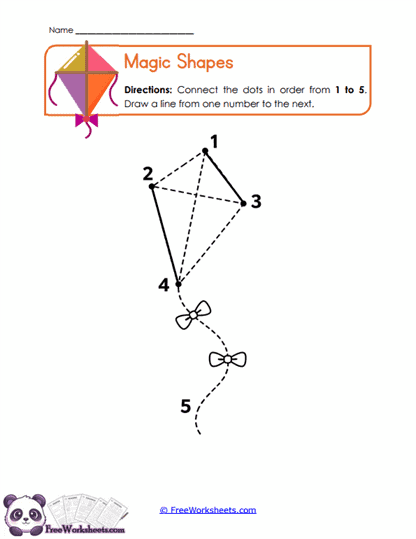
Kite Sequence
What Kids Do:
Children connect the numbers 1 through 5 to complete the outline of a kite. They draw one line at a time, pause at each numbered point, and change direction as the kite shape forms.
Target Skill:
The worksheet reinforces early number order while developing stop-and-turn pencil control. Children strengthen visual tracking, directional changes, and the ability to guide the pencil intentionally from one target to the next.
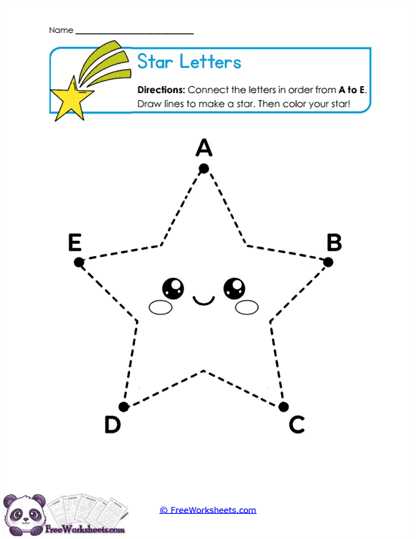
Letter Star
What Kids Do:
Children connect the letters A through E in sequence to complete a star shape. They move from one lettered point to the next, make several sharp direction changes, and can color the finished star afterward.
Target Skill:
This activity combines early alphabet sequencing with fine motor practice. Children strengthen letter recognition, hand-eye coordination, and controlled turning while learning to use an ordered sequence to guide a drawing task.
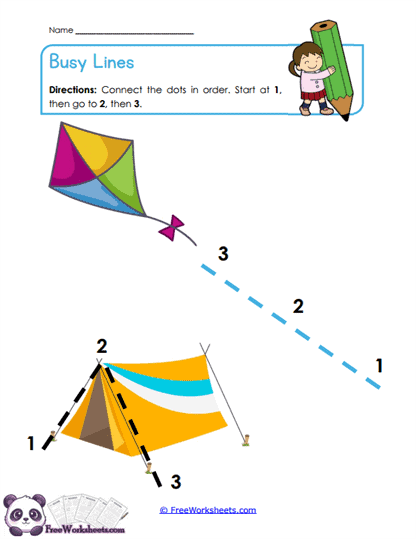
Number Trails
What Kids Do:
Children follow short numbered paths on a kite and tent by connecting 1 to 2 and then 2 to 3. The simple sequences let them practice finding the next number and stopping at each point without managing a long or complicated trail.
Target Skill:
This beginner activity develops number-order awareness and basic point-to-point pencil control. Children practice starting accurately, aiming toward a clear target, stopping at the next point, and following a simple sequence in the correct order.
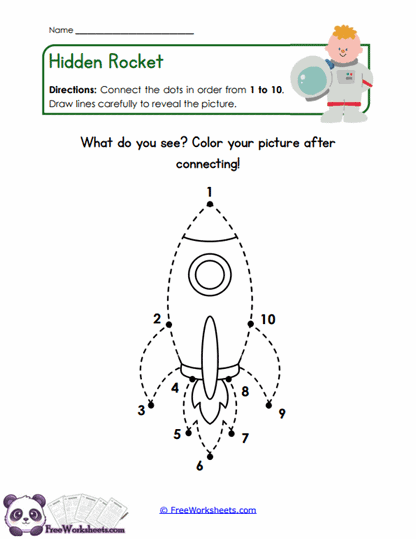
Rocket Reveal
What Kids Do:
Children connect numbered dots from 1 through 10 to reveal a rocket. They follow both straight and curved sections, look for each next number carefully, and can color the completed rocket after finishing the path.
Target Skill:
The page strengthens number sequencing through a longer series while also developing pencil control across varied line directions. Children practice concentration, visual scanning, accurate stopping, and gradual changes in movement as the picture develops.
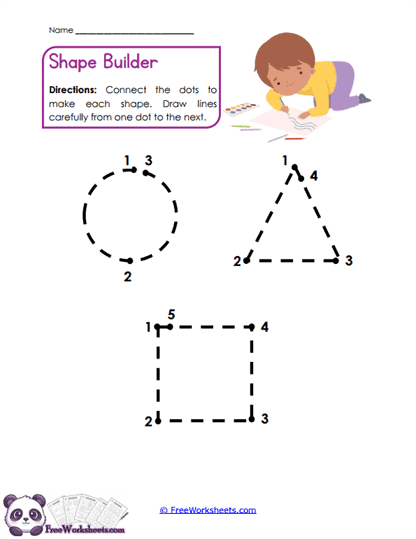
Shape Builder
What Kids Do:
Children connect numbered dots to complete a circle, triangle, and square. Each shape requires a different kind of movement, including smoother curves for the circle and straighter segments with clear stops and turns for the triangle and square.
Target Skill:
This activity combines shape recognition with flexible pencil control. Children learn to adjust their hand movements for curves, sides, and corners while also practicing sequence-following and visual comparison among common preschool shapes.
Snowman Connect
What Kids Do:
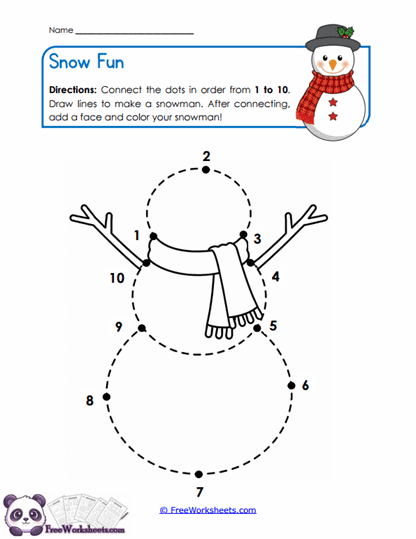
Children connect the numbers 1 through 10 to complete a snowman outline. They follow rounded sections around the head and body, stop at each numbered point, and can add facial details and color after the dot-to-dot work is finished.
Target Skill:
The worksheet develops number order, curved-line control, and visual tracking. Children practice coordinating counting with smoother pencil movements while building the hand control needed for rounded letter and number forms later on.
Sunny Connections
What Kids Do:
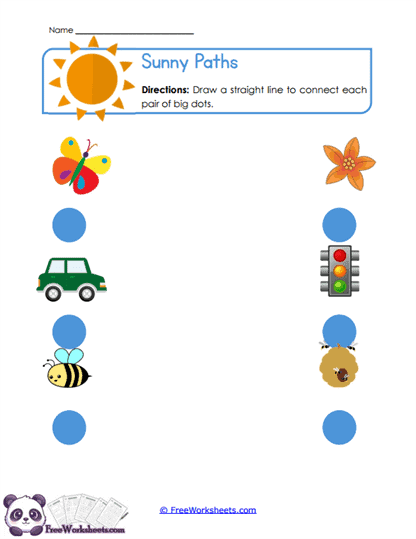
Children draw straight lines between matching pairs of large dots arranged beside familiar pictures such as a butterfly, flower, car, traffic light, bee, and bear. Each row gives them another chance to aim toward a clear target and stop at the matching point.
Target Skill:
This simple activity builds foundational pre-writing control. Children practice straight-line movement, hand-eye coordination, visual tracking, and deliberate starting and stopping before progressing to numbered paths, curves, and more complex dot-to-dot designs.
Treasure Trail
What Kids Do:
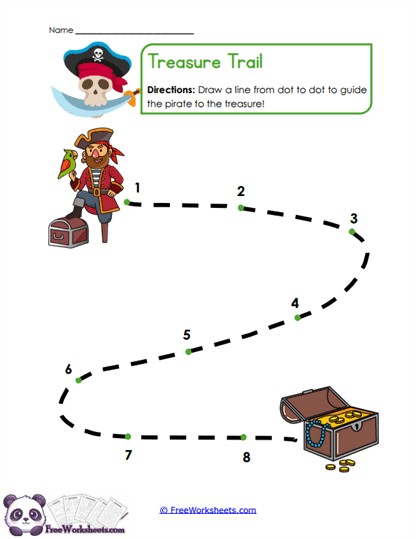
Children follow a numbered pirate trail from 1 through 8 as it bends and curves toward a treasure chest. They pause at each point, find the next number, and guide the pencil through the changing path instead of taking a shortcut to the ending picture.
Target Skill:
The activity strengthens sequencing, concentration, and curved-path control. Children practice coordinating visual scanning with hand movement while learning to follow an ordered route from a clear beginning to a clear ending.
Zigzag Lines
What Kids Do:
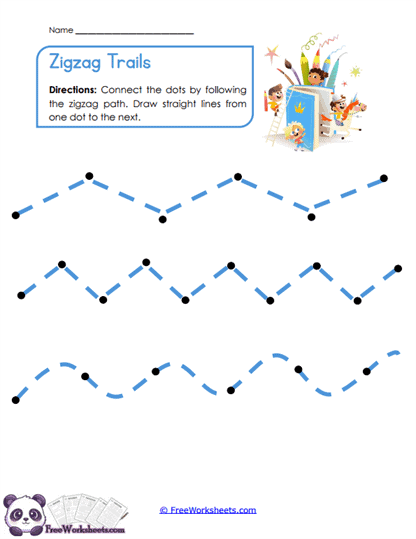
Children connect dots along several different line patterns, including sharp zigzags, smaller angled turns, and gentle waves. They stop and change direction at corners on some rows and use smoother continuous movements on curved rows.
Target Skill:
This worksheet develops flexible pre-writing movement by contrasting sharp turns with flowing curves. Children strengthen hand-eye coordination, directional control, visual attention, and the ability to change how they move the pencil based on the pattern in front of them.